Get Full Government Meeting Transcripts, Videos, & Alerts Forever!
Get email alerts on the Impact Fee Study topic
No spam. Unsubscribe anytime.
Jonesboro council approves $59,000 study to examine impact fees citywide
Summary
The Jonesboro City Council voted to contract with DTA to conduct a citywide impact-fee study at an estimated cost of $59,000, after a public discussion that included concerns that fees could raise housing costs and statutory limits on how collected fees may be used.
The Jonesboro City Council on Monday approved a resolution to contract with consulting firm DTA to perform a citywide study of development impact fees, a step supporters said is needed to determine whether, where and how such fees should be applied.
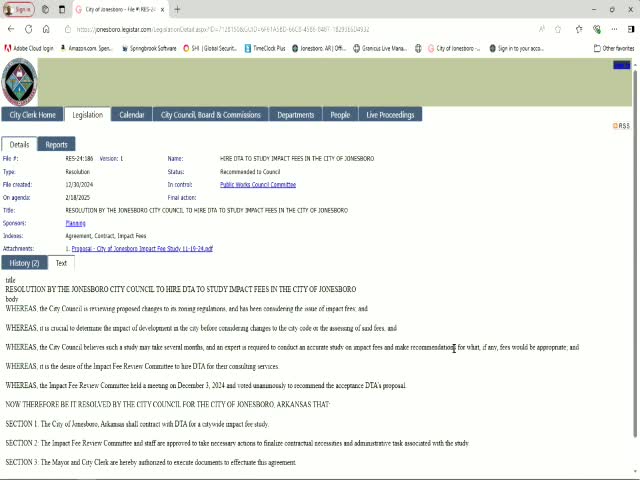
The council passed Resolution 24-186, which authorizes the city to “contract with DTA for a citywide impact fee study” and authorizes the impact fee review committee and staff to finalize contract and administrative tasks. The resolution states the committee unanimously recommended DTA’s proposal following a December 2024 meeting. The project cost identified in the meeting was $59,000.
The study will examine potential impact fees tied to new development and identify uses for fee revenue, such as public safety, drainage and parks, according to council discussion. Supporters said the study is a preliminary step — not implementation — and would show which areas and infrastructure types might justify fees.
Council member Miss Porter urged a no vote, saying the fees would “exert upward pressure on housing costs” and that many residents would view impact fees as a new tax imposed without a public vote. Porter also noted that while $59,000 is a small percentage of total expenditures, it is not a trivial amount and urged the council to consider that cost.
A council member who spoke in favor described cases of overdevelopment in parts of the city and the costs that follow when large, poorly managed complexes become blighted. That speaker said impact fees allow cities to offset the long-term costs associated with new development and cited other Arkansas cities that have adopted impact fees without harming growth. “This is why this is why part of the reason we do this,” the council member said, adding the typical uses include police, fire, drainage and parks.
Resident Rick Wyatt, who served on the Impact Fee Committee, told council members that DTA’s proposal states the work will satisfy the requirements of Arkansas Code §14-56-103, the state’s impact-fee law. Wyatt urged council members to review that statute before adopting any fee and noted several statutory constraints: fees must be reasonably attributable to new development, unused portions generally must be refunded after seven years with interest, and fees cannot be used to address needs that existed before the new project.
City staff and the consultant scope clarified during the meeting that the study would assess where fees might be appropriate and that the consultant would recommend geographic or use-based exemptions (for example, areas targeted for revitalization might not be recommended for fees).
The resolution passed; the meeting record does not show a roll-call tally. Council members said the committee will return findings after the multi-month study is complete.
Council members and staff said the study will take several months and that the Impact Fee Review Committee and planning staff will provide updates during the process. No fee will be adopted as part of this vote — the motion authorized a study only.
Next steps include finalizing the contract with DTA and beginning the consultant’s work plan, after which the committee and staff will report back with recommendations and any proposed fee schedules.