Get Full Government Meeting Transcripts, Videos, & Alerts Forever!
Get email alerts on the Cultural Funding topic
No spam. Unsubscribe anytime.
Arts Commission forwards working-group recommendations on Thrive, Elevate and Nexus grants; debate centers on matching funds and sponsorship
Summary
A cross‑sector working group presented a multi-page set of recommendations for Austin’s cultural funding programs (Thrive, Elevate and Nexus). The Arts Commission voted to submit the document to staff as a baseline for further development amid vigorous debate over proposed matching requirements, fiscal sponsorship and eligibility definitions.
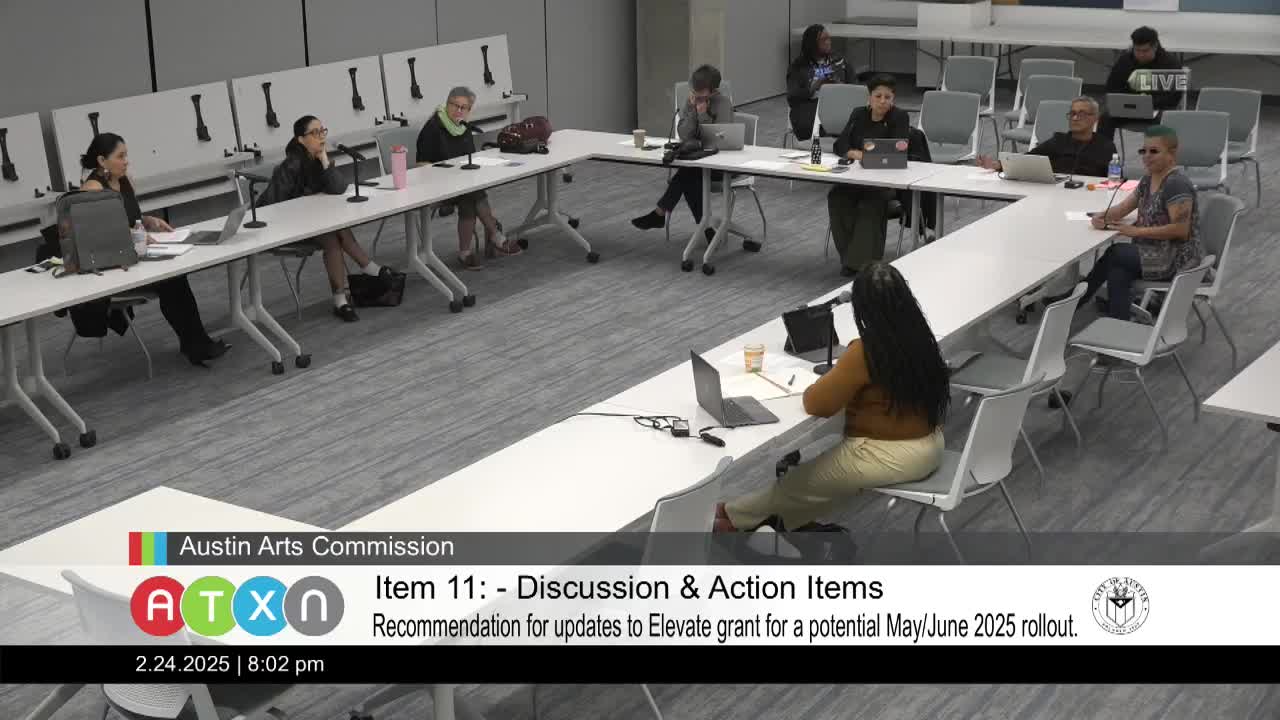
The Arts Commission on Feb. 24 accepted and transmitted a set of working‑group recommendations intended to shape the next phase of Austin’s cultural funding programs, including Thrive (operational support), Elevate (project support) and Nexus (short‑term projects).
The working group — composed of commissioners and community members — proposed eligibility and scoring changes, suggested new caps for awards, and urged clearer, jargon‑free application language and heavier community engagement. Commissioners voted to forward the recommendations as a baseline document for staff to use in further development.
“These are recommendations from the working group,” Chair Selena Zisman said while introducing the item. The group’s report recommends separate program definitions: Thrive as biennial operational support to help organizations scale toward institutional status; Elevate as project‑based awards for organizations, groups and independent artists; and Nexus as semiannual, smaller project grants.
Key proposal elements include: - Thrive: grants up to 50 percent of an organization’s two‑year average operating budget with a $150,000-per-year cap; recipients could receive up to two Thrive cycles within a six‑year period. The working group said Thrive funds should prioritize organizations that need a financial boost to advance development. - Elevate: project grants for nonprofits, arts groups and independent artists; the group discussed requiring fiscal sponsorship for some applicants and suggested matching funds equal to 50 percent of the request, including in‑kind contributions, while noting that the match threshold was contentious within the group. - Nexus: smaller awards (examples in the draft include $2,500, $5,000 and $10,000) for short‑term projects and emerging work with no fiscal sponsorship or match required.
The report recommends emphasizing artistic quality in scoring (proposed 50 percent weight), capability (25 percent) and impact (25 percent). It also recommends changes to how review panels are constituted, including discipline‑specific reviewers, subject‑matter experts for complex applications, clearer training and better score normalization to prevent outlier judges from skewing results.
Commissioners and community participants debated several points at length. Commissioner Kucheni, among others, argued against the proposed 50 percent matching requirement for Elevate, saying the match could be a barrier for grassroots artists and organizations that lack deep fundraising networks. Commissioner Garza and others urged measurement of public impact and audience reach, and some commissioners called for clearer definitions of “legacy,” “established” and “arts group” to eliminate ambiguous language.
“Matching funds anchor sustainability,” Commissioner Grama said in support of a match requirement, calling matching a sign that applicants are invested in their projects. Others pushed back that matching favors organizations with existing resources and that alternative ways to demonstrate community support should be considered.
Jesus Pantel, cultural funding supervisor, told commissioners that staff would use the recommendations as a baseline and continue community engagement; he also noted a separate timeline shift for Elevate — staff plan to postpone the next Elevate application timeline to early fall so the office can accommodate additional community engagement and review state and federal legislative impacts.
The commission voted to forward the working‑group document to staff as a baseline reference for continued development and community input. Commissioners said the document was not a final rule but a structured set of options and tradeoffs for staff to refine with additional community outreach.
Next steps described at the meeting include more public engagement, discipline‑specific review design, clarification of definitions and transparent scoring procedures. Staff said they will bring refined program guidelines back to the commission with time for commissioners to review and offer feedback before adoption.