Get Full Government Meeting Transcripts, Videos, & Alerts Forever!
Get email alerts on the Northstar Commuter Rail topic
No spam. Unsubscribe anytime.
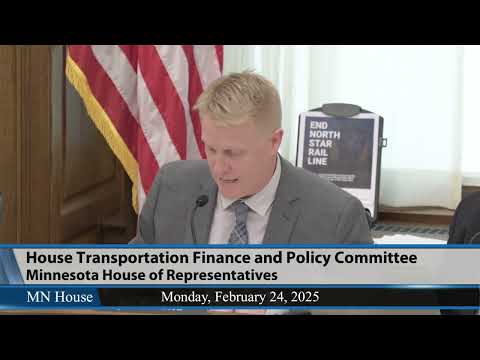
House committee advances bill to seek federal waiver and end Northstar commuter rail; companion bill laid over
Summary
The Minnesota House Transportation Committee on Monday advanced House File 269, a bill that would direct the Metropolitan Council and the Minnesota Department of Transportation (MnDOT) to request a federal waiver of obligations and to proceed with steps to discontinue operations of the Northstar commuter rail line if the waiver is granted.
The Minnesota House Transportation Committee on Monday advanced House File 269, a bill that would direct the Metropolitan Council and the Minnesota Department of Transportation (MnDOT) to request a federal waiver of obligations and to proceed with steps to discontinue operations of the Northstar commuter rail line if the waiver is granted.
The proposal, introduced by Committee Chair Kosnick, was moved to the General Register by voice vote after testimony from transit officials, labor union representatives, local residents and transportation advocates. A related measure, House File 749, which would set performance requirements that could force an immediate federal-waiver request if not met, was laid over for further work.
Why it matters: committee members who backed the bill said Northstar has persistently low ridership and high taxpayer costs and that those dollars could be redeployed to transit modes that better serve current travel patterns. Opponents — including the Metropolitan Council, MnDOT officials, rail labor and residents of Big Lake and St. Cloud — urged caution, highlighted community and economic impacts, and urged a plan to replace service if the line is terminated.
Chair Kosnick (bill author and committee chair) opened the hearing saying the bill would require the Metropolitan Council and MnDOT to request a federal waiver and, if granted, to submit a termination plan to the Legislature within 90 days. “Minnesotans and taxpayers shouldn't have to foot the huge expense that Northstar has been,” Chair Kosnick said in his opening remarks.
Former Met Council Transportation Committee chair Annette Meeks testified in favor of termination, calling the line a “boondoggle” and citing agency documents that show low ridership and high subsidies. She told the committee that Northstar’s fare revenue in 2023 was “under $324,000” and that the line’s pre-pandemic weekday ridership forecasts were never met.
Charlie Zelle, chair of the Metropolitan Council, told the committee the Met Council and MnDOT support “carefully evaluating and exploring the alternatives to commuter rail,” and said both agencies have been in contact with the Federal Transit Administration (FTA) and Burlington Northern Santa Fe (BNSF) about possible next steps. Zelle said the agencies are willing to explore transitioning to higher-frequency bus service in the corridor and stressed the need to coordinate on agreements tied to the service.
MnDOT Commissioner Nancy Daubenberger (appearing with Met Council leadership) said MnDOT is updating its state rail plan and noted that intercity passenger rail projects operate under different federal rules and agencies than commuter rail. MnDOT director of passenger rail Matt Bailey told lawmakers the agency had used $650,000 for the Northstar extension assessment and that remaining appropriations from the $4 million authorization remain available for additional work.
Several public witnesses urged different outcomes. Joel Mueller of the Brotherhood of Locomotive Engineers and Trainmen opposed termination, saying many workers and riders rely on the service. Jesse Cook and Katie Nicholson, both Minneapolis-area residents, urged retention but recommended service changes such as increased frequency. Annie Buckle, a St. Cloud resident, said her community still seeks rail service to the Twin Cities and encouraged lawmakers to consider that demand.
Committee members pressed officials about timing, asset values and federal requirements. Representative Cagle asked whether loan forgiveness would require an act of Congress; Commissioner Daubenberger said MnDOT’s preliminary view is that loan forgiveness could require congressional action. Chair Kosnick and other supporters countered that even accounting for termination costs, ongoing annual operating and maintenance expenses (figures cited in committee testimony) create a strong fiscal case for change.
Votes at a glance: House File 269 — Chair Kosnick moved the bill to the General Register; a voice vote was taken and the motion passed. House File 749 — Chair Kosnick moved to lay the bill over for further work; the motion was adopted and the bill was laid over.
Next steps: House File 269 now moves to the General Register for further consideration by the full House. House File 749 remains in the Transportation Committee for additional drafting and stakeholder work, including follow-up with MnDOT, Met Council, BNSF and federal officials to clarify waiver procedures, asset valuation and service-replacement options.
Reporting note: quotes and attributions in this article are taken from testimony and remarks on the record before the Minnesota House Transportation Committee on the date of the hearing. Officials and witnesses spoke during the committee’s public hearing on HF 269 and HF 749, and some figures discussed (costs, ridership, planned maintenance) were presented from agency documents and testimony during the hearing.