Get Full Government Meeting Transcripts, Videos, & Alerts Forever!
Get email alerts on the Municipal Finance topic
No spam. Unsubscribe anytime.
Northland council work session focuses on budget shortfall, ballot options and strategic priorities
Summary
At a Feb. 24 work session, Northland City Council members and staff reviewed a projected roughly $1 million general-fund deficit, discussed voter-backed fee options to shore up public safety funding, and identified fiscal sustainability, infrastructure, public safety and housing as top priorities for a three-year strategic plan.
Council members and staff used a Feb. 24 work session to begin drafting a three-year strategic plan while confronting a near-term budget gap and weighing whether to place new funding measures before voters.
Consultant Sarah Lechner, with Progyzio Group, opened the strategic-planning segment and framed the meeting’s objectives: “Today we get to dive into the work of starting to draft your strategic plan,” she said, asking the council to produce a draft vision, mission and priority areas to guide later work on measures and initiatives.
Finance figures presented at the meeting showed the general fund with about $8.3 million in projected revenue against roughly $9.4 million in projected expenditures, leaving an approximately $1 million gap going into next year. Staff also reported operating reserves of about $3 million and emergency reserves of about $2 million. The shortfall, staff said, means the council will need to identify revenue or expenditure changes to avoid drawing down reserves.
City staff outlined a range of revenue options the council could consider for the May or November ballot, focusing on a voter-approved monthly public-safety fee that would target funding for police services. Staff presented modeled impacts for stepped increases in a per-household fee, saying a $5 increase would bring total annual revenue in that fee category to roughly $1.1 million and larger increases would bring correspondingly larger sums if approved by voters. Staff also noted an extreme example — a much larger fee that would fully fund police costs — to illustrate scale, but said such an option would be a high-cost measure for residents.
City Administrator David (first name used in session) and consultant Lechner emphasized legal and procedural constraints on putting measures to voters. Lechner and staff noted the city charter requires specific timing and, in some cases, supermajority approval for certain measures; the council was told that if it wants a measure on the May ballot staff faces a Coos County deadline later in the week to submit a valid ballot title.
Councilors and staff discussed alternatives to a fee measure, including a charter amendment (which would change voting thresholds but itself would require voter approval), staffing-level adjustments, program cuts and targeted ballot measures in November (when turnout historically is higher). Lechner warned that changing the charter could invite challenges and litigation; staff cited the example of voter initiatives and litigation in other Oregon cities.
The council also discussed enterprise funds and service-specific funding: sewer services operate as an enterprise fund separate from the general fund, and councilors emphasized that sewer-system funding and long-term wastewater planning will need separate, specific solutions. Staff flagged that sewer infrastructure is on a critical maintenance trajectory and will require dedicated funding or structural changes to service delivery to remain sustainable.
Other topics raised during the session included parks and playground upgrades (staff estimated work to bring parks to current safety standards could cost roughly $2 million), rising legal costs (the council heard that legal fees were unusually high in the last budget cycle, with one year noted at about $400,000), and continuing use of grant sources such as ARPA funds (staff said ARPA was used for non‑recurring investments rather than ongoing staffing costs).
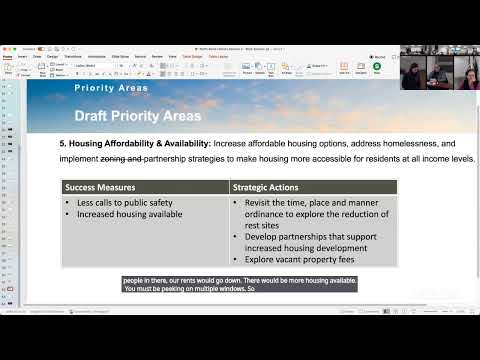
Council members and staff repeatedly framed the strategic-plan work as a means to prioritize spending and direct staff in the coming budget cycle. Lechner said the council should aim to identify three to five priority areas and then, in a subsequent session, develop success measures and up to three actions per priority. Toward the end of the meeting, staff requested clearer direction if the council wanted to pursue a May ballot measure because of the rapidly approaching county deadline; no formal motion or vote was recorded during the session.
The work-session discussion produced draft priority areas the council will refine before the next meeting: financial sustainability/balanced budget, infrastructure and maintenance (including wastewater and roads), public safety and emergency preparedness, economic and workforce development (with attention to tourism-related revenue), and housing affordability and homelessness response. Staff and the consultant will follow up with materials and a survey to solicit further input before the April 7 follow-up session.
No formal votes or ordinances were taken at the Feb. 24 work session. The council’s next strategic-planning session is scheduled for April 7, when members expect to begin identifying success measures and specific actions tied to each priority area.