Get Full Government Meeting Transcripts, Videos, & Alerts Forever!
Get email alerts on the Street Safety topic
No spam. Unsubscribe anytime.
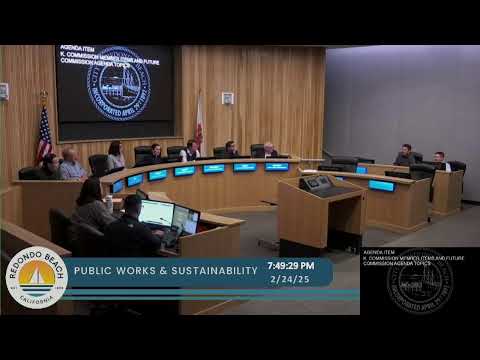
Redondo Beach commission approves removal of center line on Meyer Lane
Summary
The Public Works and Sustainability Commission voted 6–1 to remove about 1,200 feet of the double yellow center line on Meyer Lane, keeping short segments at intersections; staff said the change aims to reduce sideswipe and hit‑and‑run collisions while preserving stop‑bar striping.
The Redondo Beach Public Works and Sustainability Commission voted to remove a stretch of double yellow center line on Meyer Lane, approving staff’s recommendation 6–1.
City traffic engineering staff presented the proposal, saying the removal would apply from about 50 feet north of 190th Street up to Ralston Lane — roughly 1,200 linear feet — while retaining about 50 feet of double yellow at stop-controlled intersections and keeping the center line north of Ralston due to limited sight distance there. “Our recommendation tonight is just to remove about 1,200 linear feet of of that solid line along Meyer Lane,” staff said.
The change responds to complaints from a resident and a district council member about overnight sideswipe and hit‑and‑run collisions involving parked cars. Staff told commissioners Meyer Lane is roughly 36 feet wide — about 10‑foot travel lanes and 8‑foot parking lanes — and sees higher than typical local‑street volumes, about 3,400 vehicles per day, with 85th percentile speeds near 30 mph. The staff report noted the Manual on Uniform Traffic Control Devices (MUTCD) typically requires center lines on arterials and collectors with more than 6,000 vehicles per day and recommends them over 4,000 vpd; Meyer Lane is not an arterial or collector and is below those thresholds.
Supporters said the removal could give drivers extra maneuvering space to avoid parked vehicles and might encourage safer passing of cyclists. Commissioner Prashant said the proposal was “an interesting idea” and supported monitoring the effect, while staff agreed they already have “the before data” to compare speeds after the change. Several commissioners raised concerns that removing the center line on Meyer could set a precedent for nearby streets and noted delivery and service trucks frequently double‑park on the street; staff said those behaviors likely wouldn’t change materially but that the additional “breathing room” might reduce some collisions.
Staff said the work would be folded into the city’s restriping budget and performed by an outside contractor; the cost was described as “generally pretty low.” The commission voted to approve the staff recommendation. Commissioner Simpson moved to accept the staff report; the motion was seconded and passed 6–1 (Commissioner Nafisi cast the lone no vote).
The commission directed staff to add the striping change to the contractor list and monitor conditions; staff also discussed potential follow‑up measures such as adding an edge line or dashed markings if residents continue to report problems. The commission did not direct removal of center lines citywide; staff said they will evaluate requests on a case‑by‑case basis and will generally not reinstall center lines after resurfacing on similar local streets except where sight distance or other conditions require them.