Get Full Government Meeting Transcripts, Videos, & Alerts Forever!
Get email alerts on the K 12 Education topic
No spam. Unsubscribe anytime.
Lake Oswego SD 7J staff report progress in second year of I‑Ready math program
Summary
District staff told the school board the district is in its second year of the I‑Ready classroom mathematics curriculum and diagnostic. Staff described instructional shifts toward conceptual understanding, use of the MyPath individualized practice component, and early assessment gains, while noting some growing pains and opt‑outs by families.
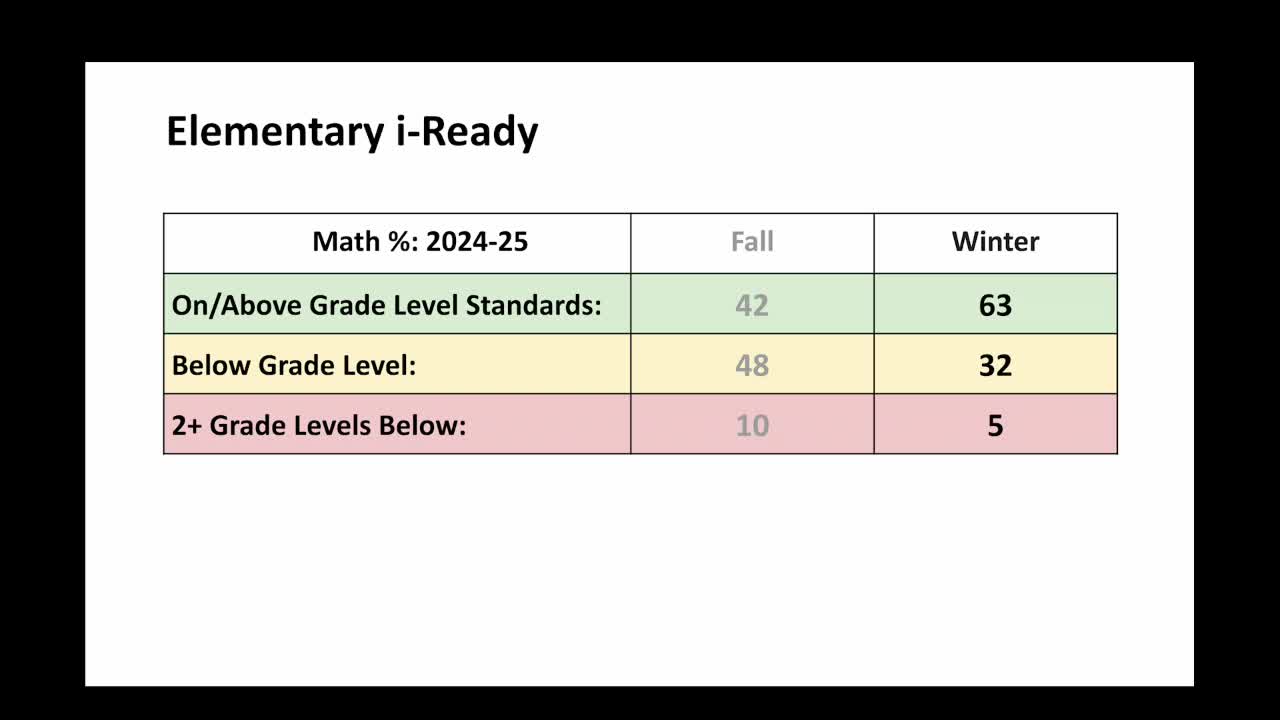
Lake Oswego School District 7J staff told the board the district is in the second year of the I‑Ready classroom mathematics curriculum and diagnostic and reported early signs of improvement in fall‑to‑winter assessment data.
The staff member presenting said the adopted I‑Ready math curriculum received a top rating from an evaluator known as EdTech and emphasized that the program goes “deep into conceptual understanding,” supports multiple problem representations and student explanation, and includes a personalized online component called MyPath that adapts instruction to each learner.
The presenter described classroom practices used with the curriculum: teachers use small whiteboards, cue quieter students to share, and ask students to defend solutions to develop communication and reasoning skills. The presenter said the district is “in the process of trying to execute that perfectly” and acknowledged “growing pains” as teachers implement a delivery model that differs from the prior Go Math program.
The staff member also highlighted a third‑grade cohort that scored lower on winter reading diagnostics and said the district expects some score increases by spring as students encounter new terminology and standards‑aligned content. The presenter said principals set goals tied to state assessments and meet one‑on‑one with district leaders to review evidence and next leadership steps.
Board and audience members asked questions about opt‑outs and grade acceleration. The presenter said a “few” parents have opted students out of the I‑Ready diagnostic and that the test is computer adaptive; it can present items above a student’s grade level as they demonstrate mastery. The presenter added that the MyPath instructional modules generally allow 30–45 minutes per week of practice to support learning between diagnostics and that the I‑Ready adaptive sequence “caps out at eighth grade.”
A board member asked whether other districts in Clackamas County use I‑Ready; the presenter said, “I don’t believe so.” The presenter also compared the district’s current math data to prior practice, saying reading data were previously easier to collect because the district already used DIBELS; math assessments under older unit‑based systems were described as more delayed.
On the role of data for teachers, the presenter said the platform can help teachers group students by standards and recommend what to teach next, but reaching that level of individualized instruction requires time and sophistication. The presenter said some teachers have adopted those features.
The update concluded with the presenter thanking staff and noting continued principal cycles focused on data, goals and leadership actions.
Additional details from the meeting: the presenter traced the district’s use of I‑Ready back to the pandemic and estimated the district began collecting this dataset in about 2021. The presenter said DIBELS and I‑Ready are both on the state’s approved list for dyslexia screening.