Get Full Government Meeting Transcripts, Videos, & Alerts Forever!
Get email alerts on the Planning Process Training topic
No spam. Unsubscribe anytime.
Brownsburg APC hears training on rezoning, plats, waivers and development-plan procedures
Summary
Town of Brownsburg planning staff provided training to the Advisory Planning Commission on rezoning criteria, plat and waiver procedures, development-plan review and legal standards to help commissioners create a robust record for decisions.
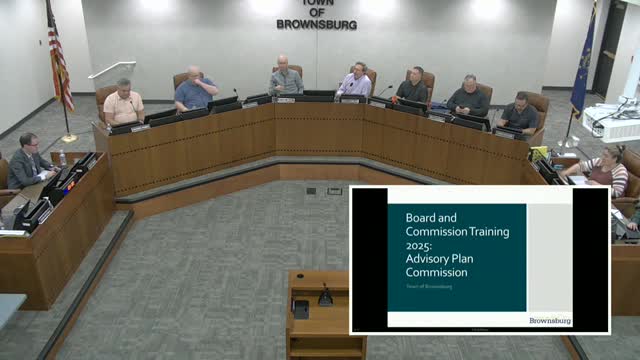
At the Town of Brownsburg Advisory Planning Commission meeting, staff led a training session on rezoning criteria, plat and waiver processes, development plan review standards and related legal issues to help commissioners weigh applications and maintain a clear record.
Planner Jenna (staff) reviewed the five rezone criteria commissioners should pay reasonable regard to: consistency with the comprehensive plan, characteristics of the surrounding area, most desirable use of the land, conservation of property values, and responsible development including impacts and fees. Jenna emphasized that rezonings are advisory to town council and that the record should show reasoned consideration of those criteria.
Staff also reviewed primary plats and plat waivers, explaining primary plats as ministerial if they meet the subdivision criteria, while plat waivers are broader deviations that function more like variances and require stronger findings. The presentation covered secondary plats, construction standards (road cross-sections, tapers, pipe sizing, required frontage improvements) and examples of common technical waivers handled by department reviewers (for example, stormwater or easement adjustments).
Legal reminders were provided by a staff presenter (Scott), who emphasized the need to develop a complete record so decisions are not arbitrary and capricious. Scott summarized a 2024 U.S. Supreme Court case addressing the Takings Clause and the Nolan/Dolan proportionality test for conditions and impact fees, and noted courts generally defer to local bodies that make reasoned, record-based decisions.
Staff advised commissioners to keep conditions and commitments narrow, related to the project, and proportional; to avoid imposing requirements unrelated to the project; and to confirm applicant agreement to conditions when possible. The presenters also explained differences between conditions (short-term items resolved before the next step) and recorded commitments (long-term, run with the land and can be enforced by the original approving body).
Commissioners asked questions about arbitrary-and-capricious standards, the council's role versus the APC, when council changes require the item to return to APC, and enforcement of prior commitments. Staff provided examples from recent local projects and recommended that commissioners ask staff for clarifications and additional data when making findings.
The training closed after staff summarized recent application volumes and areas where annexation is more or less feasible within the town.
The session was instructional and did not include formal votes beyond procedural confirmations.