Get Full Government Meeting Transcripts, Videos, & Alerts Forever!
Get email alerts on the Priority Admissions Dct Capacity topic
No spam. Unsubscribe anytime.
Review panel urges expansion of state hospital capacity, recommends 50‑bed start and two‑year extension of 48‑hour rule
Summary
A Department of Human Services review panel recommended immediate investments to expand Direct Care and Treatment (DCT) capacity, data transparency, jail-based mental health services and a two‑year extension of the 48‑hour priority admissions framework while the state builds capacity.
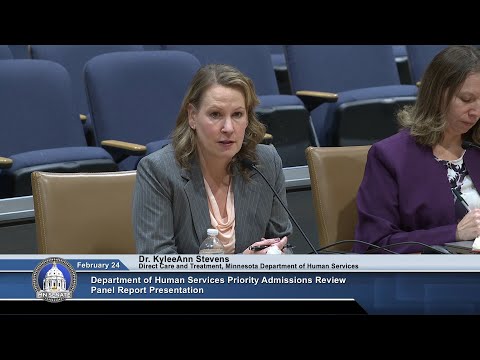
Doctor Kylie Ann Stevens, executive medical director at the Minnesota Department of Human Services’ Direct Care and Treatment (DCT), presented the Priority Admissions Review Panel’s report to the Senate Human Services Committee on Feb. 24, outlining unanimous recommendations to address long wait times for state hospital admissions and a growing concentration of high‑acuity patients in DCT facilities.
The panel, convened after 2023 statutory changes to priority admissions, recommended six actions including immediate investment to expand capacity at DCT, funding a new 50‑bed facility on the Anoka Metropolitan Regional Treatment Center (AMRTC) campus as a starting point, increased Medicaid and community rates, more mobile crisis teams and long‑acting injectable medication funding for jails, a public referral dashboard to increase transparency, and a two‑year extension of the current “medically appropriate bed” language in statute. “Minnesota is the only state with the 48 hour requirement for admission,” Stevens told the committee, citing a review of laws in all 50 states and Washington, D.C.
Stevens presented historical context: the priority‑admissions statute dates back to the early 2010s in response to rising wait lists and an initial 48‑hour standard. DHS’s analysis showed demand grew substantially — the DCT admitted 46 priority individuals in the statute’s first year and 424 in the most recent year — and civil commitments increased by over 36% from 2013 to 2023. The report identified that Minnesota’s strict 48‑hour deadline is unique among states and that many states that impose admission timelines still experience delays.
The review panel estimated a rough need of about 350 additional DCT beds to eliminate the current priority‑admissions wait list and maintain ongoing admissions within the 48‑hour framework; panel members recommended the 50‑bed project at AMRTC as an initial step paired with community investments to reduce future bed demand. The report also provides a preliminary cost estimate for addressing that 350‑bed gap; the document cited a statewide capital estimate on the order of hundreds of millions of dollars, with construction representing a large share of the cost.
County officials, prosecutors and advocates who testified alongside DHS emphasized that jails are not appropriate treatment settings and that counties already carry financial burdens for people held in local facilities. Terrell Clark, representing the Association of Minnesota Counties and related associations, reiterated the panel’s 350‑bed estimate and noted that counties face substantial “does not meet criteria” (DNMC) costs when transfers do not occur; the panel recommended continued DNMC relief for counties under certain circumstances. Kevin Magnuson, Washington County attorney, described repeat site visits and stakeholder collaboration that helped the task force identify solutions, saying the panel represented “one of the best good faith efforts to reach a solution” he had seen in his career.
Advocates said expanding community alternatives remains essential. Sue Abderholden, executive director of NAMI Minnesota, said the panel’s recommendations should be paired with investments upstream — early intervention, first‑episode psychosis and bipolar disorder programs, expanded crisis teams and transport options — and supported the 50‑bed AMRTC start while urging retention of the medically appropriate bed trigger for the 48‑hour standard to avoid litigation risks other states have faced.
Committee members asked technical questions about which recommendations are included in the governor’s budget; Carrie Priyonis, legislative director for DCT, said the governor’s proposal did not directly include all report items to avoid pre‑empting the panel’s findings but that DHS had a proposal to align the medically appropriate bed language with the panel’s recommendations. Several senators pressed the panel and counties on funding mechanisms, the feasibility of repurposing existing facilities, and whether changing criminal justice or diversion policies could reduce demand. DHS and county officials said some closed or older buildings are not cost‑effective to retrofit and that the Miller Building on the Anoka campus may cost more to upfit than to replace.
Decisions and next steps in the transcript: the panel recommended continuing to meet while the legislature considers funding and policy changes, renewing the DNMC relief for counties under certain conditions, and temporarily extending statutory language to allow legislative action on capacity before suspending the 48‑hour framework. No committee motion to adopt legislation was recorded during the hearing; committee members discussed follow‑up requests for detailed budget and spending status on related pilot programs and crisis team funding.
What to watch: the legislature will decide whether to fund planning and construction for additional DCT capacity, whether to extend DNMC relief for counties beyond the current sunset, and how to pair state hospital investments with community services and crisis alternatives.