Get Full Government Meeting Transcripts, Videos, & Alerts Forever!
Get email alerts on the Emergency Medical Services topic
No spam. Unsubscribe anytime.
Committee hears update from new state EMS office, advances bills on rural ambulance funding and workforce
Summary
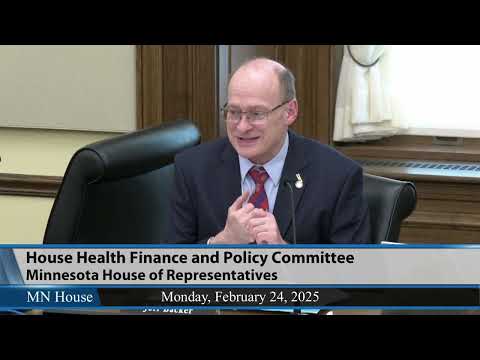
The Minnesota House Health Finance and Policy Committee on Monday heard an update from the newly created Office of Emergency Medical Services and advanced several bills aimed at shoring up ambulance funding and workforce shortages in Greater Minnesota.
The Minnesota House Health Finance and Policy Committee on Monday heard an update from the newly created Minnesota Office of Emergency Medical Services and advanced several bills intended to address ambulance funding shortfalls and workforce shortages, particularly in Greater Minnesota.
Director Ferguson, head of the new Office of Emergency Medical Services, told the committee the office began operating under its new structure on Jan. 1 after provisions in last session’s EMS omnibus bill moved regulatory operations from an independent board to a state agency. "That change became effective on January 1 and has been functioning under that since," he said, describing three divisions for ambulance operations, EMS providers, and EMS physicians and noting the office has posted a part‑time state EMS medical director position.
The director highlighted two financial measures enacted last session: a $24,000,000 aid program distributed to ambulance services and a $6,000,000 pilot for alternate EMS response (the "sprint medic" pilot). He said the $24 million was disbursed by the Department of Revenue on Dec. 26 and must be spent or encumbered by December 30, 2025. On the pilot, Ferguson said Otter Tail and Grant counties have an executed grant agreement and are preparing to begin operations, while St. Louis County’s application remains pending.
Committee members and multiple witnesses said the money and pilot projects were useful but insufficient as a long‑term solution. "House File 337 as amended picks up where last session's one‑time aid bill left off," Eric Simonson of the Coalition of Greater Minnesota Cities told the committee in support of legislation to create a longer‑term grant structure to identify ambulance services with operating deficits. Simonson said the bill would set a formula to target funds, allow financial audits of applicants and restrict eligibility for large metropolitan areas.
Local officials and providers described the financial pressures driving the proposals. Mike Warner, Red Wing fire chief, said his service’s payer mix is about 72% government funded and that reimbursements cover roughly a quarter of actual costs, requiring municipal subsidies. Tim Meyer of Sanford Ambulance told members that low‑volume services face the largest shortfalls and that declining volunteerism has pushed agencies to pay staff.
Representatives emphasized multiple policy goals: sustaining volunteer and paid services, increasing training and recruitment, improving reimbursement mechanisms, and preserving local control over primary service areas (PSAs). Representative Hewitt and others urged care in awarding state dollars so local governments retain authority over how services are run and funded.
Committee members laid over a package of bills for possible inclusion in an omnibus measure rather than voting them out of committee today. Key bills discussed or moved forward included:
Votes at a glance: - House File 337 (rural ambulance aid / operating deficit grant framework): A2 author amendment adopted (lines 1.2–1.19 adopted); bill laid over as amended for possible inclusion. - House File 36 (nonemergent/special medical transport reimbursement): laid over for possible inclusion. - House File 93 ("earn while you learn" EMT grant program administered by OEMS): laid over for possible inclusion. - House File 94 (training reimbursements for volunteer services; adds EMR training): A1 amendment adopted; laid over for possible inclusion. - House File 715 (10% increase to certain ambulance reimbursement rates as amended): A1 adopted; laid over for possible inclusion.
Proponents of workforce measures described early returns from pilot programs. Tyler Boss, an EMT at Mayo Clinic who participated in an "earn while you learn" program, described being paid while training and said the pay allowed him to focus on the course. Dan Anger, director of education and training for Mayo Clinic Ambulance, said Mayo’s pilot enrolled eight students from more than 40 applicants; all eight passed the national registry exam and accepted full‑time positions.
Testimony highlighted unanswered questions and areas for further work. Lawmakers asked for detailed breakdowns of the $24 million distribution; Director Ferguson said certified disbursement amounts are available on the Department of Revenue website and he would provide hard copies to the committee administrator. Members also pressed for clarity on eligibility rules in HF337 for PSAs that straddle metropolitan boundaries and for data on which communities qualify under proposed formulas.
Several witnesses and members warned that reimbursement pressures would persist even with incremental increases. Buck McAlpin of the Minnesota Ambulance Association said payer mixes in many nonmetro areas now reflect a large share of Medicare and Medicaid and that reimbursement rates remain far below operating cost for many services. Committee members noted congressional threats to federal Medicaid funding could further strain local providers.
Committee Chair Backer closed the hearing stressing a suite of interconnected proposals is necessary—training and pipeline programs, targeted grants for deficit operations, and reimbursement reforms—while acknowledging that some measures now under discussion are near‑term fixes that must be paired with longer‑term policy work.
The committee is scheduled to convene again later in the week; sponsors and testifiers said they expect additional technical amendments and data to be submitted before any final votes.