Get Full Government Meeting Transcripts, Videos, & Alerts Forever!
Get email alerts on the Redistricting Commission topic
No spam. Unsubscribe anytime.
Committee approves constitutional amendment proposal to create bipartisan redistricting commission amid divided testimony
Summary
House File 550, proposing a bipartisan redistricting commission via constitutional amendment, was recommended to pass (6–5) by the Elections, Finance and Government Operations Committee after extensive testimony from business groups, advocacy organizations and legal experts weighing independence, community input and selection methods.
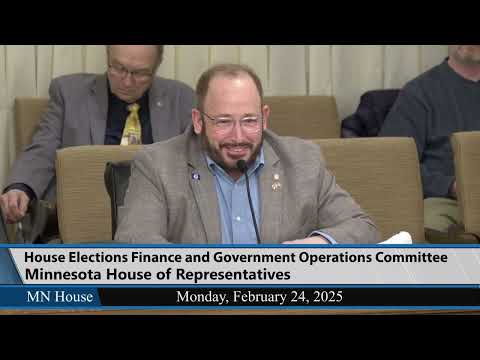
House File 550, a proposed constitutional amendment to create a bipartisan redistricting commission in Minnesota, was recommended to pass and be re-referred to the State Government Finance Committee after a 6–5 roll-call vote in the Minnesota House Elections, Finance and Government Operations Committee.
Author Representative Paul Torkelson described HF 550 as a bipartisan, evenly divided commission intended to keep the redistricting process out of the courts and ensure a legislative role consistent with historical practice. He moved an A1 amendment to clarify language for an unusual tie situation in legislative leadership titles; the amendment was adopted. The amended bill would create an eight-member commission and require approval of a map by six of the eight members.
The hearing included extensive testimony and written materials from a range of stakeholders. The Minnesota Chamber of Commerce supported the bill’s bipartisan framework, arguing a commission could provide transparency and reduce court involvement. The Brennan Center for Justice urged caution, saying HF 550 contains structural weaknesses—limited restrictions on who may serve, sparse protections for communities of color, and insufficient statutory criteria—that risk partisan outcomes or deadlock. Common Cause Minnesota, the Minnesota Council of Foundations and other grass-roots and civic groups also testified, expressing concerns that the bill allows appointed commissioners with partisan ties and that the bill ranks communities of interest lower in the redistricting criteria and lacks sufficient public-hearing requirements or protections for minority voting rights.
Public testimony included critiques that the proposed selection method embeds a two-party duopoly by allowing party caucuses to appoint commissioners and by excluding only a narrow class of individuals (current officeholders, party officials and certain close staff). Witnesses who favored more independent models described 15-member commissions with public solicitation, retired-judge screening panels and random selection methods to reduce party influence and to increase community participation. Several witnesses urged statutory placement of redistricting criteria rather than constitutional text to allow operational flexibility and suggested stronger protections for communities of interest and for racial and language minorities.
Committee members questioned the bill’s selection process, the possibility of deadlock if commissioners cannot reach six votes, the limited list of ineligible participants, and fiscal or administrative supports for the commission. House fiscal staff confirmed a fiscal note had been requested; as a constitutional amendment the immediate state cost is minimal but local costs for ballot placement and potential future commission staffing would be subject to later budgeting. Representative Torkelson said he is open to further changes but argued a workable bipartisan structure with a realistic chance of passage and ballot placement is necessary.
At the end of the hearing the committee took a roll-call vote. Chair Quam — with Vice Chair Altdorf, Representatives Davis, Gordon and McDonald — voted aye; Representatives Acum, Coulter, Lee, Greenman and Vernegg voted no. The motion passed 6–5 and HF 550, as amended, was recommended to the State Government Finance Committee.