Get Full Government Meeting Transcripts, Videos, & Alerts Forever!
Get email alerts on the Cdbg Community Funding topic
No spam. Unsubscribe anytime.
San Mateo commission recommends 2025–26 CDBG allocations; agencies urge help as federal funding uncertain
Summary
The San Mateo Community Relations Commission heard presentations from nonprofits seeking Community Development Block Grant funding and voted to recommend funding distributions that largely mirror prior-year awards, with specific recommendations for public facilities and contingency language if federal allocations change.
The San Mateo Community Relations Commission on an item about 2025–26 Community Development Block Grant funding recommended that staff forward funding allocations to the city council that largely maintain prior-year awards and distribute public services funds equally among current grantees.
The commission’s action followed a series of presentations from nonprofit service providers and staff briefings on CDBG rules and budget assumptions. Jeff Mora, the City of San Mateo housing specialist, told the commission the city is treating the 2025–26 cycle as a “renewal year” and is using the prior year’s entitlement as the baseline because the U.S. Congress had not finalized the federal budget and HUD allocations were uncertain.
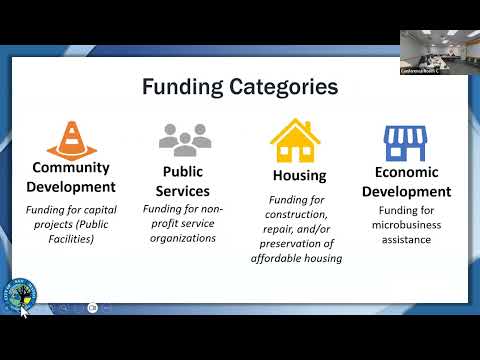
Mora said the city’s annual entitlement used for planning is $753,586, and that program income and prior-year resources lift the available dollars to “just over a million” for the draft action plan. Mora reiterated statutory program limits that affect the budget: CDBG public services are capped at 15% of the annual entitlement and administration is limited to 20%.
Why it matters: CDBG funds support food distribution, homelessness prevention, legal services, fair housing enforcement, minor home repairs and microenterprise and childcare supports in San Mateo. The commission’s recommendation will be incorporated into the city’s annual action plan and forwarded to City Council for final approval in spring.
What the commission recommended and why - Public services: the commission recommended dividing the available public‑services pool equally among the returning CDBG public‑service grantees rather than reweighting awards. Staff noted the 15% cap on public services creates a fixed envelope to allocate and presented contingency language for larger or smaller federal allocations. - Fair housing and minor‑home‑repair and economic development categories: staff recommended, and the commission supported, maintaining funding at the same level as the prior year for Project Sentinel (fair housing), Rebuilding Together Peninsula (minor home repair) and the two microenterprise programs (Renaissance and Upwards). - Public facilities: staff recommended including two previously considered projects in the 2025–26 action plan. The commission recommended funding CORA’s capital request for a breezeway project at about $49,077 (rounded in meeting discussion to $50,000) and recommending $150,000 toward HIP Housing’s elevator/public‑facility project at 115 East Fifth Avenue, with staff and applicants stating the full project estimate ranges from roughly $150,000 to $200,000 and that HIP Housing plans additional fundraising.
The commission adopted a motion “to recommend the following funding distribution for the 2025–26 CDBG community funding program as previously recited.” The vote as recorded in the meeting transcript shows recorded “yes” votes from Vice Chair Fitzgerald, Commissioner Carl and Commissioner Kent; other commissioners’ recorded votes were not enumerated in the transcript excerpt. The motion passed.
Presentations from service providers - Terry Bosch, executive director of Call Primrose, described a sharp rise in demand for grocery assistance and said Call Primrose distributed more than 110,000 bags of groceries last year and ‘‘served roughly 72,000 individuals’’ (duplicate visits counted), with a portion of those clients from San Mateo. Bosch said additional CDBG support would help the nonprofit purchase groceries and maintain staff to meet need: “Hunger and food insecurity within our community are very real, and they continue to rise as the cost of living … continues to rise.” - Melissa Gibbs, manager of the legal services program at CORA, described CORA’s legal advocacy for survivors of intimate‑partner violence and told the commission the family‑court process “has the immense power to either positively or negatively impact a survivor’s trajectory.” She said CDBG support lets CORA prioritize San Mateo residents for more comprehensive advocacy and representation services. - Representatives from Friends for Youth, Legal Aid Society of San Mateo County, LifeMoves, Samaritan House, Rebuilding Together Peninsula, Renaissance, Upwards (Boost childcare), Project Sentinel, and HIP Housing each summarized client counts, program costs and how CDBG funds support specific services. Highlights included Project Sentinel reporting higher-than-expected case volumes for fair‑housing work and noting potential federal uncertainty: Executive Director Carol Khan said HUD workforce reductions were being reported and that the organization was monitoring whether that could affect federal fair‑housing funding.
Contingency and process clarifications Staff presented contingency language to guide allocations if the final federal CDBG entitlement differs from the planning estimate. The staff recommendation includes: reducing public‑services awards proportionally to remain under the 15% cap if the entitlement is lower; retaining funding for minor home repair, economic development and fair housing where possible; reducing city‑led public facility allocations if necessary; and increasing public‑services awards up to the 15% cap if the entitlement is higher. Staff also noted a working threshold used in the recommendation—if reduced awards would drop below $10,000 per public‑service grantee, staff would consider funding fewer programs rather than distributing very small amounts across all grantees. The commission asked staff to collect grantee input on whether very small awards (below $10,000) would be meaningful before making final decisions.
Discussion vs. decision The meeting separated discussion (presentations and commission questions) from formal direction. Presenters noted program performance, client counts and financial needs; commissioners asked clarifying questions about program metrics, how applicants reach new clients and the timeline for projects such as HIP Housing’s elevator. The formal decision recorded in the minutes was the commission’s recommendation to forward the funding package (with the allocations summarized above) to City Council for approval.
Next steps and timing Staff will incorporate the commission’s recommendations into the draft annual action plan for the Consolidated Plan and present the draft to City Council for final approval in the spring (staff indicated May as a likely month, subject to change). Staff and grantees said they remain watchful of federal budget developments and will adjust final allocation recommendations if HUD’s entitlement for San Mateo differs from the planning assumption.
Ending note: multiple presenters urged continued CDBG support to maintain services as federal funding and in‑kind donations fluctuate. Several organizations described contingency plans and additional fundraising but emphasized CDBG as a predictable source that supports direct client services in the city.