Get Full Government Meeting Transcripts, Videos, & Alerts Forever!
Get email alerts on the Veteran Suicide Prevention topic
No spam. Unsubscribe anytime.
Minnesota veterans agency outlines suicide-prevention strategy and new health navigator program
Summary
The Minnesota Department of Veterans Affairs described region-based analysis, a new veteran health navigator service funded by the Lee and Penny Anderson Foundation, and collaborative projects—including a suicide mortality review and local crisis mapping—during the Senate veterans subcommittee hearing on Feb. 24, 2025.
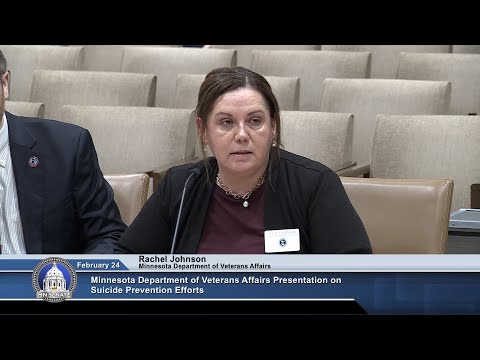
Rachel Johnson, director of Veteran Community-Based Services at the Minnesota Department of Veterans Affairs, told the Senate Subcommittee on Veterans and Military Affairs on Feb. 24 that the department is organizing region-based work to address veteran suicide and launching a veteran health navigator program.
The department established the Veteran Community-Based Services team in June 2024 and is overseeing a veteran suicide prevention program and a veteran health navigator program that will hire three social workers (including a supervisor or manager). Johnson said the work includes training and education partnerships, data analysis, crisis-intercept mapping in Chippewa County, a suicide mortality review beginning in Northeast Minnesota and collaboration with the U.S. Department of Veterans Affairs and SAMHSA.
"The reason why we do this work is that we wanna provide our lived experiences and connections and to serve our service members, our veterans, and their families throughout the state," Johnson said.
Johnson presented MDVA regional maps that show veterans as about 5% of the population and identified Northeast and Southwest Minnesota as regions with higher numbers of veteran suicide; Northwest Minnesota has seen decreases and will be studied to identify effective practices. She said preliminary 2023 data projected about 93 veteran deaths by suicide statewide and that about 97–98% of the decedents were male, with the largest share in the 55-and-older age group.
She said firearms remain the most common mechanism and that roughly 40% or more of veterans in some rural areas are not connected to VA health care benefits. The navigator program, funded through the Lee and Penny Anderson Foundation via Regions Hospital's Hero Care program, will coordinate non‑VA and VA benefit connections and aim to embed screening and referral workflows into health systems and electronic health records if grant funding is secured.
John Kelly, director of government affairs for MDVA, told the committee that the navigator program is an appropriation carried as a rider in the department's health care budget. "We are the only state that has this community health navigator program for veterans," he said, describing the appropriation and the state's role in implementing the service.
Committee members asked about related issues such as domestic violence and substance abuse; Johnson said those concerns are being addressed under social determinants of health screening and that the department is vetting service providers to make sure referrals are reliable. She described planned outreach tied to the 988 crisis line, including materials for veteran clubs and a 988 awareness day in September, and said the department will coordinate with local partners such as county veteran service officers, the Minnesota National Guard, the VA, and community health systems.
No committee action was taken on the presentation itself; the discussion informed the subcommittee and committee members about MDVA plans and next steps including grant applications and regional mortality review work.