Get Full Government Meeting Transcripts, Videos, & Alerts Forever!
Get email alerts on the Sanitary District Quorum topic
No spam. Unsubscribe anytime.
Committee advances bill to reduce quorum for Crane Lake sanitary district board
Summary
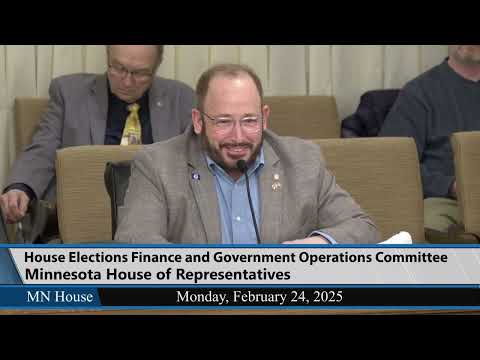
The House Elections, Finance and Government Operations Committee recommended House File 438 to the General Register after testimony that Crane Lake's five-member sanitary board struggles to meet quorum; the bill would allow a three-member quorum.
House File 438, which would allow the Crane Lake Water and Sanitary District to operate with a three-member quorum instead of five, was recommended to pass and be re-referred to the General Register by the Minnesota House Elections, Finance and Government Operations Committee.
Supporters said the change is needed because Crane Lake is a small, remote community and the existing five-member quorum requirement makes it difficult to hold regular meetings. Robert “Rob” Scott, chairman of the Crane Lake Water and Sanitary District, told the committee the district covers nearly 15 square miles, serves about 30 users on the treatment system and encompasses roughly 88 registered voters. He said voluntary board service is hard to staff, meetings have been canceled and the current quorum standard impedes the district’s ability to manage sewer finances and protect nearby waters, including portions of the Voyageurs National Park watershed.
Scott said the Crane Lake district was established in February 2004 and is the only sanitary district in Minnesota that operates both a treatment plant and manages on-site systems. “Every year, we’ve had to cancel numerous meetings due to the lack of having the minimum board members present,” he said. He told the panel that reducing the quorum to three would “significantly mitigate our current challenge.” Representative Scribe carried the bill on the committee floor and the committee chair moved the bill forward; members voted verbally and the motion passed.
Committee discussion and the testimony focused on the practical challenge of obtaining a quorum in a remote, seasonal community where many property users are not resident and therefore ineligible to serve. The committee did not take a roll-call vote on the bill; the motion was moved and passed by voice vote. The bill was recommended to the General Register so it can proceed through the legislative process.
The committee record shows no amendments were adopted during the committee consideration. Action on the bill is now pending further legislative steps listed on the General Register.