Get Full Government Meeting Transcripts, Videos, & Alerts Forever!
Get email alerts on the State Budget Transfers topic
No spam. Unsubscribe anytime.
Appropriations hears bill to eliminate Strategic Investment Projects Account; committee debates school funding guarantees
Summary
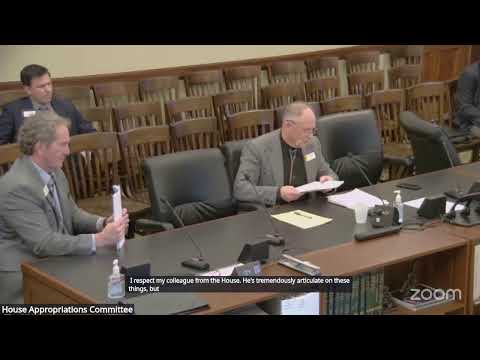
Senator Hicks presented Senate File 169 to the House Appropriations Committee, proposing elimination of the Strategic Investment Projects Account (referred to alternately as SIPA and CIPA) and a reworking of how investment earnings from the Permanent Wyoming Mineral Trust Fund are transferred and appropriated.
Senator Hicks presented Senate File 169 to the House Appropriations Committee, proposing elimination of the Strategic Investment Projects Account (referred to in testimony alternately as SIPA and CIPA) and intercepting investment earnings that currently flow through that account into other automatic diversions.
Senator Hicks said the bill "simplify[s] the budget" by stopping automatic transfers that route money from the general fund into SIPA and then into other accounts. "We don't need to take general fund money, run it, from the general fund, into the CIPA account, from the CIPA account into the school foundation program account... If we wanted to just do that, we would just do a direct general fund appropriation to the school foundation," he said, adding the change would increase transparency about where general fund money originates and how it is appropriated.
Hicks walked committee members through a schematic showing the Permanent Wyoming Mineral Trust Fund, the reserve account and where current investment earnings flow. He described the bill's mechanics as blocking the money that currently flows into the Strategic Investment Projects Account and leaving some existing outflows — such as the $10 million annual transfer to the penitentiary capital construction account — to be handled as direct general‑fund appropriations.
Committee members focused on the practical consequences. Representative Sherwood asked about specific amounts the school foundation program would receive today from SIPA: "out of CIPA, the school foundation program will receive in fiscal year 27 around 60,400,000.0. And then in fiscal year 28, it'll receive about 63,900,000.0," she said, and asked whether eliminating SIPA means the Legislature would have to appropriate those amounts from the general fund. Senator Hicks replied that either the general fund or the Legislative Stabilization Reserve Account (LSRA) would backfill any shortfall and that the Legislature would need to make appropriations if the model generates a deficit.
Representative Harshman and other members emphasized the history of the auto‑flow structure and the policy reasons it was created, including its prior role replacing a lost coal lease bonus revenue stream and funding recurring needs such as school major maintenance and capital projects. Harshman recommended guaranteeing at least a portion of the current SIPA flows through the LSRA or another mechanism: "If you want to keep both of those current programs that are coming out of the SIPA, I think they would both be better to come out of a portion of a guaranteed list or a partial guaranteed list," he said.
Budget staff and witnesses cautioned that the state's revenue streams are volatile and that eliminating automatic diversions could make funding for ongoing obligations more discretionary. "I worry that the more we go to just general fund, that will become more of an optional biannual choice," Mr. Schwartz told the committee, noting the volatility of severance and other revenues.
Committee members discussed options including preserving the annual $10 million penitentiary transfer, guaranteeing part of the current spending policy flow, or leaving the transfer mechanism in place for certain uses. No final committee vote on the bill was taken during the session; the committee recessed with plans to reconvene and continue work on the measure.