Get Full Government Meeting Transcripts, Videos, & Alerts Forever!
Get email alerts on the Trust Funds Investment Policy topic
No spam. Unsubscribe anytime.
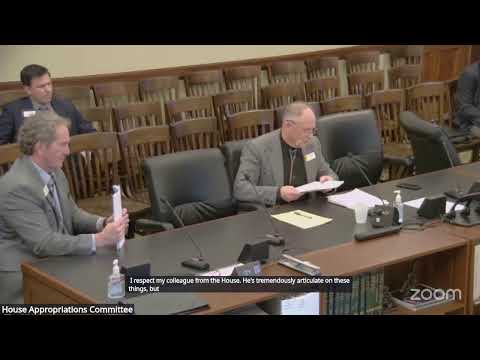
House Appropriations approves changes to wildlife and cultural trust fund investment and spending rules
Summary
The House Appropriations Committee voted to pass Senate File 70, which would remove statutory "inviolate" restrictions on two Wyoming trust funds and create spending policies designed to inflation‑proof the accounts and increase long‑term returns.
The House Appropriations Committee on a roll‑call vote moved Senate File 70 forward, a measure that would change how the Wildlife Natural Resource Trust Fund and the Cultural Resources Trust Fund are invested and spent.
Senator Hicks, the bill bringer, told the committee the proposal removes statuory "inviolate" language that limits how the treasurer’s investment staff can manage the funds, establishes formal spending policies for the two accounts and redirects excess investment earnings back into each fund’s corpus to help inflation‑proof the balances. "The big thing is inflation proof the account, provide higher rate of returns and then provide a steady flow of money for the boards and commissions," he said.
The bill would eliminate a statutory requirement that the funds be invested in the state’s short‑term pool (referred to in testimony as "pool A"), allowing a different asset allocation intended to improve returns. Senator Hicks and other presenters said even a modest improvement in long‑term returns would generate material additional annual income for the agencies. "If we move... a 2 and a half percent increase in return above what we currently get in pool A, we generate about a million and a half dollars a year in investment income above what we're currently getting," Senator Hicks told the panel.
Agency directors backed the spending‑policy approach. Bob Budd, Director of the Wildlife Natural Resource Trust, said the trust’s historic average spending rate is roughly 4 percent. "We went back and looked at what our average spending was over the last 20 years and it's right at that 4%. We've had years where we were above that, years where we were below, but in general, it's right at that," Budd said.
Sarah Sheen, deputy director of the Cultural Resources division at State Parks, said the change would make year‑to‑year funding more predictable for grant applicants and constituents: "[I]t's really leveling out the interest earnings so we know what we can expect." Dave Glenn, Director of State Parks and Cultural Resources, added: "Some years, it's 1%, some years, it's 6 or 7%. So to have a consistent... we can look back at the averages and know kind of the amount of money that's going to be given out and we love the inflation proofing idea."
Officials from the treasurer's office supported the bill but urged simplifying or removing a proposed separate "income account." Patrick Fleming, chief operating officer for the treasurer’s office, said income accounts can be "expensive and cumbersome" and argued the agency could distribute funds directly from the main fund into the state agency pool used by agencies as a checking account. "When they're saying this bill creates an income account, we don't need the income account," Fleming said.
Committee members discussed technical language and agreed staff and the bill bringer would refine wording on income‑account operations and related conforming edits. Representative Harrelson moved the bill and Representative Smith seconded; the committee recorded seven "aye" votes and the measure was reported as do‑pass. "Roll call votes. Senate file 70 do pass," the clerk announced during the recorded vote. The committee noted Representative Harrelson will floor‑manage the bill.
Proponents and agency directors emphasized the bill does not change the amount currently in the two trust funds; rather, it changes how the funds are invested and how excess earnings are handled going forward. Questions from committee members focused on where to place any required income accounting, how donated or specially appropriated monies would be handled, and whether the new spending policy percentages align with past average spending.
The committee closed public comment after testimony and moved the bill to the next stage for amendment work on income‑account language.