Get Full Government Meeting Transcripts, Videos, & Alerts Forever!
Get email alerts on the Digital Kiosks topic
No spam. Unsubscribe anytime.
Boca Raton CRA asks staff to return with smaller, no-ad digital-kiosk pilot after vendor review
Summary
The Boca Raton Community Redevelopment Agency heard a staff proposal for 20 digital kiosks, including a revenue-sharing advertising model offered by Ike Smart Cities, but members asked staff to return with options limited to fewer units and no third-party advertising.
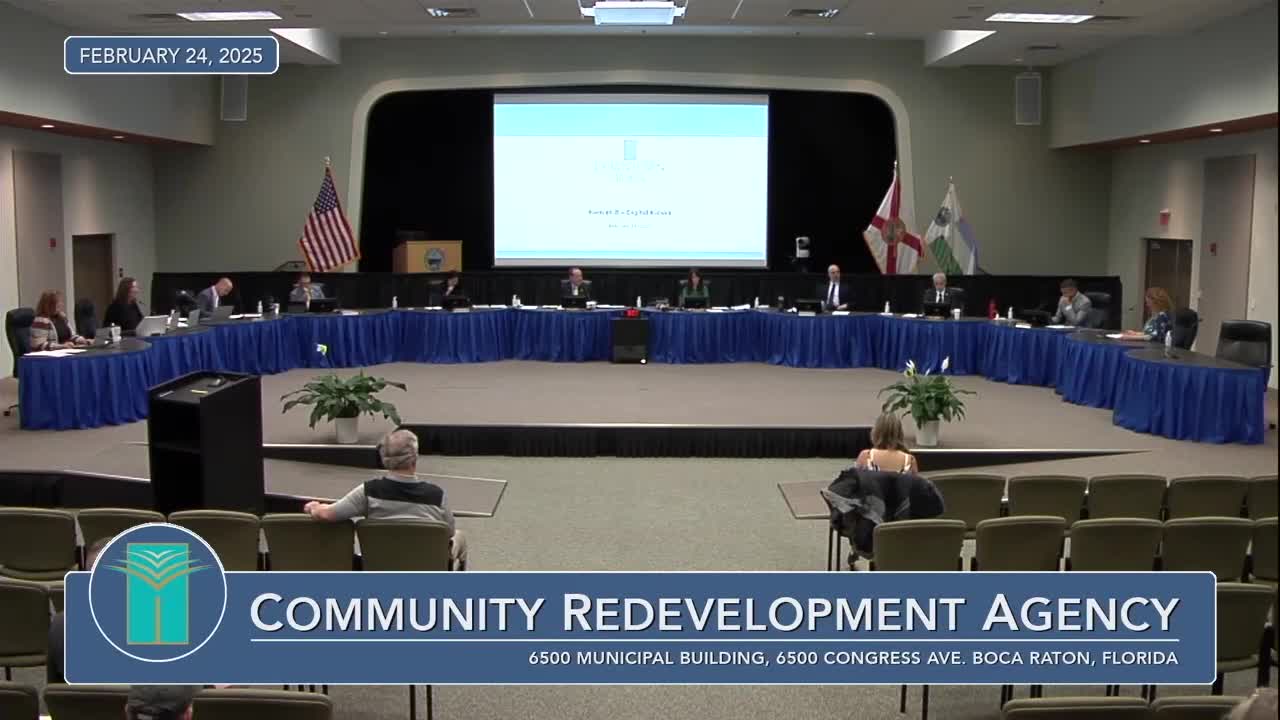
BOCA RATON, Fla. — The Boca Raton Community Redevelopment Agency on Feb. 24 heard a staff presentation on proposed downtown digital information kiosks and asked staff to return with scaled, non-advertising options and a pilot plan instead of proceeding with the 20-unit, ad-driven program staff initially outlined.
Ruby Riley, downtown manager, told the board staff had identified roughly 20 potential kiosk locations across downtown, including the Brightline area, City Hall, the downtown library, Meisner Park and Palmetto Park Road. She said staff’s preferred vendor, Ike Smart Cities, offers a turnkey, license-agreement program that places the vendor’s equipment on city right-of-way and shares advertising revenue with the city.
“Their advertising loop, 12.5% of it, would be available to the city for public content, such as events and emergency information,” Riley said. She said Ike estimated average annual revenue to the city at approximately $811,000 and a total revenue share over the life of the agreement of roughly $16 million, and that the program is currently operating in several Florida cities.
Board members pushed back on the advertising model and the scale of the rollout. Commissioner Singer said he was concerned about the advertising and long-term maintenance costs. “I don’t like the advertising model,” Singer said. He and other members also argued 20 units across the roughly 10-block north–south downtown footprint would be too many and urged a more modest pilot.
Vice Chair Thompson also opposed the advertising model and questioned long-term costs if the city purchased or leased kiosks without a revenue partner. Commissioner Drucker and Commissioner Wictor said they were open to a limited pilot if the city could control content and keep kiosks at key transit and activity nodes.
Riley presented an alternative vendor, Toshiba, available through the Omnia contract. She said a five-year purchase option from that vendor would be “a little over a million” for 20 units (staff used the 20-unit comparison to match the Ike proposal), with lease costs around $1.4 million, but that Toshiba’s offering lacks cameras, emergency-call capability and the turnkey services Ike provides. Riley said Toshiba would provide fully customizable content controlled by the city but that maintenance, software updates and on-site troubleshooting beyond a basic level would be additional costs.
Following discussion, CRA Director Brown summarized board direction: staff should return with options that limit or eliminate third‑party advertising, focus on a small number of strategic locations (for example near transit stops, Meisner Park and Royal Palm Place), and propose a short pilot rather than a 20-unit, long-term deployment. Several commissioners asked staff to explore kiosks that include public-safety features and wayfinding without the full advertising loop.
The board did not approve any contract or license agreement at the meeting and gave staff direction to return with refined options, cost comparisons and recommended locations.
Ending: Staff said it will bring back alternative proposals that emphasize fewer units, local content control and pilot testing before any licensing or procurement decision.