Get Full Government Meeting Transcripts, Videos, & Alerts Forever!
Get email alerts on the Traffic Safety School Zones topic
No spam. Unsubscribe anytime.
Boca Raton council to introduce ordinance allowing automated school‑zone speed enforcement; six schools targeted for phase one
Summary
City staff will introduce Ordinance 5731 to permit automated speed‑detection enforcement in eligible school zones. Staff recommended an initial six‑school rollout this fall after a data review; officials flagged staffing, certification and procurement as constraints that will shape expansion.
Boca Raton officials said Monday they will introduce Ordinance 5731 at the March 25 regular meeting to authorize automated speed‑detection enforcement in eligible school zones, with staff recommending a phased rollout that would begin at six school zones identified by traffic and crash data.
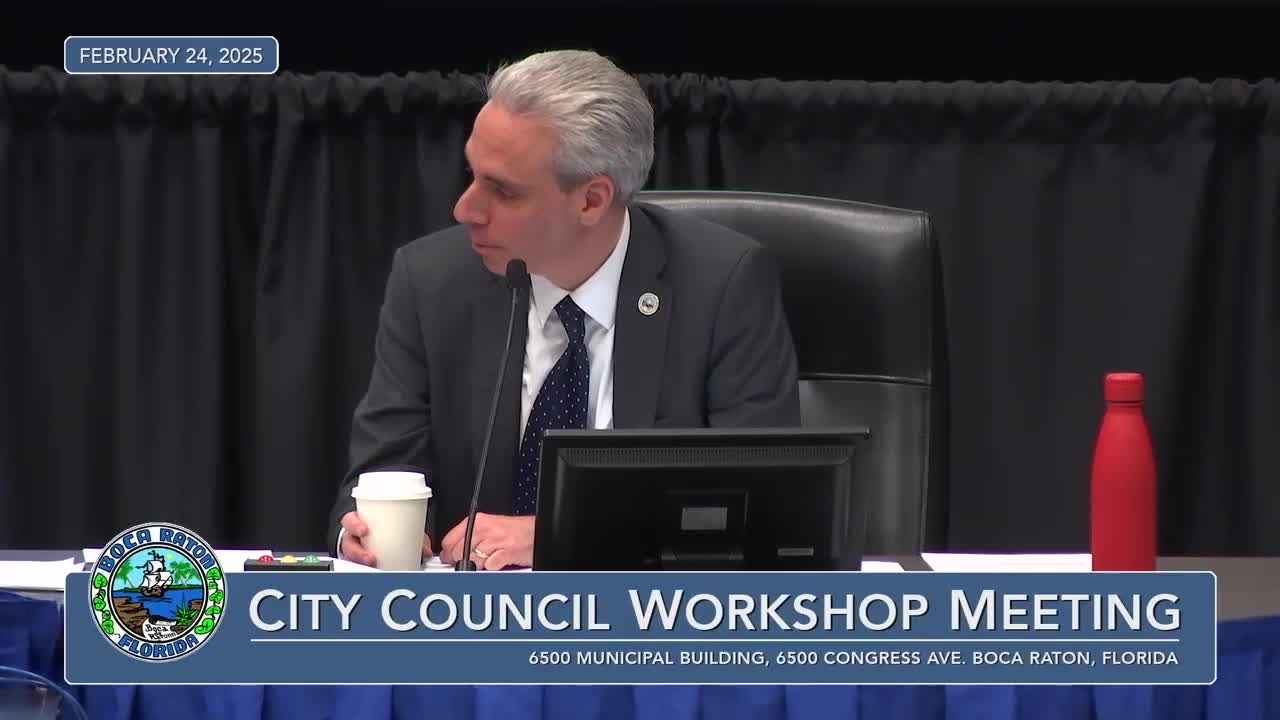
City staff presented the plan at a Feb. 24 workshop. "Only applicable in eligible school zones," Zack Bier, Municipal Services Director, told the council, describing a data‑driven selection that considered average daily traffic, crash history, 85th‑percentile speeds and the percentage of drivers exceeding the posted limit by 10 mph.
The recommendation for phase one identifies six sites that met the city’s heightened‑risk criteria, Bier said, listing Addison Meissner, Blue Lake Elementary, Colusa, Omni/Onnie Middle School (a combined zone), Spanish River/Boca Raton High School and JC Mitchell. Bier said staff analyzed crashes from 2018–2023 and other datasets developed under the city’s Vision Zero action planning.
Why it matters: the state revised statutes now permit automated detection in school zones for certain speeds and times, and City Hall officials said they want to reduce crashes and improve pedestrian safety near schools. "That prepared staff to be able to pull our crashes within Boca Raton from 2018 to '23," Bier said, noting the analysis informed the phase‑one list.
Key details and constraints
- Timing and scope: Staff told the council they plan to begin enforcement in the fall semester after a public education campaign. The ordinance language includes a phased approach; staff proposed starting with six zones to limit initial operational workload and to validate procedures before broader deployment.
- Operational window: The detection systems will operate during school activity periods — from the morning flashing lights through the end of the afternoon flashing lights on school days — and staff noted the systems will remain active for the duration of the school day even when reduced posted speeds are not in effect.
- Staffing and certification: Police leadership warned that each automated violation requires review by a certified reviewer before notices or citations issue. "You can use civilian employees, but you have to be certified traffic enforcement infraction officer," Chief Muccio said, adding that the department has reached out to the Florida Department of Law Enforcement (FDLE) to identify training resources. If civilians cannot be certified promptly, officers may need to be pulled from other duties, the chief said.
- Procurement and vendor roles: Staff recommended an RFP rather than piggybacking existing contracts so the city can tailor the program, require vendor support for implementation and include education and expansion options. Council members asked whether vendors could provide or facilitate reviewer certification; staff said that training commitments will be requested in the RFP.
- Phase expansion: Councilmembers urged urgency and discussed hybrid rollouts — issuing a city‑wide education campaign while enabling enforcement in a limited set of zones — to speed benefits without overloading back‑office review capacity.
- Revenue and administration: Staff noted the program will generate citation revenue and will require financial and administrative systems to process payments and appeals; the RFP and contract will address these needs.
Council comments and next steps
Several council members pressed for faster implementation and for options that do not limit the city to only six zones long‑term. Councilmember Thompson suggested a hybrid approach: notify all school zones while enforcing only an initial subset so the city can process violations and scale up. Bier and city staff committed to returning with procurement language and operational details; the ordinance introduction is scheduled for the March 25 meeting.
The council also asked staff to confirm the exact count of school zones within city limits (staff referenced 15 school zones in the dataset, and multiple times the discussion referenced 15–16 zones) and to re‑evaluate sites such as Don Estridge if engineering conditions change.
Quotes in context
"Only applicable in eligible school zones," Zack Bier, Municipal Services Director, said when summarizing statutory and technical limits for automated enforcement.
"You can use civilian employees, but you have to be certified traffic enforcement infraction officer," Chief Muccio said when explaining certification and staffing constraints.
Ending
Staff will return with procurement language, training and operational plans after the council’s March consideration of Ordinance 5731. Councilmembers asked staff to explore training avenues and interlocal cooperation to accelerate deployment while protecting review and due‑process steps.