Get Full Government Meeting Transcripts, Videos, & Alerts Forever!
Get email alerts on the Energy Solar topic
No spam. Unsubscribe anytime.
County committee hears MACo briefing on three presiding-officer energy bills and two data-center measures
Summary
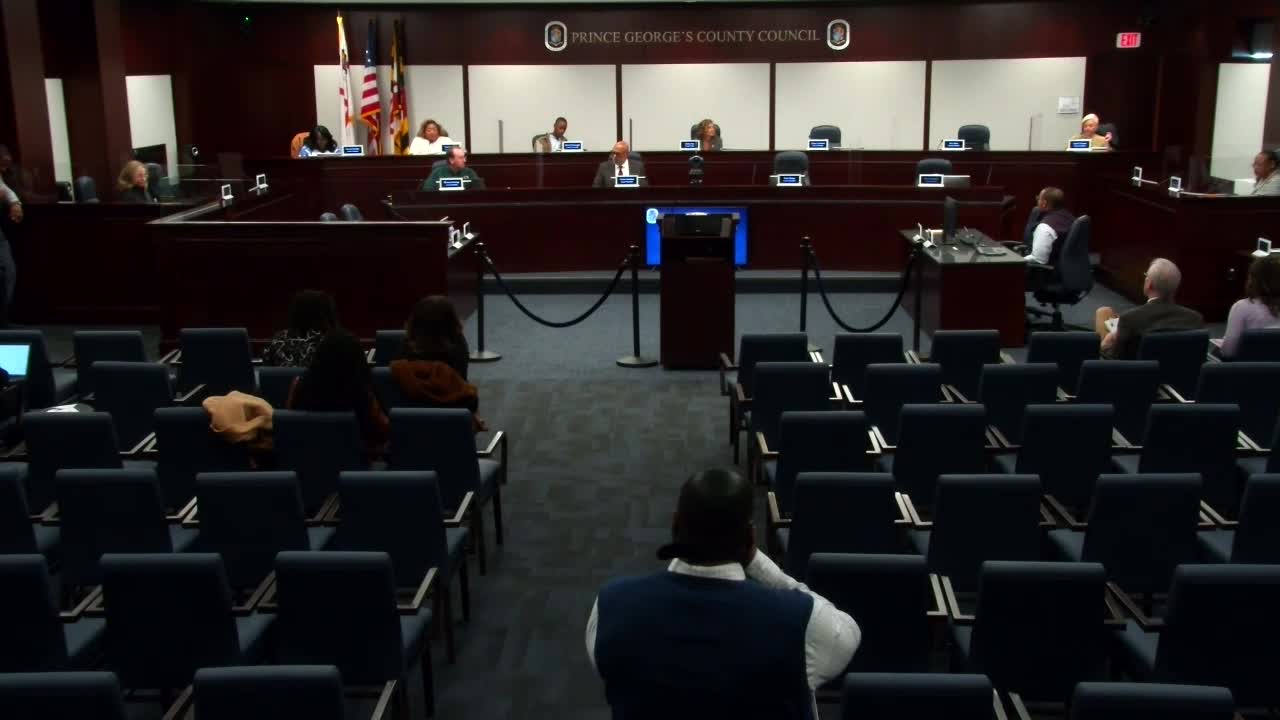
Prince George’s County Council’s committee of the whole heard a briefing Feb. 24 from the Maryland Association of Counties on three presiding‑officer energy bills and two data‑center measures and was told one solar‑siting proposal could reduce local land‑use authority and hit county revenues.
Prince George’s County Council’s committee of the whole heard a briefing Feb. 24 from Dominic Pushko of the Maryland Association of Counties (MACo) on three presiding-officer energy bills and two separate data‑center bills, and was warned that one solar-siting proposal could reduce local land‑use authority and have measurable fiscal impacts on counties.
MACo’s overview outlined three energy bills that staff said will be the main vehicles for statewide energy policy this session and two bills dealing with data-center approvals and impact studies. “There are 3 really big bills this year, coming from the presiding officers,” Pushko told the committee, and MACo’s positions range from “no position” to “support with amendments” to “opposed.”
Why it matters: Council members pressed MACo on how the measures would affect local planning, public safety and county revenues. The most contested provision, MACo said, would change how solar projects are sited and taxed and could limit counties’ authority over setbacks, screening and other land-use protections. MACo also raised alarm about applying those same siting rules wholesale to utility-scale battery storage without explicit battery‑safety or fire‑suppression standards.
Most important details
- Bills and MACo positions: MACo told the committee it has no position on the Next Generation Energy Act (House Bill 1035 / Senate Bill 937), is likely to “support with amendments” the Energy Resource Adequacy and Planning Act (House Bill 1037 / Senate Bill 909), and has taken an opposed position on the large solar/energy package (House Bill 1036 / Senate Bill 931) as drafted. Pushko said MACo is open to negotiating changes despite the current opposition.
- Solar siting and county authority: MACo said the solar section of HB 1036 / SB 931 “varies rather dramatically” from prior interim negotiations and would limit county siting authority and revenue. As an example, Pushko described a pilot tax provision that sets a $5,000 per‑megawatt tax for a single project in a single county (he cited Queen Anne’s County as an example), saying "that would be a million dollar hit to their underlying budget just on 1 project alone in a relatively smaller county."
- Energy storage concerns: MACo urged removing the bill’s energy‑storage provisions or substantially rewriting them. “There’s no mention of battery safety standards, fire suppression, etcetera,” Pushko said, adding that utility‑scale battery incidents can be “scales of magnitude larger than a traditional fire.” MACo’s amendment, he said, would excise the energy section and leave siting and safety specifics to the Public Service Commission’s ongoing rulemaking.
- Nuclear and natural gas roles: MACo characterized HB 1035 / SB 937 (Next Generation Energy Act) as a package that would promote next‑generation small modular nuclear reactors and preserve natural gas as a short‑to‑medium‑term resource. Pushko called it controversial but said MACo took no position.
- Data center bills: MACo described Senate Bill 903 as a fast‑track mechanism for certain data centers (notably colocation facilities with on‑site power). MACo said it supports SB 903 with amendments to avoid unintentionally preempting local review and permitting authority. The data‑center impact analysis bill (House Bill 270 / Senate Bill 116) is supported with amendments to ensure the analysis includes agricultural impacts and other land‑use considerations.
Council questions and MACo responses
- Councilmember Hawkins asked how data‑center fast‑tracking would affect local economies and infrastructure. Pushko answered that revenues can be substantial but warned of energy‑system impacts because neighboring jurisdictions’ data‑center growth has strained regional grids.
- Councilmember Wanika Fisher asked whether the bill treats urban and rural jurisdictions differently. Pushko said the legislation has no urban/suburban/rural distinctions and "this would just be kind of a one‑size‑fits‑all in terms of the energy storage siting" — a reading that, he said, could allow storage installations “right next to housing.”
- MACo emphasized that the Public Service Commission is already working on regulations addressing storage siting and safety; MACo’s view is that statute is not the best place to duplicate or pre‑empt that regulatory work.
Next steps: MACo staff told the committee the three presiding‑officer energy bills are scheduled for a joint hearing in Annapolis on Feb. 28 at 1:30 p.m.; MACo also said it would continue stakeholder talks and recommended county staff and members follow MACo outreach and proposed amendments.
Ending: County members asked MACo to send specific amendment language to committee staff so members can share it with other Prince George’s members of the General Assembly. MACo said it had already sent a letter to bill sponsors outlining objections and potential paths forward and remains open to negotiation.