Get Full Government Meeting Transcripts, Videos, & Alerts Forever!
Get email alerts on the Legislative Procedure topic
No spam. Unsubscribe anytime.
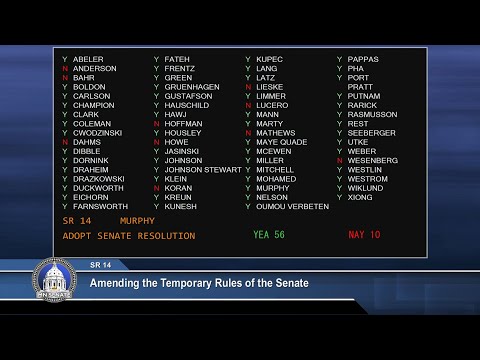
Minnesota Senate adopts amended temporary rules after debate, 56-10
Summary
The Minnesota Senate voted 56-10 to adopt Senate Resolution 14, revising temporary Senate rules; members discussed technical edits and procedural changes including notice requirements, committee processes and remote-voting reimbursements. A concurrent resolution adopting temporary joint rules was also adopted.
The Minnesota Senate on Monday adopted Senate Resolution 14, a package of amendments to the chamber’s temporary rules, by a roll-call vote of 56-10 after roughly 10 minutes of floor debate.
Senate Resolution 14 makes technical and procedural changes to the Senate’s temporary rules, including language shifts ("shall" to "must"), terminology updates ("group" to "caucus"), and clarifications on notice to members and the public before agenda changes, admission to the chamber, decorum, and the handling of ethical-subcommittee procedures. Senator Omar M. Murphy introduced the resolution on the floor and asked members for a roll call vote.
The resolution’s supporters said the updates were largely technical modernizations developed over about a year of bipartisan work and nonpartisan staff review. "Senate resolution 14 is the motion that moves our temporary rules...to make sure that the rules are modern, that they are clear, and that they serve the purpose intended," Senator Murphy said on the floor.
Senator Julian Ress urged colleagues to support the measure, noting the hours of review by caucus leaders and staff. "I don't recall that level of attention...being given to the rules at any time in the past since I've been here," Ress said.
The adopted package includes a new Rule 12.3 requiring notice to members and to the ranking member before going public with an agenda change; clarifications of the admissions process for the chamber and modest updates to decorum rules (including staff privileges); changes clarifying message delivery from the secretary’s office; a renumbering and cleanup of several sections; a clarification in Rule 39 on division of the question; removal of language referencing "peacetime, public health emergency and COVID" from Rule 40 and a decoupling of per diem from remote voting; updates to the Subcommittee on Ethical Conduct in Rule 55 addressing executive sessions and complaint withdrawal; and a clarification in Rule 57 about prohibited lobbying activities. The resolution text also references the appointment or recognition of Germaine Niss in relation to Rule 35.
Following the debate the secretary recorded 56 ayes and 10 noes and announced that Senate Resolution 14 had been adopted.
Separately, the Senate adopted Senate Concurrent Resolution 2, a concurrent resolution to readopt temporary joint rules used in the previous biennium; the secretary's announcement showed the same recorded tally, 56 ayes and 10 noes. Senator Murphy moved adoption and requested a roll call for that measure as well; the sponsor said the joint rules had not been revised since February 2009.
On procedural matters, members moved to withdraw and re-refer several files: a motion on the floor sought to withdraw Senate File 1447 from the Committee on State and Local Government and re-refer it to the Committee on Environment, Climate and Legacy (mover identified on the record as Senator Hoffman). Senator Lucero moved to withdraw Senate File 1750 from the Committee on Judiciary and Public Safety and re-refer it to the Committee on Housing and Homelessness Prevention; Lucero said both committee chairs had agreed. The transcript records the motions but does not include a roll-call result for those specific re-referral motions in the floor text provided.
The Senate also moved to adopt the committee reports printed in the agenda earlier in the session and recessed to the call of the president.
The measures and procedural changes take effect under the chamber’s rules process; the Senate identified some items still in a "parking lot" for future vetting. No policy substance beyond procedural rule changes and the listed re-referrals was adopted during the period recorded here.