Get Full Government Meeting Transcripts, Videos, & Alerts Forever!
Get email alerts on the Deepfakes topic
No spam. Unsubscribe anytime.
Minnesota bill would ban creation of nonconsensual pornographic deepfakes and allow attorney general to sue
Summary
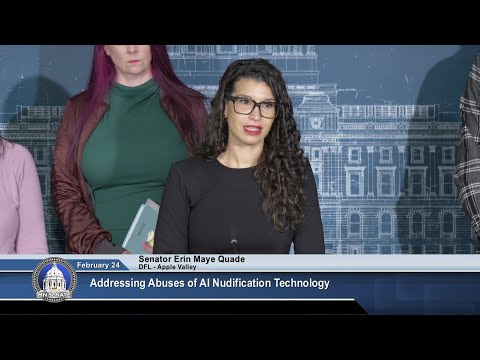
Senator May Quaid introduced Senate File 1119 on the harm posed by nonconsensual pornographic deepfakes and called witnesses who said the technology had caused lasting trauma.
Senator May Quaid introduced Senate File 1119 on the harm posed by nonconsensual pornographic deepfakes and called witnesses who said the technology had caused lasting trauma. The bill would prohibit creation of hyperreal pornographic deepfakes, require apps, platforms and websites to disable nudity-generation functions, and give the Minnesota attorney general authority to sue companies that allow access — with civil penalties of no less than $500,000 for each allowed access or download, according to testimony.
The bill addresses what witnesses and the sponsor described as a gap in current law. A 2023 Minnesota law already prohibits dissemination of nonconsensual deepfake images and videos, but speakers said that law does not address harms that occur when explicit deepfakes are created in the first place rather than shared. "The act of creation itself is the harm because it happens without consent and knowledge," Molly Kelly told the committee after describing how a longtime acquaintance used widely available software to create realistic pornographic images and videos of her.
Kelly, who said she lives in Otsego and was six months pregnant when she discovered the images, said the same person targeted roughly 80 to 85 other women, many in Minnesota. "My initial shock turned to horror when I learned that a friend of 20 years had used my face and widely available deepfake technology to create hyper realistic pornographic videos and images of me," Kelly said. She described psychological and physical health effects and said the existing legal burden to prove intent and dissemination has left victims with little recourse.
Megan Hurley, who identified herself as a massage therapist, said she also discovered hyperreal pornographic deepfakes made with a photo from her private Facebook page. Hurley told the committee the images and videos have caused "irreversible harm" and said she fears re-victimization because someone could find the images, pose as a client and attempt to reuse them to harm her professionally.
Quaid and witnesses said the technology and companies that host it create and profit from the ability to produce convincing sexualized imagery. Committee testimony said many of the websites and apps involved are foreign-based, that the servers used in the case the witnesses described were located outside the United States, and that the services often require payment for high-quality results. "They are marketed to make images like, ‘what would I look like with purple hair,’" a witness said, but in practice the technology is often used to produce sexual content.
Senate File 1119 has already had at least one committee hearing. Quaid told the committee the bill was tabled in the Judiciary Committee to let sponsors tweak language before it moves to the Commerce Committee. She said legislators are also considering where civil penalties recovered by the attorney general would be deposited — whether to victim-survivor services, the general fund or other uses — and that the author in the House is Representative Zach Stevenson.
Committee members asked how enforceable a state-level ban would be when apps and servers operate across borders. Quaid acknowledged the limits of state action without federal legislation but said state enforcement, through attorney general lawsuits and steep penalties, could deter companies from allowing access to Minnesotans. Quaid noted that federal bills had previously been introduced by U.S. Senators Amy Klobuchar and Ted Cruz but had not passed.
No formal floor vote on Senate File 1119 was recorded at the hearing; the committee action listed in testimony was that the bill was tabled in Judiciary pending language changes and referral to Commerce. Sponsor and witnesses urged swift statutory changes, and both victims testified that the creation of deepfakes — not just dissemination — causes immediate and enduring harm.
Looking ahead, Quaid said the lawmakers plan to send a revised draft to Commerce and, if the language and enforcement provisions are resolved, to seek a standalone vote in the full Senate and House.