Get Full Government Meeting Transcripts, Videos, & Alerts Forever!
Get email alerts on the Early Childhood Education topic
No spam. Unsubscribe anytime.
Austin ISD reports 77% of pre-K–2 teachers score 3.5+ on observation rubric; lower-resourced campuses lag
Summary
Austin ISD officials reported to the Board of Trustees that 77.37% of pre-K through second-grade teachers scored 3.5 or higher on the Professional Pathways for Teachers appraisal system (PPFT) as the district begins baseline reporting for Constraint 4 and progress measure 4.1.
Austin ISD officials reported to the Board of Trustees that 77.37% of pre-K through second-grade teachers scored 3.5 or higher on the Professional Pathways for Teachers appraisal system (PPFT) as the district begins baseline reporting for Constraint 4 and progress measure 4.1.
The report, presented by Marian Maxwell, assistant superintendent of elementary academics, and Heather Petruzzini, executive director of academics, said the district is collecting baseline data in 2024–25 tied to Constraint 4, which the board adopted as part of its scorecard measures. Maxwell said the constraint "states that the superintendent shall not require or support developmentally inappropriate practices or assessments in early childhood through second grade." She added that developmentally appropriate practices "promote students' confidence as learners by tailoring their instruction to their developmental needs along their learning and growing continuum," include "purposeful play in early childhood classrooms to foster engagement, creativity, and critical thinking," and "prioritize the development of executive functioning skills of our youngest learners, including self-regulation [and] problem solving."
Why it matters
The metric is intended to gauge whether classroom practice aligns with the district's expectation that early-grade instruction be developmentally appropriate. Petruzzini told the board that, districtwide, 77.37% of teachers received an overall instructional-practices score of 3.5 or higher on PPFT; pre-K–2 teachers specifically were at 77.45%.
Key findings and disparities
Petruzzini reported variation across campuses grouped by SRI bands: band 1 campuses had 67.91% of teachers scoring 3.5 or higher, rising incrementally to 83.21% at band 4 campuses — a 15.3 percentage-point gap. She attributed some of the gap to band 1 campuses having a larger share of teachers who are new to the profession or alternatively certified and who have had less professional learning around developmentally appropriate practices.
The presenters said there were effectively no teachers scoring in the lowest PPFT ranges: "0% of our teachers are scoring between 1 and 1.49 and even between 1 and 2.49," Petruzzini reported. The bulk of teachers fall between 3.5 and 4.49. When PPFT is broken into its five strands — Practices and Interaction, Standards and Alignment, Assessment and Feedback, Routines and Procedures, and Classroom Climate and Culture — districtwide scores were above 3.5 in every strand, with Assessment and Feedback identified as the lowest-scoring strand and Classroom Climate and Culture and Routines and Procedures scoring highest.
District analysis and causes
Maxwell and Petruzzini told the board that classroom observations can be subjective and that, while Austin ISD conducted observation calibration at the start of the year, deeper and more frequent professional learning and calibration focused on early-learning practices have been limited by time and accountability priorities at tested grade levels. The report lists recruitment and retention patterns and the prevalence of less-experienced or alternatively certified teachers at lower-SRI campuses as likely contributors to uneven scores.
Planned actions and initiatives
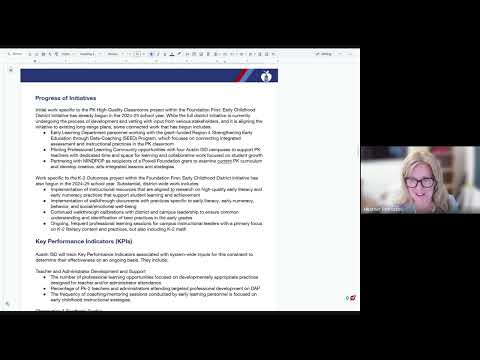
The presentation outlined several initiatives the district said it will use to address gaps and support developmentally appropriate practices across pre-K–2:
- Strengthening professional learning and calibration for central-office and campus instructional leaders to build consistent evaluation and feedback related to early-learning practices. - Expanding coaching and professional learning communities (PLCs) in pre-K classrooms where common planning time has been historically limited. - Continuing partnership work: using the SEEDS (Strengthening Early Education through Data Coaching) program with Region 4 for pre-K assessment and instructional coaching; partnering with MindPop via a PAL grant to examine and support pre-K curriculum and creative-arts integrated lesson plans; and ongoing work with early learning specialists and other external partners. - Aligning walkthrough tools and observation rubrics with desired early-literacy, early-numeracy, behavioral and social-emotional strategies to ensure observations reflect the practices the district wants to see.
The presenters said the district will track inputs such as the number of professional learning opportunities focused on developmentally appropriate practices, the percentage of pre-K–2 teachers attending those sessions, frequency of coaching and observations, and annual comparisons between early learning department observations and campus administration walkthroughs to support calibration.
What the report did not specify
The presentation did not give a districtwide target percentage or the five-year goal that will be set after baseline data collection, nor did it specify campus-level student counts or the precise number of teachers represented in each SRI band in the board presentation (campus-level tables and teacher counts were included in the appendices referenced for board review). The district also did not provide a detailed timeline or budget for the initiatives beyond naming multi-year work on an instructional framework rooted in developmentally appropriate practice.
Closing
Maxwell and Petruzzini closed the briefing by citing supporting research — including materials from a national professional association for early childhood education — and saying the district will return with baseline results and additional details as data collection continues in 2024–25.