Get Full Government Meeting Transcripts, Videos, & Alerts Forever!
Get email alerts on the Strategic Planning topic
No spam. Unsubscribe anytime.
Norwalk reviews Envision 02/1935 strategic goals; council directs study of Highway 28 ownership and options
Summary
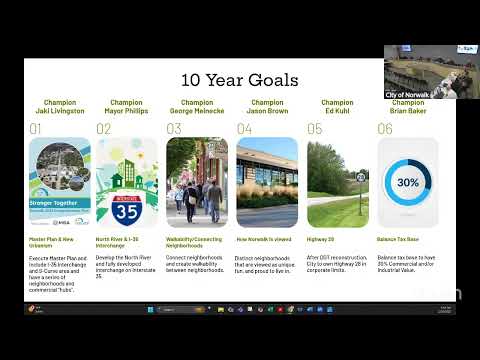
At a Feb. 20 work session, Norwalk city leaders reviewed a 10-year strategic plan called Envision 02/1935 and agreed to form a study group to examine options for improving Highway 28 — including whether city ownership is appropriate — rather than moving immediately to acquire the road.
Norwalk Mayor Phillips and city staff presented Envision 02/1935, a 10-year strategic vision and set of goals, and councilmembers asked staff to collect information and convene a study group to evaluate options for Highway 28.
The plan, introduced by Lindsay (city staff) and Luke (city development staff), lays out 10-year goals including a master plan for neighborhoods and commercial hubs, redevelopment around the North River and I‑35 interchange, increased walkability, distinct neighborhood identities, and moving the city toward a balanced tax base with roughly 30% commercial/industrial property. Lindsay said staff will add projects to department work plans, set 90-day benchmarks and produce a public communications plan.
Why it matters: Highway 28 is one of the items citizens have flagged for improvement in the city survey and appeared frequently during the council’s strategic planning work. Councilmembers stressed the corridor’s heavy use and its effect on community drivability and neighborhood appearance.
Council discussion focused on the specific implications of taking ownership of Highway 28 versus other ways to improve conditions. Wayne (council member) cautioned that "if we were to try to take our ownership of it ... the state will require ... that the highway within Norwalk be operated and maintained to their standards and their rules," adding that taking ownership likely would require conveyance of the full right-of-way, including stormwater swales and landscaping. He said, "We won't have autonomous control over it. They're gonna want it to be operated as a state highway." (Wayne)
Livingston Meineke volunteered to help assemble a study group and described the council’s direction as collecting information to evaluate the “pluses and minuses” of city acquisition versus state retention. Mayor Phillips summarized council direction: "The goal is information. Right. Making an informed decision." (Mayor Phillips)
Several councilmembers framed the question as whether the council’s end goal is improved drivability and aesthetics rather than ownership per se. Wayne suggested the city could pursue improved maintenance under the existing annual winter-maintenance agreement with the state, while Meineke and others said a time and cost study is needed to determine when — if ever — a transfer of ownership would make sense.
Discussion-only items and next steps: Council did not take a formal vote to acquire the highway. Instead, the council directed staff to: - Convene a study group to identify pros and cons of city acquisition versus state retention, including timing relative to the state’s planned reconstruction. - Compile data on operational costs, right-of-way conveyance implications (including storm sewer, ditches and green space), and potential impacts on traffic control and access. - Report back to council with findings for a future agenda.
Quotes in context: "If the goal is just more maintenance or to improve rideability ... we can work with the DOT," Wayne said. "Maybe there's another option ... to improve Highway 28 without ownership of it." (Wayne)
What to watch: Staff will notify council when the study group has convened and will return with an information report; councilmembers indicated they want input from absent members (including Jackie) and to solicit public feedback before any formal acquisition decision.
Ending: The Envision 02/1935 presentation will be added to department project tracking and public communications will follow; the Highway 28 study is the primary follow‑up directed by council at the Feb. 20 session.