Get email alerts on the Senate Rules Sr110 5 topic
No spam. Unsubscribe anytime.
Senate rules panel unanimously backs broad amendments to temporary rules, including permanent remote participation
Summary
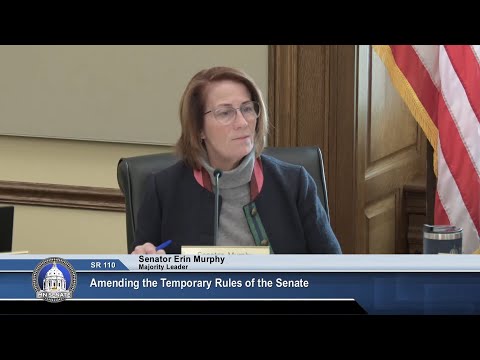
The Minnesota Senate Committee on Rules and Administration voted unanimously Feb. 21 to recommend adoption of amendments to the Senate's temporary rules contained in Senate Resolution SR110-5.
The Minnesota Senate Committee on Rules and Administration voted unanimously Feb. 21 to recommend adoption of amendments to the Senate's temporary rules contained in Senate Resolution SR110-5.
The package, described to the committee by staff member Ms. Stangel, includes a mix of technical edits and substantive changes: it requires that committees permit remote participation by members and witnesses as a regular practice; raises the threshold to recall a bill from committee subject to committee deadlines to 41 affirmative votes of the whole Senate; assigns responsibility for engrossing certain measures to the Secretary of the Senate; and moves and clarifies procedures for ethical-complaint handling and executive-session recordings.
Ms. Stangel, who presented the proposal, told the committee the document is “SR110-five” and that many edits are technical (for example, changing language such as “shall” to “must”) but flagged several policy changes for the panel to consider.
Why it matters: The changes reshape how the Senate will handle hearings, votes and internal personnel processes for the remainder of the biennium. Most prominently, the rule changes make remote committee participation a standing option rather than an exception tied to public-health emergencies or special sessions. The amendments also clarify procedures for posting meeting notices, minute-taking, floor access and decorum, and set out notification and recording rules for the subcommittee on ethical conduct.
Key provisions and committee discussion - Remote participation: The revised Rule 12 separates remote hearing rules for committees into distinct paragraphs for hearings, member participation and witness participation. Committees and subcommittees “must be held in a manner that permits remote participation,” and the draft requires that members be visible when speaking or voting. Witnesses must be able to see and hear members when testifying; witnesses may turn off cameras if they have technology issues. Ms. Stangel said the phrase “Internet connection” was updated to “technology connection.”
- Remote voting: The package amends Rule 40 to allow members to vote remotely with the permission of their caucus leader. The prior limitation tying remote voting to a public-health emergency or special session was removed. The rule also requires remote votes to be recorded in the journal; language that previously prohibited receipt of per diem for remote floor votes was stricken.
- Recalls and thresholds: A new provision establishes that recalling a bill from committee that is subject to committee deadlines requires 41 affirmative votes of the whole Senate; if a committee is not subject to deadlines, a majority of all members suffices.
- Committee notices and minutes: The draft removes requirements to post notices on Senate bulletin boards or the House bulletin boards and instead requires posting on the Senate website with a time-and-date stamp; the ranking minority member of each committee must receive notice before posting or before listserv distribution. Minutes must reflect every action and vote taken.
- Floor access, decorum and demonstrations: Changes reorganize who may be on the floor without individual admission (members, officers and staff) and prohibit demonstrations in chambers and galleries at all times. The chair is charged with maintaining order and decorum.
- Ethics subcommittee procedures: Rule revisions retain the subcommittee’s investigative authority but reorganize provisions. Complaints are to be submitted to the subcommittee chair, who must provide copies to members and the subject; complaints and attachments become public after notice is provided. Executive sessions will not call witnesses or take testimony, sessions are recorded upon a vote of three members, and recordings are only available after final action on the complaint. The rules permit representation by private counsel but state the Senate will not pay for that counsel.
- Other technical and organizational changes: The package references Mason's Manual as the parliamentary authority to be used (the most recent edition); moves duties related to messages and engrossing between rules; clarifies appointment preferences for conference committees (preference, but not requirement, to appoint members who voted yes); and relocates several housekeeping duties to titles and offices appropriate to the Secretary of the Senate.
Questions from members focused on implementation details. Senator Pappas asked whether the change to per diem for remote voting would be retroactive to the start of session; the chair said she would confer with staff and later indicated that the change would be prospective unless otherwise negotiated. Senator Rest and Leader Johnson both praised the bipartisan and nonpartisan work that produced the document and said biometric or other authentication procedures to secure remote voting would be addressed separately this session rather than embedded in the rules.
A procedural motion to recommend passage of SR110-5 to the full Senate was made by Senator Rest and adopted unanimously without further roll-call detail at the committee level.
What the committee did not decide The committee recommended the resolution to the full Senate; the transcript records no final action by the full body. The committee discussed but did not adopt a separate procedure for biometric authentication of remote votes, and the transcript shows members expect authentication details to be handled outside the temporary rules package.
Outlook SR110-5 proceeds to the Senate floor for consideration. If approved by the full Senate, the changes would guide committee process and some floor procedures for the remainder of the biennium until further rule changes are adopted.
AI generated
The text on this page is AI generated. Summaries, highlights, analysis, and video transcripts are all produced from the original source material.
AI can make mistakes, so if you spot one, and we will fix it for everyone.
Note: the source content is unaltered by us. Any content source we link to, be it a video, an audio recording, or a document, is presented exactly as its publisher released it. That publisher is usually a government body, sometimes an individual official or another organisation.