Get Full Government Meeting Transcripts, Videos, & Alerts Forever!
Get email alerts on the Consumer Protection Cfpb topic
No spam. Unsubscribe anytime.
Minnesota lawmakers, attorney general warn dismantling of CFPB will leave consumers exposed
Summary
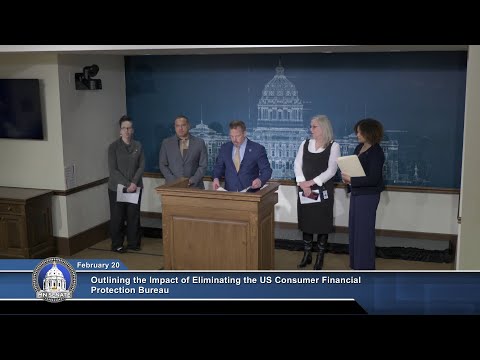
Sen. Matt Klein, chair of the Senate Commerce and Consumer Protection Committee, and Attorney General Keith Ellison told a committee hearing that recent actions disabling the Consumer Financial Protection Bureau (CFPB) risk removing key protections for Minnesotans who use credit cards, mortgages, student loans, virtual currency and bank accounts.
Sen. Matt Klein, chair of the Senate Commerce and Consumer Protection Committee, and Attorney General Keith Ellison told a committee hearing that recent actions disabling the Consumer Financial Protection Bureau (CFPB) risk removing key protections for Minnesotans who use credit cards, mortgages, student loans, virtual currency and bank accounts.
Klein said the CFPB — an independent federal agency created after the 2008 financial crisis — has “returned $20,000,000,000 for over 200,000,000 Americans.” He and other senators said that a recent effort by the federal administration to halt CFPB operations and by outside actors to access agency systems has left a regulatory gap that state offices cannot fully fill. “We cannot let the fox guard the hen house,” Klein said.
Attorney General Keith Ellison told the committee the CFPB performs supervisory work — including subpoena and discovery authority for large, systemically important banks — that the state lacks. “We just don't have the staff to make up the gap,” Ellison said. He added that without CFPB supervision, some large banks could again operate with effectively less federal oversight, a condition he said contributed to catastrophic failures in the past.
Several senators described concrete consumer protections that depend on federal oversight or CFPB rulemaking. Sen. Liz Bolden, who represents Senate District 25, described Minnesota’s 2024 Minnesota Debt Fairness Act, which she said (and which was discussed at the hearing) prohibits unpaid medical debt from being reported to credit bureaus, stops certain automatic transfers of debt between spouses, requires providers to publish collection practices, bans withholding necessary care solely because of unpaid debt, and expands bankruptcy protections. Bolden said the CFPB’s now-halted national rule barring unpaid medical debt from credit reports would have extended similar protections nationwide. “While the Trump administration is dismantling protections for people across the country, in Minnesota…medical debt cannot be reported against people's credit scores,” she said.
Sen. Judy Seaburger, D-Senate District 41, and Sen. Claire Umu Verbaten, assistant majority leader and sponsor of recent student loan protections, warned that CFPB actions imperil pending federal rules on payday lending, overdraft and late-fee caps, and student loan servicing protections. Seaburger cited a 2023 CFPB enforcement action that recouped more than $53 million for consumers in a scam facilitated by a third-party payment processor. Verbaten said state-level law will remain but that enforcement and data collection from a federal agency are critical for holding servicers and lenders accountable.
Committee members asked whether state offices can scale up to replace CFPB functions. Klein and Ellison agreed that state agencies and the attorney general’s office can pursue complaints and litigation but lack the CFPB’s subpoena powers, supervisory authority over large banks, and staffing capacity to replicate the bureau’s nationwide oversight. “They have supervisory responsibilities to delve into certain practices that we do not have the jurisdiction to do,” Ellison said.
Committee discussion also touched on budget implications: Klein said the committee will watch the governor’s Commerce budget closely and will prioritize consumer protection funding where possible.
The hearing included questions about ongoing litigation where the CFPB had been a co‑plaintiff; Ellison said those cases remain active but that the loss of CFPB staff and capacity “has damaged” the ability to pursue document review and other burdens that the agency had been carrying. He said his office would “do the best we can.”
No formal committee actions or votes were recorded during the CFPB discussion portion of the hearing.
The committee recessed after additional questions and moved on to other items on the agenda.