Get Full Government Meeting Transcripts, Videos, & Alerts Forever!
Get email alerts on the Newborn Screening Ml D topic
No spam. Unsubscribe anytime.
Families, clinicians push Minnesota to add MLD to newborn screening panel
Summary
Families who lost children to metachromatic leukodystrophy and University of Minnesota clinicians urged the Legislature to add MLD to Minnesotas newborn screening list, saying early detection enables gene therapy that can prevent irreversible decline. A bill to add MLD has been introduced in both chambers and is awaiting committee hearings.
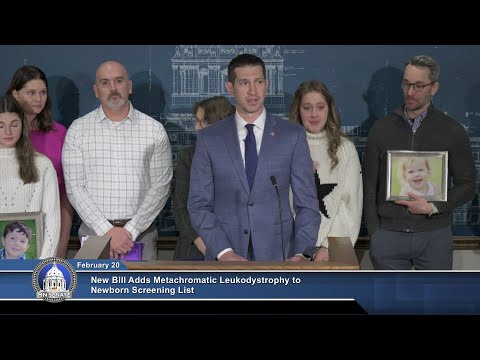
Senator Jeremy Miller and Representative Paul Torkelson joined families and clinicians at a Minnesota legislative briefing to press lawmakers to add metachromatic leukodystrophy (MLD) to the state newborn screening panel, arguing that early detection lets clinicians treat affected infants before the disease causes irreversible decline.
Advocates described yearslong diagnosis delays that allowed children to lose motor and cognitive skills before MLD was identified. "If MLD had been on the panel Gavin's life would have been exponentially different," said Shanna Quimby, whose son Gavin died of MLD at age 5. Clinicians at the University of Minnesota, where gene therapies and specialized care are available, said tests and treatments are now ready for screening.
Adding MLD to the newborn screen is meant to identify infants before symptoms appear so they can receive gene therapy or other early interventions. Dr. Julie Isengard, associate professor and pediatric neuropsychologist at the University of Minnesota, said treated infants demonstrate developmental progress rather than the steady loss of abilities seen in untreated children. "There's no time to wait for an MLD diagnosis that comes because a child has lost skills," she said.
Families at the briefing recounted clinical timelines and interactions with health systems. Nick and Shanna Quimby described repeated pediatric visits beginning in toddlerhood, an MRI showing extensive demyelination on Dec. 20, 2013, and a later confirmed diagnosis. Gavin received a stem-cell transplant in 2014 but continued to deteriorate and died Sept. 8, 2015, at age 5. Laura Elberts described a separate case: her son Thomas was diagnosed after an MRI series and genetic tests that concluded with a positive urine test; the family was told to "go home and make memories." Both parents said earlier detection would have made different treatments available.
Speakers emphasized that MLD screening differs from parental-carrier testing: MLD is autosomal recessive, and carrier status in parents does not guarantee an affected child. At the briefing staff explained that adding MLD would not require extra heel pricks; the condition would be tested from the same dried-blood-spot specimen already used for newborn screening.
Advocates cited prior newborn-screening work in Minnesota. The transcript references the Super GAV Act, enacted after a prior newborn-screening committee process, which added conditions including X-linked adrenoleukodystrophy (ALD), Pompe disease and MPS I to Minnesota's panel. Presenters said MLD was not included in that earlier package because screening assays and treatments were not yet ready; they said both are now available.
Clinicians at the University of Minnesota Masonic Childrens Hospital told legislators the hospital has treated children with early-stage MLD using gene therapy and that those children have shown markedly better developmental outcomes than untreated peers. The transcript reports that the hospital has treated pre-symptomatic or low-symptomatic MLD patients with gene therapy (number given in testimony: 8 children). Advocates said these successes show the value of screening infants so interventions can begin while children are still asymptomatic.
Senator Miller said a bill to add MLD has been introduced in both the Minnesota House and Senate and is awaiting committee hearings in each chamber. Committee consideration and legislative action would be required before the state Department of Health could add MLD to the official newborn-screening panel.
The briefing mixed family testimony, clinical evidence and an appeal to legislative process. Families and clinicians asked lawmakers to schedule committee hearings and to move the introduced bill through the committees that oversee newborn screening and public health. No formal vote or committee action occurred at the event; the bill remained pending at the time of the briefing.
Minnesota's newborn-screening system currently uses a dried-blood-spot panel collected by heel prick; presenters said MLD testing can be done on that same specimen. Advocates urged lawmakers to authorize screening so eligible infants can access gene therapy at centers such as the University of Minnesota Masonic Childrens Hospital. They framed the change as preventive: when infants are treated before neurologic decline, clinicians said, they can preserve the children's development and quality of life.
The families asked legislators to move quickly but noted the bill is in an early stage. Senator Miller and Representative Torkelson described bipartisan support and expressed hope the committees will schedule hearings. The briefing concluded without a formal legislative action; the next steps cited were committee hearings in both chambers.