Get Full Government Meeting Transcripts, Videos, & Alerts Forever!
Get email alerts on the Education Math Pathways topic
No spam. Unsubscribe anytime.
Senate committee hears bill to remove statewide Algebra II graduation mandate, let districts choose math pathways
Summary
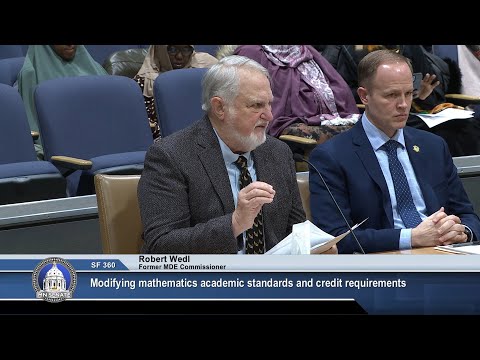
St. Paul — The Minnesota Senate Education Policy Committee on Feb. 19 considered Senate File 360, authored by Sen. Farnsworth, which would eliminate the statewide Algebra II high‑school graduation requirement and allow schools to offer locally designed third‑year math options tailored to students' career and postsecondary plans.
St. Paul — The Minnesota Senate Education Policy Committee on Feb. 19 considered Senate File 360, authored by Sen. Farnsworth, which would eliminate the statewide Algebra II high‑school graduation requirement and allow schools to offer locally designed third‑year math options tailored to students' career and postsecondary plans. The bill also would allow a personal finance course taught by a licensed math teacher to count as the third math credit.
Supporters told the committee the current one‑size‑fits‑all requirement is excluding large numbers of students from meaningful, career‑relevant coursework. “This was the reason that I ran for the Minnesota Senate,” Senator Farnsworth said, introducing the bill and saying the change would give districts flexibility on the third year of math. Scott Fedbrot, superintendent of Browerville Public Schools, said districts already personalize learning and that forcing students into a uniform Algebra II curriculum “does an injustice to our students.” Fedbrot added, “We do not need for every student to have Algebra II.”
Longtime classroom teachers also supported the change. Tony Harkonnen, a retired math teacher who taught Algebra II for many years, said the current Algebra II course is “very, very rigorous” and that many students would be better served by courses in statistics, data analysis or consumer math and by “math for the trades” pathways. Chad Snyder, assistant principal at Hibbing High School, told the committee that applied measurement and math used in trade programs and a personal finance course would better prepare many students for work or technical training.
Testimony opposing removal of the requirement argued it would reduce college readiness and narrow students’ long‑term options. Kristen Hentgen, college and career readiness policy lead at the Education Trust (Washington, D.C.), cited research showing students who take higher‑level math are more likely to enroll in and complete postsecondary credentials and warned that eliminating the requirement would likely reduce the number of students taking Algebra II. Matt Shaver, senior policy director at MetAllies, said lowering statewide expectations risks pushing more students into costly, remedial college coursework.
Speakers debated several data points in testimony: witnesses cited differing proficiency rates on state assessments and national studies, and referenced the University of Minnesota’s admissions requirement that includes four years of math. Supporters said only a minority of jobs require Algebra II in practice and urged counselors to guide students into appropriate math pathways; opponents said Algebra II (or equivalent) remains a recognized indicator of rigor that colleges and competitive careers use in admissions and placement.
Committee members asked whether districts would continue to offer Algebra II and whether the change would leave students who later decide to pursue four‑year STEM programs disadvantaged. Senator Farnsworth said districts would retain Algebra II as an option and counselors should advise students who intend to pursue calculus‑based majors to take the traditional sequence. The bill text would keep a three‑year math requirement but drop the state‑mandated Algebra II course as the required pathway.
After testimony and questioning, the committee laid Senate File 360 over for possible inclusion in the omnibus education bill; no final vote on the bill’s substance was taken.
The committee will review the measure again as omnibus negotiations proceed and as further fiscal or implementation details are developed.