Get Full Government Meeting Transcripts, Videos, & Alerts Forever!
Get email alerts on the Property Tax Reform topic
No spam. Unsubscribe anytime.
Wyoming committee reviews bill to base residential property tax on acquisition value
Summary
Representative David Locke told the Revenue Committee on Friday that House Bill 282 would change how residential property is taxed in Wyoming by using acquisition value—the price paid at purchase—as the base for taxing most homes beginning in 2026.
Representative David Locke told the Revenue Committee on Friday that House Bill 282 would change how residential property is taxed in Wyoming by using acquisition value—the price paid at purchase—as the base for taxing most homes beginning in 2026.
Locke summarized the bill as a three‑phase transition that would rebase older properties to a 2019 baseline, treat purchases from 2020–2025 using that year’s fair‑market calculation as a base, and apply acquisition value with a rebuttable presumption for purchases made on or after Jan. 1, 2026. He said the bill includes an annual escalator capped at 2 percent or the consumer price index, whichever is lower, and carve‑outs for transfers and clearly non‑arm’s‑length transactions. "My view of acquisition value is this is fair market value at time of purchase," Locke said during his presentation.
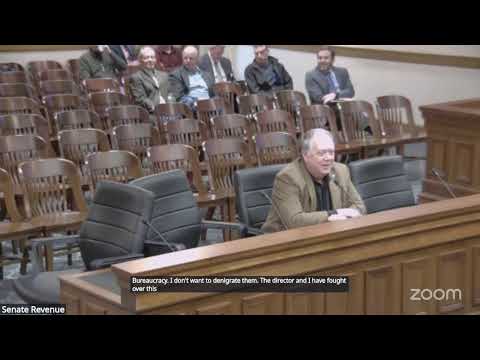
The bill’s sponsor and multiple witnesses framed the change as a move to limit taxation of unrealized capital gains tied to market spikes in recent years. "This bill is not tax relief, and it should not be considered tax relief," Brenda Henson, director of the Wyoming Department of Revenue, told the committee, urging the panel to consider implementation burdens and legal questions before advancing the measure.
Why it matters: HB 282 would alter the basis used to compute taxable value for roughly the state’s entire stock of residential accounts and, according to the Department of Revenue, affects roughly 230,000 properties statewide. Proponents say acquisition value would make annual tax increases more predictable for a homeowner who pays a high purchase price in a hot market; opponents and several state officials said the measure raises constitutional and administrative barriers that could create disparate treatment across taxpayers.
Key provisions and how they would work - Phase 1: Properties last acquired on or before Dec. 31, 2019, would have a base value equal to fair market value as of Jan. 1, 2019, then adjusted forward by the escalator. - Phase 2: Properties last acquired from Jan. 1, 2020, through Dec. 31, 2025, would use the fair market value on Jan. 1 of the year they were last acquired as their base, then be adjusted by the escalator. - Phase 3 (beginning 01/26/2026): For properties acquired on/after Jan. 1, 2026, there would be a rebuttable presumption that acquisition value equals fair market value and that acquisition value would be used as the base year value, except where a preponderance of evidence shows the price was not arm’s length or the data required by clerks/assessors is missing or insufficient.
The bill also includes rules for large additions, transfers (spouse, parent‑to‑child, trust transfers, intra‑entity transfers), and provisions allowing county assessors or the Department to require fair market valuation where acquisition price appears nonrepresentative. Locke described the intent to prevent obvious manipulation (for example, a sale listed at an implausibly low price) and to require stronger statement‑of‑consideration data through clerks and title processes.
Concerns from agencies and assessors - Implementation burden: Director Henson warned that the change is substantial and would not be administrable without extensive rulemaking, changes to the statement of consideration process, and likely computer system work for mass appraisal systems that currently value multiple property classes. She noted the state has roughly 230,000 residential accounts and that only about 7,000 valid open‑market sales nationwide were used in 2023 valuation work (about 3% of residences), emphasizing how limited sales are relative to accounts that must be valued. - Constitutional and uniformity issues: Marty Hartzog, chairman of the Wyoming Board of Equalization, told the committee the bill "on its face ... is unconstitutional" in a respect he said would strip or conflict with the board’s constitutional and statutory role to equalize values across counties. Hartzog said acquisition value is evidence of market value but not necessarily equivalent to market value for constitutional purposes and that adopting the new methodology without a constitutional amendment "would invite a court challenge," because Article 15 requires valuation and taxation to be uniform. - County administration and data limits: Converse County Assessor Dixie Huxtable told lawmakers assessors must be able to separate allocations in a recorded total price (land, structures, personal property, agricultural parcels) and said current statement‑of‑consideration practices and recording processes would need significant revisions; she warned that many buyers or their agents do not respond to assessors’ verification requests now and that the new law would intensify those data‑collection challenges.
Public testimony and committee response - Supporters: Former Representative Mark Jennings, who sponsored earlier versions of acquisition‑value proposals, called the measure a substantive reform to protect homeowners from being taxed on unrealized gains and said constituents have requested change. - Opponents/concerns: Sheridan County resident Gail Simmons urged the panel to delay implementation until passage of a constitutional amendment, saying the acquisition‑value study and prior committee work identified issues that must be resolved before the policy takes effect. Several witnesses cited the October 2023 acquisition‑value study and pointed to California and other states’ experiences as cautionary examples.
Committee action and next steps The committee concluded public testimony and agreed to resume work on the bill at its next Revenue Committee meeting on Monday; no vote was taken Friday. Chairman McEwen closed the hearing by saying the panel would continue working the bill next week and invited further agency and stakeholder input.
Ending note: The hearing highlighted a sharp split between the bill’s stated policy aims—reducing exposure to market‑driven tax spikes for individual homeowners—and substantial legal, technical and administrative objections raised by the Department of Revenue, the Board of Equalization and county assessors. Those agencies urged lawmakers to resolve data‑collection procedures, mass‑appraisal system limits and constitutional uniformity issues before advancing the proposal.
Quotes used in this article are drawn from the Revenue Committee hearing transcript and attributed to speakers who testified or questioned committee witnesses.