Get Full Government Meeting Transcripts, Videos, & Alerts Forever!
Get email alerts on the Education Cte Funding topic
No spam. Unsubscribe anytime.
Senate Appropriations advances bill to earmark high school CTE supplies and equipment
Summary
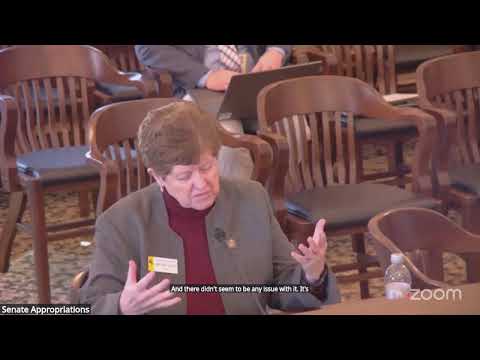
At a meeting of the Senate Appropriations Committee, members voted 3-0 to pass House Bill 235, a measure that would pull the portion of high school career and technical education funding for supplies, materials and equipment out of the general block grant and place it into a categorical grant directed to CTE programs.
At a meeting of the Senate Appropriations Committee, members voted 3-0 to pass House Bill 235, a measure that would pull the portion of high school career and technical education funding for supplies, materials and equipment out of the general block grant and place it into a categorical grant directed to CTE programs.
Representative Andrews told the committee the bill “ensures the career and technical education funding is used as intended to prepare Wyoming students for the workforce,” saying that under the current block grant model some of the funds meant for supplies, materials and equipment “are being used in areas that have nothing to do with CTE.” He told the panel that last year 55.1% of the funds were reported as spent in the intended areas and that “60% of today's job openings in Wyoming require CTE skills.”
The bill, as presented, removes the CTE supplies-and-equipment portion from the block grant and creates a categorical grant. Representative Andrews said the appropriation is “a wash” overall because the state would recapture funds from districts that are above local funding thresholds and then re‑spend those dollars from the school foundation program as the categorical CTE grant. He said the only net increase in spending in the bill reflects the effects of House Bill 18, which amended the block grant model to help small schools; those effects were rolled into HB 235 so the small-school funding change would be preserved if HB 235 becomes law.
Wanda Maloney, speaking with Trent Carroll of the Wyoming Department of Education and representing Superintendent Degenfelder, told the committee the superintendent supports career and technical education and supports including the House Bill 18 effect in the bill. Jessie Dafoe of the Wyoming Association for Career and Technical Education said the data the association and the department track show many districts underspend the CTE allocation: “This table that you have received, everybody in red is what they're underspending. And anybody in green is spending what they're supposed to spend on the model.” Dafoe said the proposal preserves the way districts receive money and would add reporting that confirms funds are used as intended.
Trent Carroll of the Wyoming Department of Education described the fiscal mechanics to the committee. He said the bill is a net wash except for the small-school adjustment tied to HB 18, which he said generates roughly $284,000 per year by ensuring certain small districts receive a minimum of 2 full‑time‑equivalent (FTE) positions. Carroll explained that differences on the fiscal note arise because some districts are recaptured districts: “Instead of them receiving all of their funding through local resources and then sending any amount above that to the state as a recapture, they receive now a CTE grant payment from the state and they send that much more to the state in recapture. So it nets itself out.” Carroll summarized the fiscal numbers in committee: a net decrease shown of $3,800,000 on one line and an increase of $4,600,000 on another, with roughly $100,000 of the latter representing recaptured district payments.
Committee members asked whether expanding the categorical grant to middle school CTE programs — an amendment proposed in an education committee — would be appropriate. Representative Andrews and other speakers said the CTE grant funds are generated by high school CTE enrollment and cautioned that expanding the grant to middle school programs would require separate consideration; one committee member said he planned to ask that amendment be defeated in this chamber and suggested studying the middle‑school question in interim work.
The committee recorded a roll call vote to pass the bill. Senators present and recorded voting “aye” included Senator Garou, Senator Smith and Chairman Salazar; the clerk announced “3 ayes do pass.” The motion to move the bill was made, seconded and then approved on the roll call.
The committee did not act on any further amendments at the meeting. Chairman Salazar said the next Appropriations Committee meeting would be Tuesday and might carry a heavy agenda.
Votes at a glance: House Bill 235 — motion to pass reported out of the Senate Appropriations Committee by roll call, 3 ayes, 0 nays. Outcome: passed by the committee to the next stage.