Get Full Government Meeting Transcripts, Videos, & Alerts Forever!
Get email alerts on the Public Health Budget topic
No spam. Unsubscribe anytime.
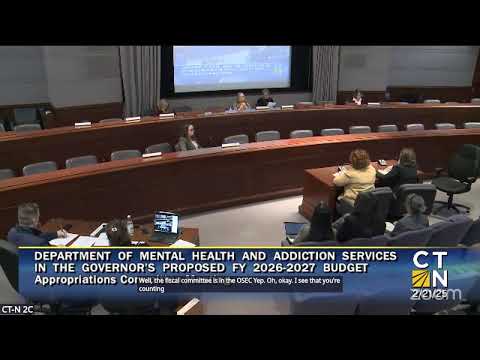
Appropriations panel grills Department of Public Health on cuts to local health district funding, ARPA accounting and 988 expansion
Summary
Deputy Commissioner Lisa Morrissey told the Appropriations subcommittee that the governor’s budget recommends cuts to per‑capita grants for local health districts even though DPH officials requested the funds be maintained, prompting lawmakers to demand detailed accounting of service impacts, ARPA spending and contingency plans for federal funding uncertainty.
Deputy Commissioner Lisa Morrissey appeared before the Appropriations subcommittee to defend the Department of Public Health’s (DPH) budget and to answer questions about proposed reductions to funding for local health districts, ARPA transitions and the 988 crisis line.
Morrissey told the committee: “public health saved your life today and you don't even know it.” She said the governor’s budget under consideration “reflects the need to continue and preserve the great work that we do,” but acknowledged the governor recommended a cut to the per‑capita grants line that DPH had asked to keep level.
Committee members pressed DPH on the local health district reduction and its practical effects. Representative Walker and other legislators said the proposed cut — which Morrissey confirmed is in the governor’s budget, not DPH’s request — risks forcing local departments to curtail services. Morrissey said her team has “been talking to the local health districts” and pledged increased technical assistance, but acknowledged that “supporting them, in conversation or, other means doesn't really support them in funding.”
Why this matters: local health departments provide immunizations, disease surveillance, lead abatement work and other services relied upon by municipalities. Lawmakers repeatedly asked for a line‑by‑line accounting of what services would be lost if grants were reduced.
Other budget issues covered
• Vaccine stockpile: Senator Marks pressed DPH on immunization planning. Miriam Miller, DPH director of policy and strategic initiatives, said the agency “currently have enough vaccines in our stockpile right now that we can utilize that first before we need to purchase additional vaccine.” She added that federal vaccine funding is largely reimbursable and subject to program limits, so the state cannot fully “stockpile” federally purchased vaccine beyond federal program rules.
• ARPA‑funded scholarships and lead abatement: multiple legislators asked for an accounting of ARPA grants for health‑sector scholarships and lead abatement spending. DPH staff agreed to provide a detailed report to the subcommittee of how many recipients and how much was disbursed and whether those activities have been annualized into the baseline budget.
• AIDS prevention and federal uncertainty: lawmakers asked whether cuts to state AIDS prevention lines could force the state to backfill federal reductions. Morrissey and staff said there has been no formal federal notice changing grant levels and that DPH has not identified an immediate adverse impact to federal funding, but the agency agreed to follow up with a briefing for the subcommittee on contingency planning.
• 988/text/chat expansion: DPH described funding to expand text and chat coverage for the 988 crisis line. The witnesses said existing ARPA and federal grant streams helped stand up initial operations and the budget request would cover additional shifts for text/chat services; staff agreed to provide the subcommittee a schedule of ARPA support, its expiry dates and the state costs required to sustain operations after ARPA funds end.
• Gun violence prevention grants and conflict of interest concerns: Senator Summers said three members of a violence‑prevention advisory committee have received grants from the same funding stream and flagged potential conflict‑of‑interest concerns. DPH staff clarified that the committee does not itself decide grantees; the department makes funding decisions, and staff agreed to provide the committee with the list Summers referenced and an explanation of the grant decision process.
• Haven and licensure fee shifts: lawmakers asked about the governor’s proposal to supplement Haven — a program that helps licensed health professionals reenter the workforce after substance or mental‑health issues — using opioid settlement and other off‑budget sources, partly to backfill revenue lost when certain licensure fees are reduced. Miriam Miller described Haven as a nonprofit that receives a partial share of licensure fees; DPH agreed to provide the subcommittee the total Haven budget, how much comes from licensure fees, how many people the program serves and per‑person costs.
What DPH will provide the subcommittee: a) a detailed accounting of local health district grant reductions and what services would be affected; b) ARPA disbursement tables for scholarships and lead abatement, including participant counts and whether funding was annualized; c) a breakdown of the 988/text/chat funding: ARPA/federal support, expiration dates and the state funding needed to continue services; d) documentation on the gun violence prevention grant decision process and the list of grantees flagged by Senator Summers; and e) Haven funding sources, program size and cost per participant.
Ending: Morrissey said DPH will supply the requested materials to the subcommittee. Lawmakers signaled they would revisit the local health district line and ARPA transitions in future work sessions.