Get Full Government Meeting Transcripts, Videos, & Alerts Forever!
Get email alerts on the Micromobility Regulation topic
No spam. Unsubscribe anytime.
Flower Mound council directs staff to draft micromobility ordinance after survey shows strong support for helmet rules
Summary
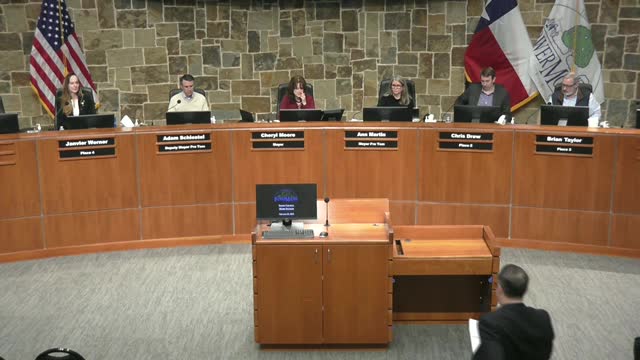
At a Feb. 20 work session, Flower Mound town council asked staff to draft an ordinance proposing helmet requirements for younger micromobility users and restrictions on headphones and cell-phone use, following an 832‑response public survey and a lengthy council discussion about enforcement and education.
Flower Mound town council members agreed Feb. 20 to have staff draft a micromobility ordinance for consideration at a regular council meeting, directing that the draft include a helmet requirement for younger riders and a ban on headphones and cell‑phone use while operating micromobility devices.
The direction followed a presentation of an 832‑response town survey and a public comment urging more safety education. "The time is now to make significant changes that can truly save lives in our town," resident Jessica Trent told the council during public comment.
The survey, presented by Blake (staff) and JP Walton, chief strategic officer for the town, showed broad support among respondents for safety measures. According to staff, 84% of survey respondents supported helmet requirements for children using micromobility devices and about 80% favored requiring helmets at all times, on streets and sidewalks. Other survey results cited by staff: roughly 67% backed including parking lots in an ordinance, 81% opposed headphone/cell‑phone use while operating micromobility devices, and about 65% reported a near miss with a micromobility user in the past six months.
Council members debated scope, enforceability and the proper age threshold. Several council members emphasized education and school‑based outreach while others said an ordinance would give police a legal tool to encourage compliance. Police Chief Coulon told the council that reported crashes involving micromobility users have been rare: "in the last 5 years, we average 1 a year," he said, adding that many incidents are not reported to police and that social‑media accounts may overstate frequency.
Council members discussed whether the ordinance should apply to bicycles; Blake clarified during the presentation that bicycles were not included in the micromobility definition used for the survey but that nonmotorized scooters and similar small devices were included. Council members also considered whether riders should be required to dismount at crosswalks (the survey found about a 53% preference for dismounting) and whether to restrict micromobility use on higher‑speed roadways.
A council member cited a 2022 American Academy of Pediatrics technical report as evidence that helmet laws and enforcement increase helmet usage and reduce head injuries; the council debated how much weight to give education alone versus rules tied to enforcement. Chief Coulon described enforcement in neighboring Highland Village, saying officers there issue few tickets and rely heavily on education and warnings; Highland Village was discussed as a local model for ordinance language.
By the end of the work session, council members directed staff to prepare ordinance language and bring it to a regular council meeting rather than another work session. Council discussion indicated a preference to propose a helmet requirement covering younger riders; several members said they would support an age in the mid‑teens if that made prompt consideration more likely. One stated outcome from the discussion was that staff should draft language reflecting an age of 14 (to be discussed/confirmed at the regular meeting) and include prohibitions on headphone and cell‑phone use while operating micromobility devices. The final scope (for example, whether to explicitly mention parking lots or to state a location‑agnostic helmet requirement) was not settled and will be clarified in the ordinance returned to council.
Next steps: staff will draft ordinance language based on council direction and the survey results and return the draft to the council for consideration at a regular meeting. The council did not vote on ordinance language at the Feb. 20 work session.
Votes at a glance: None taken during the Feb. 20 work session; council provided direction to staff to draft a proposed ordinance for a future regular meeting.