
Committee hears SB124 to create limited licensure pathway for internationally trained physicians
Get AI-powered insights, summaries, and transcripts
Sign Up Free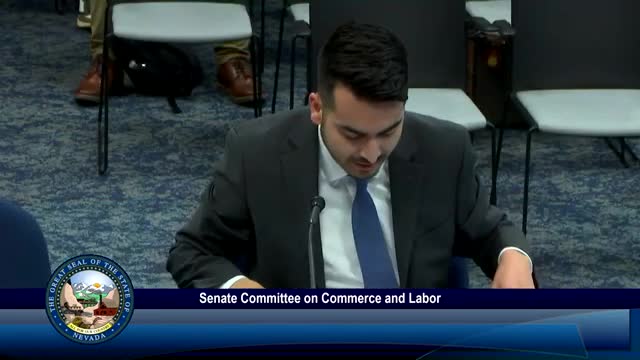
Summary
Senate Committee on Commerce and Labor members heard testimony on Senate Bill 124, a proposal to create a limited licensure pathway for internationally trained physicians to practice in Nevada under a supervised, time‑limited license while meeting U.S. exam requirements.
Senate Committee on Commerce and Labor members heard testimony on Senate Bill 124, a proposal to create a limited licensure pathway for internationally trained physicians to practice in Nevada under a supervised, time‑limited license while meeting U.S. exam requirements.
Proponents told the panel the measure would expand access to primary and specialty care in rural and underserved areas. Senator Donate, the bill sponsor, said the bill would remove unnecessary barriers to licensure for international medical graduates while requiring applicants to hold a valid foreign license, pass U.S. licensing exams and meet good‑character standards. “This bill will remove barriers for limited and unrestricted licenses for international medical graduates,” Donate said during his opening remarks.
Supporters described Nevada’s physician shortage as acute: the sponsor said the state needs roughly 2,600 more physicians to reach the national average; Iris Jones, director of the Governor’s Office for New Americans, said long wait times and shortages hit rural communities hardest. Jones and others told the committee that dozens of internationally trained physicians already live in Nevada and would be available to practice if licensing barriers were reduced. Donate said he and staff have identified about 60 physicians in Las Vegas who could work under the proposed pathway; Jones later referenced 67 individuals in related outreach.
The bill as presented would require applicants to have a valid foreign medical license, pass the same U.S. examinations required of other applicants (the USMLE steps and ECFMG certification where applicable), and work under a Nevada‑licensed physician for a two‑year limited license period before a pathway to unrestricted licensure. The sponsor said an employment offer is currently reflected in the conceptual amendment but that he is open to removing the job‑offer requirement if the committee prefers. He also said the bill contains a “basic fluency” requirement but that he would consider removing it if the committee desires.
Several internationally trained physicians testified in support, many through Spanish interpretation. Dr. Jose Alberto Rodriguez described 14 years practicing internal medicine and infectious disease and said he now works as a medical assistant in Nevada while seeking opportunity to practice his specialty. Other witnesses described experience in geriatrics, rheumatology, oncology, dermatology and general practice and urged lawmakers to allow qualified foreign‑trained clinicians to serve Nevada patients.
Technical witnesses described other states’ approaches. Mike Zimmer of World Education Services summarized that roughly 11 states have enacted similar provisional or limited licensure laws; Washington and Tennessee have begun issuing licenses under that model with initial evidence suggesting many licensees serve in federally qualified health centers, rural practices or teaching hospitals. Zimmer and the sponsor both said most states that adopt these pathways tie limited licenses to service in shortage areas for a defined period.
Opponents cautioned against creating a parallel pathway that could undermine patient safety. Jacqueline Winn of the Nevada State Medical Association said Nevada’s current standard requires three years of U.S. graduate medical education for an unrestricted license and that expanding Graduate Medical Education (GME) slots is the preferred way to increase the physician workforce without lowering training standards. Wolfgang Gilliar, dean of Touro University Nevada’s College of Osteopathic Medicine, testified the state should prioritize expanding residency positions and collaborate with the sponsor rather than create a separate licensing track.
Donate closed by reiterating that the bill maintains U.S. exam requirements, that the limited license includes a two‑year supervised practice period, and that he is willing to negotiate language on the job offer and fluency requirements. The committee took testimony from supporters and opponents before closing the hearing and moving to a separate bill.
The hearing record contains extensive personal testimony from physicians who said they are legally present and licensed abroad but currently work in non‑physician roles in Nevada; supporters argued their integration would improve access, particularly for Spanish‑speaking patients and in rural counties. Opponents consistently emphasized expanding GME slots and preserving standardized residency‑based training as the primary solution for Nevada’s long‑term physician supply.
The committee did not take a vote during the hearing; the matter remains before the committee for further consideration.