Get Full Government Meeting Transcripts, Videos, & Alerts Forever!
Get email alerts on the Board Procedures topic
No spam. Unsubscribe anytime.
Cochise County supervisors weigh formal rules, county administrator role and limits on attorney contact
Summary
At a Feb. 20 work session, the Cochise County Board of Supervisors debated adopting a written rulebook, whether to retain a county administrator position and whether board staff should communicate with the county attorney only through the full board. No formal votes were taken; supervisors agreed to draft rules and schedule follow-up meetings.
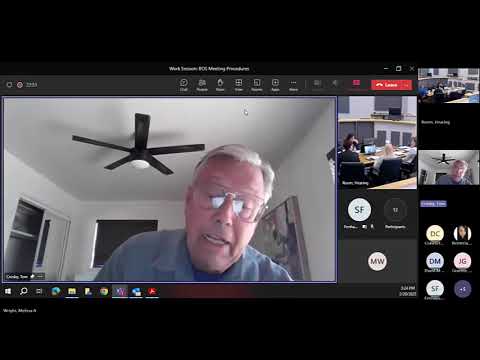
Supervisor Tom Crosby, vice chair of the Cochise County Board of Supervisors, opened a Feb. 20 work session in Bisbee by urging the board to adopt a formal, written set of rules of order and to reconsider the county’s organizational chart and the county administrator role.
Crosby said the county should explore adopting a short parliamentary guide and a rules document modeled on legislative rules so the board has a clear mechanism for enforcing order and for disciplining or temporarily removing a chair who does not follow those rules. "I don't want a county administrator position to exist anymore because that was the cause of all the problems," Crosby said during his presentation.
Why it matters: Supervisors said clearer, written rules could reduce internal disputes and make meetings more transparent for the public. The board discussed several related governance items together: formal rules of order, the county organizational chart (including titles and reporting lines), limits on how board staff interact with the county attorney’s office, and practical enforcement mechanisms if a presiding chair is perceived as overstepping.
Discussion highlights
- Rules of order: Crosby proposed using an abbreviated parliamentary guide as a baseline, with individually numbered rules supervisors could reference (for example, "rule 1," "rule 2") when raising points of order. He said the approach used by the Arizona Legislature — enumerated house rules that members can cite by number — would give the board a straightforward enforcement mechanism. "You rise to the point of order and say, ‘Mr. Chair, I rise to point out a violation of rule number 7,’" Crosby said.
- County administrator and organizational chart: Crosby criticized the current organizational chart, said it contains titles he believes are inappropriate, and repeated his view that the county should not create or retain a county administrator position in a way that would supplant or supervise elected officials. Other supervisors acknowledged the risk of concentrating too much authority in an unelected administrator but also noted the practical role a chief of staff or administrator can play implementing the board’s policies.
- County attorney access: Crosby proposed a policy that "Board of Supervisors staff shall not interact with the county attorney's office except through a meeting with the board of supervisors." He said the proposal responds to past situations where he believes staff or other officials acted without the board’s direction. Board members and the county attorney’s representative discussed the statutory lines of authority while noting that county attorneys also have duties to advise public bodies about legal issues.
- Consent agenda and public speakers: The supervisors discussed how consent agendas affect members of the public who want to speak about multiple items. Crosby said the current practice — allowing a member of the public three minutes per request but treating the consent agenda as a single vote item — can limit speakers who want to address several consent items. Board members described their current practice of pulling items from consent when a supervisor or member of the public requests discussion.
- Enforcement mechanisms: Multiple supervisors said the rules should include a procedure for handling a chair who is perceived to be out of order, such as a temporary removal of the chair by a majority vote and appointment of a temporary presiding officer for that meeting. One supervisor compared the process to a legislature's motion to "vacate the chair" and noted that Robert’s Rules contains similar mechanisms.
Next steps and scheduling
Supervisors agreed to draft a compact set of initial rules in stages rather than adopting a full parliamentary code at once. Each supervisor will prepare proposed rules; staff will combine them for review. The board set a follow-up work session to continue drafting rules and to address job descriptions and the organizational chart. No formal rules were adopted during the Feb. 20 session, and no formal votes or ordinances were taken.
Ending
The board concluded the work session with a plan to circulate drafts and meet again to refine a rules packet and to address the county-administrator job description and reporting lines. Several supervisors said they prefer a staged approach — adopting a small number of core rules first and adding others later — to avoid overly rigid procedural complexity while still creating clear guardrails for conduct and governance.