Get Full Government Meeting Transcripts, Videos, & Alerts Forever!
Get email alerts on the Flood Control topic
No spam. Unsubscribe anytime.
Cochise County flood-control staff outline watershed and recharge projects; staff to seek higher permit fees
Summary
At a Feb. 20 work session, Cochise County Flood Control District Director Jackie briefed supervisors on statutory authority, multiple watershed and recharge projects and planned permit-fee increases; the board heard a motion to set the district tax rate to 0% but no vote was recorded.
Cochise County Flood Control District Director Jackie outlined the district's statutory authority, active watershed studies and recharge projects and told the Board of Supervisors on Feb. 20 that staff will seek higher commercial floodplain and right-of-way permit fees later this year.
The presentation focused on the district's role under state law, a portfolio of design-stage and planned construction projects across the county, and property holdings the district uses for recharge. Jackie said the district is “a separate taxing district” created under ARS Title 48, Chapter 21 and that it administers floodplain permits for several municipalities and unincorporated areas.
The briefing mattered because the district manages money collected from a county tax and because several projects are contingent on grant awards, design completion and intergovernmental agreements. Jackie noted the district will seek to shift more tax revenue from permit-review staff time into on-the-ground projects and said staff will present a fee increase for commercial developments and right-of-way permits to the Board later this year.
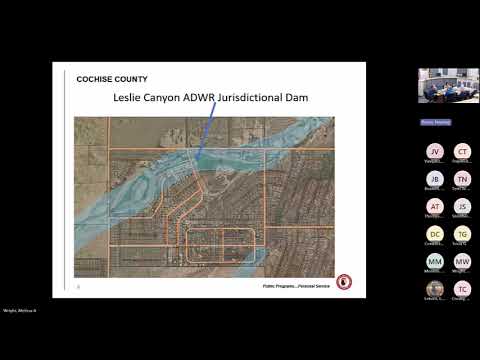
Key projects and funding details presented include: - Pomerene Road: a high-level watershed study budgeted at $250,000 to size culverts and drainage channels. - Wilcox Basin: a Building Resilient Infrastructure and Communities (BRIC) grant study with consultant J.E. Fuller; contract work shown at about $299,000 (grant $250,000; Flood Control District adding $49,000) to examine recharge and dual-purpose flood-control locations north of Interstate 10. - Leslie Canyon Pond: design work (about $219,000) to modify inlet/outlet structures so the pond would no longer qualify as a regulated dam under the Arizona Department of Water Resources; estimated construction cost about $3.5 million pending grants and ADWR approval. - Bay Acres (Douglas area): 60% design complete for a diversion channel and Palm Grove Wash improvements; construction estimated at $15 million; NEPA clearance and right-of-way acquisitions remain. - Coyote Wash: final designs due in April, with estimated construction of about $6.5 million. Funding cited in the presentation included a $1.5 million grant (identified in the transcript as an Army-related award), a $3 million WIFA/WIPA grant and a $1.5 million Governor’s grant.
Jackie described several recharge properties owned or managed by the district, including Bella Vista Ranch (about 2,900 acres), Riverstone (about 1,800 acres) and a 3 Canyons site (roughly 300–475 acres). The Riverstone plan would use treated effluent from the Sierra Vista wastewater plant for recharge; the Palominas site near Palominas Elementary School uses a combination of dry wells and infiltration trenches as a pilot to identify best approaches.
On permitting and revenue, Jackie said staff charges roughly $300 for some commercial drainage reviews now but that those reviews can require substantially more staff time — “it could take us $2,000 of staff time to review their drainage reports” — and said the district plans to propose higher fees to cover review costs and free tax revenues for projects.
During a brief discussion period, a supervisor identified as the chair said he had “made the motion to make the flood control district tax rate 0%” and noted the district reserve balance “last I saw, there was $9,000,000 in reserve.” The transcript records no second or formal vote on that motion during the work session.
The work session concluded with supervisors present (District 1 via Teams, Districts 2 and 3 in person) and no formal board actions reported on project approvals. Next steps noted in the presentation include completing final designs (Coyote Wash expected in April), pursuing grants for construction, completing regulatory approvals (ADWR and NEPA), acquiring necessary drainage easements and returning to the Board with proposed fee changes and right-of-way permit adjustments.