Get Full Government Meeting Transcripts, Videos, & Alerts Forever!
Get email alerts on the Healthcare Definition Abortion topic
No spam. Unsubscribe anytime.
Committee takes up bill to define 'health care' in state law; consideration continued
Summary
Sen. Sherry Steinmetz presented Senate File 125 to insert a definition of "health care" into state rules of construction mirroring the Life Is a Human Right Act; the committee heard public comment and technical amendments and continued consideration to the next meeting.
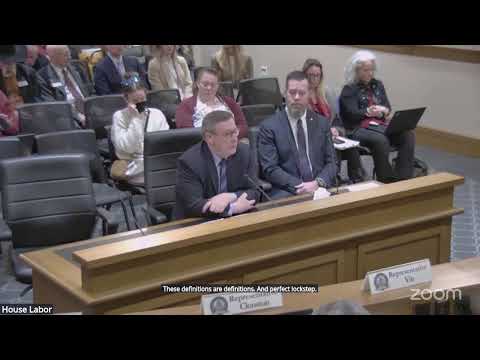
Sen. Sherry Steinmetz introduced Senate File 125 to the House Labor, Health & Social Services Committee, proposing that definitions from the Life Is a Human Right Act be codified in the state’s rules of construction so that specified acts involving an unborn child would be construed as health care only under excluded conditions.
Sen. Steinmetz told the committee the bill is designed as a trigger: it would take effect March 12, 2026, or on the date the Wyoming Supreme Court renders a decision on the Life Is a Human Right Act, whichever is sooner. The sponsor said the text mirrors definitions in the Life Is a Human Right Act, identifies exceptions (including medical treatment resulting in an unintentional injury or death of the unborn, sexual assault, lethal fetal abnormality determinations and molar pregnancy), and explicitly excludes contraception from the definition of prohibited conduct.
Committee members asked procedural and substantive questions. Representative Yen asked why the definitions were placed in rules of construction rather than by restating the underlying statute; Sen. Steinmetz said the placement makes the definitions an overarching rule of construction across state law. Representative Heft asked whether substitute language might provide clearer, enforceable statutory language rather than relying on a statute that has been the subject of litigation; the sponsor said the Senate preferred a trigger approach to avoid affecting the pending litigation.
Public testimony included a range of pro- and anti- measures. Supporters argued the measure clarifies that elective abortion is not health care. Michael Eamon, speaking for the Catholic Diocese of Cheyenne, described training as an EMT and said responders must account for a pregnant patient as two patients and added: “Abortion is not health care.” Several speakers urged more definitive statutory language to define the unborn as a person and to ensure protections would be effective regardless of ongoing litigation.
Legal counsel and outside speakers urged the committee to consider substitute language that would replace definitions now contained in a district court–enjoined statute with legislative definitions that the courts and state agencies must follow. Drake Hill, who addressed the committee during public comment, recommended substitute language to make the statute operative rather than reliant on a lower-court ruling; he told the panel the current bill, as drafted, is ineffective because it relies on definitions in a statute a district court found unconstitutional.
No final vote was taken. The committee adopted a technical LSO amendment inserting a reference to the Wyoming Constitution and made no substantive changes; members agreed to continue the bill and reconvene Monday morning at an earlier hour to allow additional time for discussion and possible drafting of substitute language.
Ending note: Committee members and several witnesses asked for substitute language to be prepared and suggested the Legislature could adopt explicit statutory definitions to avoid reliance on litigation outcomes and to provide immediate enforceable legal effect if that is the committee’s intent.