Get Full Government Meeting Transcripts, Videos, & Alerts Forever!
Get email alerts on the Diversity Equity Inclusion topic
No spam. Unsubscribe anytime.
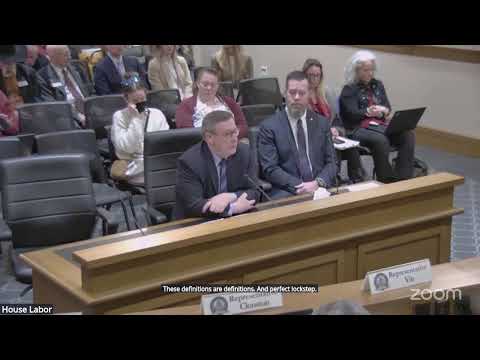
Committee advances bill restricting diversity, equity and inclusion programs in state entities
Summary
The House Labor, Health & Social Services Committee advanced Senate File 103, a bill sponsored in the Senate by Sen. Sherry Steinmetz, that would broadly limit diversity, equity and inclusion (DEI) programs and restrict the use of governmental funds for related activities.
The House Labor, Health & Social Services Committee advanced Senate File 103, a bill sponsored in the Senate by Sen. Sherry Steinmetz, that would broadly limit diversity, equity and inclusion (DEI) programs and restrict the use of governmental funds for related activities.
The bill, discussed in a lengthy committee hearing, would prohibit state governmental entities and public education institutions from using appropriated funds to establish or maintain DEI offices or to require DEI statements or trainings as a condition of employment or academic requirements, with enumerated exemptions for compliance with state or federal law and for federally recognized tribes. Senator Sherry Steinmetz said the intent was to prevent DEI coursework or programs from being mandatory: “it is my intent that that cannot be a mandatory course,” she told the committee.
Supporters told the committee the bill restores a merit-based approach and prevents government-funded programs from prioritizing group identity. Patricia McCoy, speaking for Moms for Liberty Wyoming, called the bill “a strong practical step towards fairness, merit, and fiscal responsibility.” Nathan Winters of the Wyoming Family Alliance said the measure addresses what he characterized as ideological framing in some university coursework and training.
Opponents, including representatives of the University of Wyoming, community colleges, museums and statewide nonprofits, warned the bill as written is overly broad and would unintentionally bar funding for historical exhibits, student services, culturally specific events and required trainings tied to accreditation or federally recognized obligations. Sean Rees, Executive Director of Wyoming Humanities, told the panel: “This bill would prevent us from being able to provide funding for those topics,” and urged changes so museums and historical societies could continue programming about Wyoming history. Mike Smith of the University of Wyoming said the university has already implemented many changes following last year’s budget footnote and called much of the bill “unnecessary” and “not well constructed.”
Committee action changed the bill during the hearing. Members approved an amendment inserting the word governmental to narrow the funding prohibition to governmental entities. The committee also replaced repeated language that had used the phrase “in reference to” related trainings and programs with wording intended to focus on programs that “provide differential treatment or special benefits” on the basis of race, color or ethnicity. Committee members rejected several proposed edits to remove private donations, endowments and other non-appropriated funds from the bill’s scope.
Public testimony represented a wide cross-section of views. Proponents included advocacy and faith groups; opponents included the University of Wyoming, the Wyoming Nonprofit Network, the Wyoming Association of Community College Trustees, and nonprofits that support museums and historical programming. Several speakers urged narrower language to protect tribal cultural work and educational events. The bill already contains explicit exemptions for the Eastern Shoshone and Northern Arapaho tribes, which the sponsor said were added to avoid harming tribal cultural programs.
After debate and multiple amendments, the committee voted on Senate File 103 as amended. The roll call recorded seven votes in favor, one vote against and one excused member; the clerk reported the tally as 7 yes, 1 no, 1 excused and the committee chair declared the bill advanced. The committee also recorded a series of adopted technical and substantive amendments intended to limit the bill’s reach to governmental entities and to clarify that ordinary academic instruction, student organizations and scholarly research were not the bill’s targets.
What's next: Committee members directed the sponsor to find a House member to carry the bill forward. The committee hearing record shows extensive requests for drafting clarifications from universities and nonprofits; some committee members indicated they expect additional amendments if the bill moves to the floor.
Ending note: Multiple witnesses warned the bill as originally drafted risked unintended consequences for accreditation, private fundraising and community historical programming. Supporters said the changes adopted in committee strike a balance by narrowing the funding prohibition to governmental entities while maintaining a ban on compensated DEI offices and compelled DEI statements for public employers and institutions.