Get Full Government Meeting Transcripts, Videos, & Alerts Forever!
Get email alerts on the Data Privacy topic
No spam. Unsubscribe anytime.
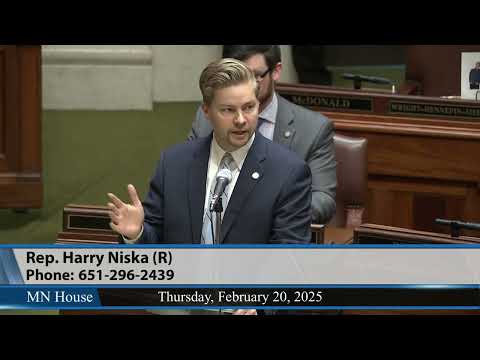
Minnesota House debates bill to narrow attorney general data privacy; House File 20 laid on table after votes
Summary
The Minnesota House spent much of its Feb. 19 floor session debating House File 20, a proposal to change how the attorney general's office classifies certain records under the Minnesota Government Data Practices Act.
ST. PAUL, Minn. — The Minnesota House spent much of its Feb. 19 floor session debating House File 20, a proposal to change how the attorney general's office classifies certain records under the Minnesota Government Data Practices Act. Representative Nyska, the bill's author, said the measure adds "two words" to restore a prior interpretation of the law after a 2022 Minnesota Supreme Court ruling.
"House File 20 is a very small change in the law. Adds 2 words to the Minnesota data practices act," Representative Nyska said in opening remarks, arguing the bill would correct what he described as a mistaken judicial expansion in Energy Policy Advocates v. Ellison and would improve transparency about who influences the attorney general's office.
Supporters said the bill would protect the public's right to know how the attorney general's office is influenced and operated. Representative Nyska also cited staffing numbers in the attorney general's office, saying it was "estimated to have 433.7 FTEs, which is a 34% increase since 02/2019," and that administrative operations are projected at "73.87 FTEs." He said those resources are adequate to handle any classification changes.
Opponents, including Representative Liebling and Representative Greenman, said the bill would jeopardize investigations and chill cooperation from small businesses, farmers and other private parties that provide information in investigations. "This bill puts a big part of that in jeopardy," Representative Greenman said, arguing protected data helps the attorney general build cases on behalf of consumers and workers.
The floor saw several procedural motions about the bill's referral before final action. Representative Cleavorn moved to refer House File 20 to the State Government committee; the motion failed on a roll call, recorded as 65 yays and 67 nays. Later, Representative Stevenson moved to re-refer the bill to the Ways and Means Committee, citing potential fiscal impacts and a missing fiscal note; that motion also failed, 65 yays and 67 nays.
On third reading the body voted on final passage. The clerk recorded a close vote and the bill initially did not pass on final passage; the roll call recorded 66 ayes and 67 nays and "the bill does not pass." Representative Nyska then moved to reconsider the vote; the motion to reconsider passed on a subsequent roll call, 67 ayes and 65 nays. After reconsideration, Representative Nyska moved to lay House File 20 on the table; the chair sustained the motion and it "prevails," ending immediate consideration of the bill.
Debate was highly partisan and lengthy for an opening-session bill. Supporters framed the measure as a narrow transparency fix limited to statutory classification language and tied its origin to the Minnesota Supreme Court decision Energy Policy Advocates v. Ellison. Opponents warned the change would make investigative and complaint materials more likely to become public and harm the attorney general's ability to gather evidence and protect consumers. Representative Liebling said the bill "forces the attorney general's office to give out information that impairs its ability to do its job."
Votes at a glance: - House File 20 (author: Representative Nyska): Third reading vote — initial final passage failed, 66 ayes, 67 nays. Motion to reconsider passed, 67 ayes, 65 nays. After reconsideration the House voted to lay the bill on the table (motion prevailed). Outcome: laid on the table following reconsideration. - Procedural re-referrals approved by voice votes (no roll-call recorded): several house files were recalled from one committee and re-referred to another, including House Files 10005 (referred from Health Finance and Policy to Human Services Finance and Policy), 1065 (from Capital Investment to Taxes), 1093 (Human Services Finance and Policy to Health Finance and Policy), 177 and 178 (from Taxes to Housing Finance and Policy). Those motions were approved on the floor by voice vote.
What the bill would have changed and why it matters
Representative Nyska and supporters characterized House File 20 as restoring the long-standing statutory meaning that protections for "data on individuals" apply only to data that are actually about identifiable individuals, not to broader categories of records that do not implicate personal privacy. They cited the Minnesota Supreme Court decision in Energy Policy Advocates v. Ellison and said that case expanded privacy protections beyond what the legislature intended.
Opponents warned that narrowing the attorney general's ability to classify certain records as nonpublic could expose closed investigative files, complainant information and other materials that businesses and individuals share under assurances of confidentiality. Representatives who spoke against the measure described possible chilling effects for small businesses and farmers that provide information to help state investigations, and they argued the change could hinder multistate litigation and consumer-protection actions.
Where it stands now
Because the House laid House File 20 on the table after reconsideration, the bill is not currently advancing to the Senate or to the governor from this floor action. The author's successful motion to reconsider returned the measure to the floor briefly, but laying the bill on the table prevents immediate passage; sponsors could seek future action under House rules.
Speakers (selected) Representative Nyska — author of House File 20 Representative Cleavorn — moved referral to State Government (motion failed) Representative Stevenson — moved referral to Ways and Means (motion failed) Representative Liebling — spoke in opposition Representative Greenman — spoke in opposition Representative Craft — spoke in opposition Representative Franson — spoke in support Representative McDonald — spoke in support Representative Long — spoke in opposition Representative Scott — spoke in support Representative Nash — spoke in committee-jurisdiction argument Representative Torkelson — responded to jurisdiction questions
Ending
The debate underscored a broader partisan divide over transparency and investigative confidentiality at the state level. Advocates for transparency framed the change as a limited statutory correction; opponents argued it risks exposing sensitive investigative materials and weakening the attorney general's consumer- and antitrust-enforcement work. House File 20 remains laid on the table after the Feb. 19 session, and any further action would require new procedural steps by its sponsors or referral by the House leadership.