Get Full Government Meeting Transcripts, Videos, & Alerts Forever!
Get email alerts on the Budget topic
No spam. Unsubscribe anytime.
Timberlane budget debate centers on proposed $81.9 million operating budget and the risk of staff cuts
Summary
Board and public commenters clashed over Warrant Article 2, a citizen-reduced FY26 operating budget near $81.9 million. District staff warned the trimmed figure would leave a structural shortfall that likely requires cuts to personnel or programs; community advocates said deeper cuts are possible without layoffs.
Timberlane Regional School District trustees and numerous residents spent the February 20 meeting debating Warrant Article 2, a citizen-driven reduction of the 2026 operating budget to roughly $81.9 million and whether the cut could be achieved without reducing staff or core programming.
The issue reached the board during a public-delegate block and in later administrative briefings. Superintendent staff reported they had reached out to eight community members who had proposed line-item cuts; administrators said the outreach yielded four nonresponses, two refusals, one detailed emailed submission and one hourlong phone call. That input yielded about $4.6 million in suggested reductions, primarily from salaries and benefits, lease principal and interest, and capital-improvement-program (CIP) money — short of the $6.6 million reduction the citizen petition used to reach the $81.9 million bottom line.
Why it matters: The district’s administrative staff and several board members told the public that the summed, contracted and required costs for FY26 approach $83 million. At that level, the $81.9 million figure leaves a structural deficit and, according to multiple speakers, would likely require cuts affecting staff, programs or student services.
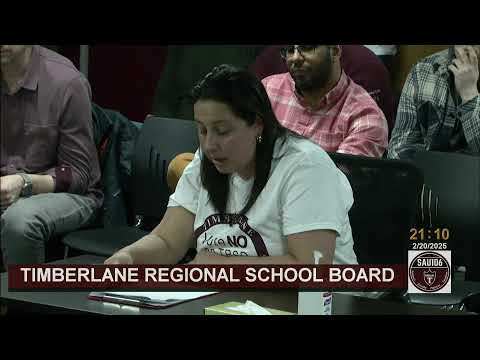
“We ask everyone to, vote no on warrant,” Lou Broad, speaking as president of the Timberlane Teachers Association, told the board during public comment, arguing the citizen-reduced figure “will result in sizable staff cuts” and warned that certified staff must be notified of layoffs by April 15 under state rules. Broad summarized the union’s concern: “This budget will result in sizable cuts that will strain or damage our ability to deliver content, provide services, and offer opportunities.”
Several other residents urged a no vote or said they feared the budget would damage programming and recruitment. Jessica Merrick, a parent, said, “I urge my good neighbors to make a plan to get to the polls and to vote no on Article 2.” Speakers who supported a reduced budget argued that deeper cuts could be found; superintendent staff requested specifics and reported only limited, concrete line-item proposals were supplied in response.
District context and numbers: Administrators briefed the board on enrollment, staffing and contracted services as part of the conversation. Highlights they provided at the meeting include: - Timberlane’s cost per pupil ranks roughly 34th lowest among New Hampshire districts (state data reporting in progress). - Since February 2019 the district has a net loss of about 200 students; since February 2021 it has a net gain of roughly 30 students. - Since February 2018 the district has reduced 35.5 staff positions overall. - As of the board meeting the district reported 20 open or vacant positions (17 posted, three not posted because funding may be used for contracted services). - The district is contracting with 61 individual providers for student services; the administration broke that down to 32 paraprofessional roles, nine speech/language clinicians, five psychologists, seven behavior specialists, three vision specialists, five special-education teachers (including NECC lead teachers) and five additional specialists.
Board and staff responses: The board directed staff to solicit details from members of the public who had proposed cuts, and the administration said it would continue analysis after the March 11 vote. The superintendent told the board the district would convene an internal planning meeting March 12 (the day after the vote) to prepare options for implementation depending on the electorate’s choice. The administration also said it will hold off signing a proposed EEI contract for CIP work until after the vote, per board direction.
What remains open: The March 11 ballot will present voters with the citizen-reduced operating budget (around $81,941,925 as shown on the sample ballot in the packet) and the default budget option (the district’s default was reported at roughly $89 million). Administrators presented sample township tax-rate impacts per $1,000 of assessed value showing both choices would lower tax rates compared with the prior year, but they stressed the operational differences for school programming and staff could be material.
Next steps: The school board and budget committee have scheduled outreach and “office hours” for voters before the March 11 election. If voters approve the citizen-reduced budget, district leaders said they will have to present a plan to address contractual obligations and provide the board with recommended spending and staffing adjustments after the March 12 internal meeting.
Ending: The district’s final course depends on the March 11 vote. Board members and administrators urged voters to review the district’s published budget materials and the outreach results staff compiled before making a decision.