Get Full Government Meeting Transcripts, Videos, & Alerts Forever!
Get email alerts on the Economic Development topic
No spam. Unsubscribe anytime.
House committee hears bill to replenish BDPI grants for Greater Minnesota industrial parks
Summary
Representative Pete Johnson presented House File 335 to restore funding for the Greater Minnesota Business Development Public Infrastructure (BDPI) grant program; city administrators from Hermantown and Fosston testified that past grants enabled large projects and private investment. The committee laid the bill over for further consideration.
Representative Pete Johnson introduced House File 335 to a House committee as a bipartisan measure to restore funding for the Greater Minnesota Business Development Public Infrastructure grant program.
"House file 3 35 is a bipartisan effort to keep the Greater Minnesota Business Development Public Infrastructure Grant Program operating so that it can continue to deliver investments to Greater Minnesota," Representative Pete Johnson said, describing the bill as a request for $2,500,000 per year of the upcoming biennium to support public infrastructure investments that underpin local economic development.
The BDPI program, Johnson said, was created after an effort by the Coalition of Greater Minnesota Cities and enacted in 2003. Johnson told the committee that since 2010 the program has awarded about $75 million through 167 individual grants, creating more than 5,000 new jobs and retaining nearly 10,000.
John Mulder, city administrator for Hermantown, testified by Zoom about a $2,000,000 BDPI grant his city received to support infrastructure at a 40-acre business park site near Duluth International Airport.
"This site is a former EPA Superfund site, which was delisted within the last 5 years," Mulder said. He told the committee the site had sat vacant for decades because of contamination from a former used-oil refinery and that state grant funding was key to attracting private investment. Mulder said the project's projected infrastructure costs exceed $5,000,000, with the state grant at $2,000,000, a $1,000,000 city contribution, and private investment expected between $50 million and $100 million. Mulder said the development would support roughly 200 jobs.
Cassie Hyde, city administrator for Fosston, said Fosston combined a BDPI award with a federal EDA grant to develop a 40-acre industrial park and build 12 lots.
"These funds help keep the lot prices affordable, attracting businesses to Fosston, fostering job creation, and strengthening the local economy," Hyde said. She added that past industrial park expansions in Fosston created more than 100 jobs and that investments in utility infrastructure and housing have followed park development.
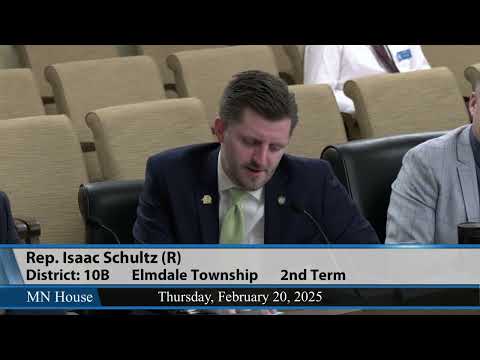
Committee members asked about the requested funding level and geographic reach. Representative Schultz asked how the bill's $5,000,000 figure was derived and whether funds would reach communities outside northern Minnesota. Johnson replied that the bill would provide $2,500,000 per year (a small increase from about $2,200,000 previously) and that the BDPI program is available to all of Greater Minnesota — defined as areas outside the seven-county Twin Cities metro.
Representative Greenman and others praised the program's role in linking infrastructure, workforce and housing needs across Greater Minnesota. No committee member offered a final amendment or motion on the bill during the hearing.
At the close of the presentation, the committee chair said the panel would "lay this bill over for further consideration." There was no final vote on House File 335 during the hearing.