Get Full Government Meeting Transcripts, Videos, & Alerts Forever!
Get email alerts on the Mpca Overview topic
No spam. Unsubscribe anytime.
MPCA director briefs committee on grants, permitting, staffing and federal relationships; lawmakers press timeline and funding concerns
Summary
Tom Johnson, Government Relations Director for the Minnesota Pollution Control Agency, outlined MPCA structure, funding sources, recent grant spending and rulemaking priorities. Lawmakers pressed the agency on staffing, permit timelines, odor rulemaking and reliability of federal grants, including Inflation Reduction Act funds tied to the Climate
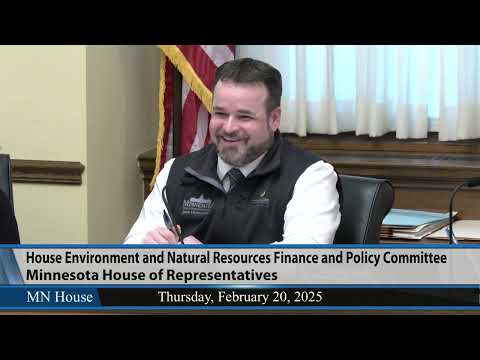
Tom Johnson, Government Relations Director for the Minnesota Pollution Control Agency, gave the Environment and Natural Resources Finance and Policy Committee a broad overview of the agency’s structure, recent grant activity, permitting work and rulemaking priorities and answered extensive member questions about staffing, federal funding and timelines for odor and cumulative‑impacts rulemaking.
Johnson described the MPCA’s mission “to protect and improve the environment and human health,” and summarized the agency’s core programs — water, air, land, remediation and climate — and the federal laws MPCA implements, including the Clean Water Act, Clean Air Act and the Resource Conservation and Recovery Act. He said the MPCA also executes state laws and rules (MPCA referenced Minnesota statutes governing chapters commonly cited for water pollution control, solid waste, remediation and air permitting) and has formal delegations and reporting responsibilities to the U.S. Environmental Protection Agency on many permits.
Grants and funding: Johnson told the committee the MPCA has issued more than $400,000,000 in grants over the last two bienniums and highlighted several large, recent federal and state awards. He identified a $200,000,000 Climate Pollution Reduction Grant (CPRG) award under the Inflation Reduction Act that the state is managing across agencies; a $100,000,000 climate‑resiliency grant program that the MPCA has awarded or placed under requests for proposals; and noted the Clean Water Fund provides roughly $25,000,000 per year to agency work (Johnson spoke of that fund as an important, separately appropriated source). The MPCA also described grant examples that reached communities statewide, including recycling and composting upgrades and refrigerator equipment replacement at a grocery store in Thief River Falls.
Permitting and staffing: Members asked about whether recent appropriations led to increased MPCA staffing and whether that staffing has reduced permitting timelines. Johnson said roughly 60 positions have been hired in recent years and most are filled, and he credited staffing increases and new community‑affairs teams with improving permit responsiveness. He told lawmakers Minnesota’s approach often involves significant technical assistance to applicants; by contrast, he said some neighboring states return incomplete applications more quickly and require applicants to resubmit a complete package. That difference, Johnson said, affects Minnesota’s permit timelines because MPCA staff often work with applicants to refine designs and emissions calculations during review.
Rulemaking and enforcement priorities: Johnson summarized MPCA priorities including continued PFAS work under Minnesota’s PFAS Blueprint, climate action and resiliency, and several major air rulemakings: cumulative impacts, air toxics and an odor rule. On odor rules specifically, Johnson said the agency completed a literature review and began rule development in January 2025 with an “intent to adopt” in early fiscal year 2027. He told the committee MPCA staff are concentrated on those three major air rulemakings and that the same small team of air-quality specialists must advance them.
Federal relationships and grant reliability: Members pressed the MPCA about its relationship with EPA and with other federal actors such as the U.S. Army Corps of Engineers. Johnson explained that EPA delegates many authorities and may review or comment on state-issued NPDES and major federal permits; EPA can also enforce directly in some cases. He said the MPCA has at times had to obtain additional information requested by EPA (citing a recent foundry review) and has improved complaint‑tracking and municipal coordination. On federal grant reliability, Johnson said the state has encountered unpredictability drawing down some Inflation Reduction Act funds and that large federal grants are reimbursement‑based — which complicates starting big programs if reimbursement is uncertain.
Member concerns and follow up: Lawmakers asked for additional detail on staff counts, how federal‑delegated permit reviews can create delays, how many communities have received climate‑resiliency grants, and the status of the MPCA’s complaint-tracking system. Johnson said the agency will follow up with more specific data on award/encumbrance/expended status for major grants, and reiterated that MPCA is committed to improving transparency, faster permit processing where possible, and continuing to work with municipalities and federal partners.
Ending: The committee closed after additional questions about electric school buses, staffing arrangements, and MPCA’s contingency planning for a potential state budget shortfall. Johnson said he would provide requested follow‑up information to the committee on staffing numbers, grant status, and other details.