Get Full Government Meeting Transcripts, Videos, & Alerts Forever!
Get email alerts on the Property Tax Fiscal Shift topic
No spam. Unsubscribe anytime.
Minnesota counties tell House tax committee governor’s budget could shift roughly $200 million in costs to local property taxpayers
Summary
Representatives of Minnesota counties told the House Tax Committee that the governor’s proposed budget would shift about $200 million in costs to counties when fully phased in, potentially driving levy increases in multiple counties and eroding the state'local fiscal balance.
County officials told the House Tax Committee that the governor's proposed budget would shift roughly $200 million in costs to counties when fully phased in, and that the resulting expense would largely appear as higher property tax levies for residents.
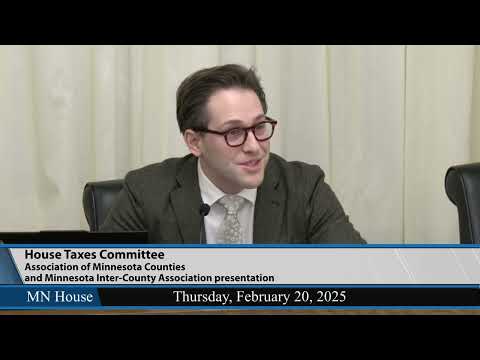
At a full committee hearing, Matt Hilgert of the Association of Minnesota Counties (AMC) and Nathan Jessen of the Minnesota Inter-County Association (MICA) described county responsibilities in administering property taxes and gave examples of how the budget proposal could affect individual counties.
"An important reminder that market value increase, don't necessarily equate to the same property tax increase," Hilgert said, explaining that value changes, levy decisions and exemptions interact in ways that can mute or magnify homeowner tax bills.
Why it matters: counties are the primary local administrators of property tax assessment, notices and collections in Minnesota, and many county responsibilities'from public health to child protection to roads'are funded in large part by property tax levies. County advocates urged the committee to consider downstream effects before adopting changes that alter classifications, exclusions or benefit one group of taxpayers.
County role and timeline
Hilgert and Jessen summarized the county role: assessors classify property, calculate rates, mail valuation statements and collect taxes for multiple taxing jurisdictions, including cities, school districts and the state general property tax. They reviewed the two-year property tax timeline: valuation notices (March of year one), appeals, preliminary levies (September), and final levies (December), with final tax statements arriving the following March.
Market trends and distribution effects
Presenters described recent market patterns that complicate tax messaging. Hilgert and Jessen said seasonal-recreational properties and lakeshore parcels have posted steep value gains since the pandemic (they cited an example where per-square-foot lakefront values rose from about $4,800 in 2014 to $12,000 in 2024 in a Cass County lake market). They also noted that apartment values were down modestly in the most recent assessment year while commercial and industrial classes vary by county.
They emphasized distribution effects: in a hypothetical four-home community with a fixed levy, one property'if it rises faster in value or receives an exclusion'can shift the tax burden among neighbors even when the total levy is unchanged.
County Program Aid and fiscal history
Jessen and Hilgert traced decades-long changes in County Program Aid (CPA), saying purchasing power of CPA has fallen since the mid-2000s and noting the 2017 and 2023 legislative actions that partially addressed volatility. They said a recent infusion of $80 million in CPA produced roughly a 30% increase for almost every county, but overall aid remains far below earlier real (inflation-adjusted) levels in many places.
Examples of county-level impacts under the governor's proposal
The presenters described county-by-county estimates produced from recent county surveys and staff modeling. They said the Department of Revenue'level revenue estimates show a total state/county property-tax interaction of roughly $200 million biennially when fully phased in. Specific county examples cited by presenters:
- Dakota County: roughly $11.5 million in new local costs and an estimated 7% automatic levy increase when certain components are fully phased in (presenters said 10.5 of the $11.5 million related to a 5% disability waiver cost-shift). - Anoka County: about $8 million in new liability, roughly a 5% levy increase, an amount presenters said would exceed that county's recent CPA boost. - Beltrami County: described as "tax base poor" with a large share of tax-exempt land and substantial service needs; presenters estimated a potential 9% automatic levy increase and warned of limited local ability to absorb new burden. - Ramsey County: presenters cited roughly $17.8 million in levy pressure from several components identified in the governor's package (including disability-waiver shifts and behavioral health funding changes), which they described as an estimated 4.7% levy increase. - Fillmore County: an estimated $1.1 million in new costs, many times its 2023 CPA increase, according to presenters.
Presenters told the committee these county estimates do not include additional levy pressure from routine inflation drivers such as health insurance increases or collective bargaining cost-of-living adjustments.
Mandates, program funding and systems modernization
Hilgert and Jessen urged the committee to consider implementation resources for several recent policy changes. They said a high-priority ask from counties is resourcing for the African American Family Preservation Act (AAFP Act), passed in 2024, which introduces "active efforts" requirements for child welfare and will require training, staff and systems support if implemented statewide. Presenters warned that some counties estimate AAFPA-related levy pressure in the single-digit to mid-teens (percent) range depending on county size and local assessments.
They also urged state funding to modernize legacy systems used by counties for human services casework. They described the SSIS (child protection) and MaxIS/"green screen" systems used to administer benefits as antiquated, fragile and a driver of staff turnover: "We are still using [a] DOS-based system," Hilgert said, and presenters recounted county staff describing hours lost to slow screens and the so-called "wheel of death" in child-protection intake.
Assessor safety and limited market-value proposals
Presenters said assessor safety has become a rising concern and asked the Department of Revenue to consider flexibility for in-person inspection requirements, noting technological alternatives (satellite imagery, photography) that could reduce assessor exposure in hostile encounters.
They also warned against limited market value caps and other partial freezes, arguing such rules create long-term distortions across classification buckets and can shift tax burdens in ways that are difficult to reverse.
Court case and renter impacts
Jessen cited the Alliance v. Hennepin County court matter (a Minnesota Supreme Court issue raised last year) and said the Department of Revenue'level proposals addressing that ruling mitigate direct tenant tax bills but still risk shifting benefits and affecting renters' eligibility for the renters' credit.
What the presenters asked for
County representatives asked legislators to: (1) beware of policies that erode the tax base or shift costs to other property owners; (2) fund implementation for any new mandates (especially AAFPA); (3) restore or index CPA and other aids to maintain stability for counties; and (4) invest in systems modernization and workforce supports for human services and child-protection staff.
The hearing included extended question-and-answer with committee members; no formal votes or bill actions were taken during the session.
Ending: The committee invited additional technical follow-up and then heard the League of Minnesota Cities for a related presentation.