Get Full Government Meeting Transcripts, Videos, & Alerts Forever!
Get email alerts on the Higher Education Budget topic
No spam. Unsubscribe anytime.
U of M budget directors outline $235 million O&M request, riders and campus priorities for the legislature
Summary
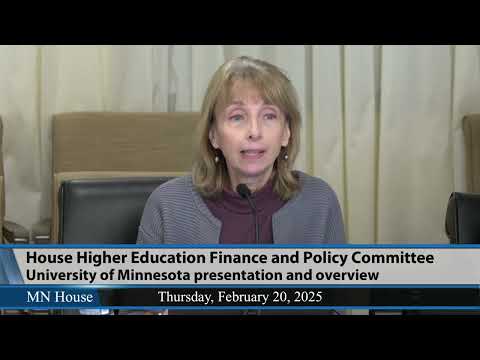
Julie Tonneson, the University of Minnesota's budget director, and President Rebecca Cunningham told the House Higher Education Finance and Policy Committee on Feb. 25 how state O&M, state special appropriations and tuition interact in the university's all‑funds budget and presented a biennial O&M request totaling $235 million across the biennium.
Julie Tonneson, the University of Minnesota's budget director, and President Rebecca Cunningham briefed the House Higher Education Finance and Policy Committee on the university's all‑funds budget, the distribution of state appropriations and a biennial operations and maintenance (O&M) request totaling $235,000,000 across the biennium.
Tonneson summarized the university's FY25 all‑funds budget, noting the board approved an estimate of about $4,800,000,000 in total revenues and explaining that the university uses fund accounting to track restricted and unrestricted revenue streams. She described three major buckets: restricted sponsored and donor funds, self‑supporting auxiliaries (housing, dining, athletics) and unrestricted funds, with the state O&M appropriation and tuition forming the largest unrestricted sources.
Tonneson walked committee members through several state appropriations and riders from the 2023 session (Chapter 41). She identified the College of Science and Engineering state special that supports the Minnesota Geological Survey (state special cited as $846,111) and the Talented Youth Mathematics Program (roughly $293,890). She said the system special appropriation listed on the university spreadsheet totaled $9,181,000 across FY24 and FY25 and highlighted system allocations to the Center for Urban and Regional Affairs ($985,496), the Bureau of Business and Economic Research at UMD ($39,211), Carlson School labor education services ($777,533) and the Humphrey School public engagement allocation ($91,942).
Tonneson also described riders within the O&M appropriation. She said the Morris campus provides approximately $4,100,000 in American Indian tuition waivers this academic year; of that, roughly $1,000,000 is covered by a new American Indian scholarship program and $500,000 is accounted for in the appropriation rider, leaving about $2,600,000 covered by the university's general O&M allocation. Tonneson said the new unemployment insurance reimbursement rider produced roughly $368,000 in reimbursable payments during summer 2024 for employees in 9‑ and 10‑month appointments. She also summarized the new menstrual product statute and associated funds (transcript cited $374,000 in FY24 and $110,000 ongoing) and said campuses proportionally allocated the funds to purchase dispensers and stock products.
Tonneson outlined the university's internal budget process: the board and president set the high‑level framework, the budget committee issues instructions to 51 responsibility center units (RRCs), and units return proposals that the central officers iterate into a recommended balanced budget. She explained that much of the O&M appropriation is allocated to academic units and that the university uses internal cost pools to charge academic units for central support services.
Cunningham framed the O&M request as a partnership with the state to "maintain excellence," citing market pressures on compensation and a need to address deferred maintenance and new operating costs for campus facilities. The university's "core mission" portion of the request seeks recurring investments for compensation and ongoing costs (Tonneson said the university is asking for roughly $120,000,000 of the total $235,000,000 to meet a share of projected needs; the larger $235M figure is the total need identified). She said the board and university will pursue additional revenue from tuition, grants and internal reallocation to cover the remainder.
Colleen McDonald of Boynton Health presented a student‑experience component of the request, saying data show substantial basic needs and mental‑health needs among students: "1 in 4 students system wide reported that food insecurity impacted their academics and 1 in 3 students system wide experienced housing insecurity," she said. McDonald asked for investments to expand food‑security programs, hire basic‑needs coordinators, and increase counseling and psychiatric capacity across the system. The student‑experience request also includes funding for academic supports and career‑readiness services.
Representative Wagner asked for an update on the PEAK Initiative, the university's efficiency project. Cunningham said the university has completed phase 1 and begun phase 2 of 4, and that it is too early to identify net savings from the effort. Committee members asked for detailed follow‑up on specific riders and state special allocations at upcoming hearings; Tonneson said the university will return for additional hearings on the public safety, health‑science and agriculture and research appropriations and provide more granular detail.
The committee took no final vote on the budget request during the hearing; university officials will return for additional briefings in the committee's next scheduled sessions.