Get Full Government Meeting Transcripts, Videos, & Alerts Forever!
Get email alerts on the School Funding Safe Schools topic
No spam. Unsubscribe anytime.
House education committee adopts technical amendment to bill merging Safe Schools and student-support aid; lays bill over
Summary
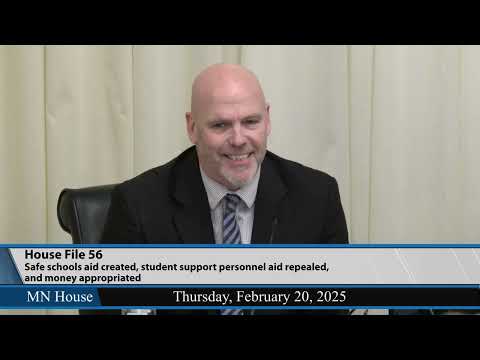
The Minnesota House Education Finance Committee on Feb. 20 considered House File 56, a bill to combine the Safe Schools Revenue Program and the Student Support Personnel Aid into a single program; a technical amendment was adopted and the committee laid the bill over for possible inclusion in an omnibus bill.
ST. PAUL, Minn. — The Minnesota House Education Finance Committee on Feb. 20 considered House File 56, legislation that would combine two K–12 funding streams — the Safe Schools Revenue Program and the Student Support Personnel Aid — into a single Safe Schools Revenue Program while leaving total funding unchanged.
Supporters, including the bill sponsor and two school superintendents, said the change would give districts more flexibility in spending restricted state dollars. Opponents and several student and mental-health advocates warned the consolidation could weaken dedicated funding for counselors, social workers and other school-based mental-health supports unless statutory protections were preserved. The committee adopted a technical A1 amendment and laid the bill over for possible inclusion in a later omnibus bill.
Nonpartisan staff described the bill’s mechanics to the committee. Tim Strom, a nonpartisan committee staffer, said the bill "combines 2 programs" and that total funding would remain the same, showing a current district-level safe schools levy authority of $36 per pupil and an overall combined per-pupil amount of $48.73 under the proposal. Strom told the committee that the existing minimum payments in the student-support program — $40,000 for small districts and $20,000 for charter schools — remain part of the distribution in practice and that districts that participate in cooperatives have separate cooperative allocations.
Representative Shane Lawrence, the bill’s sponsor, moved House File 56 and then moved the A1 Amendment, which he described as "just a technical amendment" removing or revising a few words. The committee approved the A1 amendment by voice vote; no roll-call tally was recorded on the floor. After hearing testimony the committee chair "laid over House File 56 as amended for possible inclusion into a later omnibus bill." (The committee’s formal action was to lay the bill over; no final passage or appropriation was taken.)
Superintendents who testified said current restrictions on student-support dollars can prevent districts from meeting local needs. Ben Barton, superintendent of Princeton Public Schools, told the committee his district serves about 3,300 K–12 students and additional early-childhood children and argued the proposal would "give flexibility to school districts." Barton described a practical example: student-support personnel aid in the past came with eligibility limits that, in his view, forced districts to seek a licensed school nurse (LSN), a role he said can cost about $100,000 a year and is hard to recruit in rural Minnesota. Barton said a $40,000 allocation with strict licensing rules could not, by itself, support hiring an LSN and therefore limited districts’ ability to use the money to meet health needs locally.
Nate Rudolph, superintendent of Cambridge-Isanti Schools, said his 5,000-student district shares the view that flexibility is the principal benefit but urged the committee to clarify that no district would experience a net loss of funding if the student-support aid statute is repealed and absorbed into the Safe Schools program. "Our primary concern is that the repeal of the student-support personnel aid ... may receive less total funding than currently allocated under existing law," Rudolph said, asking the committee to "ensure that districts do not experience a net loss in funding now or into the future." Representative Lawrence and nonpartisan staff said the bill’s technical presentation shows there are no net reductions in total dollars as drafted.
Mental-health advocates, school social workers and students urged preserving or increasing dedicated support for counselors, social workers, psychologists and nurses. Caitlin Schneider of Education Minnesota said data show the two strongest predictors of academic success are "stable housing and 1 strong relationship with someone in the school," and urged lawmakers to "do not defund mental health services and licensed personnel in your district." Multiple student testifiers described how school-based counseling and social work services affected their daily school experience; a student, Hannah Heine of Edina High School, told the committee that "knowing that those counselors are there for you ... is absolutely really important." Several licensed social workers and school counselors emphasized that their roles differ from security measures and that merging funding streams could reduce access to clinical services.
The Minnesota Department of Education raised technical concerns. Sami Bridal, assistant director of government relations at MDE, said the department was worried by a lack of clarity around unspent district carryover funds from fiscal 2024, potential validation and accounting issues if cooperative allocations are changed, and additional administrative costs for MDE to recode and update systems if the student-support aid is transformed into Safe Schools aid. Bridal noted the governor has proposed separate modifications to the distribution for cooperatives.
Committee members pressed for assurances. Representative Cheryl Bennett asked the sponsor to point to specific bill language that would cut funding; Lawrence and nonpartisan staff reiterated the sponsor's intent and the staff analysis that the consolidation is intended to leave total funding unchanged but to provide districts more flexibility. Other members voiced a "both-and" approach, saying they want more resources overall while also making funds easier to use locally.
The committee recorded no final appropriation or program change at the meeting. The chair laid over the amended bill for possible inclusion in a later omnibus bill, meaning House File 56 could return as part of broader budget negotiations. Lawmakers and testifiers said they expect continued discussion on safeguards to protect student-support personnel positions and on technical details about carryover and cooperative distributions.
The committee also heard unrelated forecast and nonprofit briefing items at the same hearing; those discussions were procedural and informational and did not change the status of House File 56.