Get Full Government Meeting Transcripts, Videos, & Alerts Forever!
Get email alerts on the Research Funding topic
No spam. Unsubscribe anytime.
U of M officials tell House committee NIH indirect‑cost cuts would 'gut' research and threaten jobs
Summary
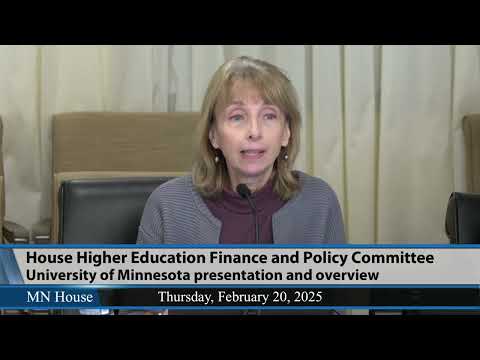
University of Minnesota President Rebecca Cunningham and budget staff told the House Higher Education Finance and Policy Committee that a proposed reduction in federal indirect cost rates would sharply reduce the university's overhead revenue, impair research capacity and could cost jobs and graduate training positions.
President Rebecca Cunningham told the House Higher Education Finance and Policy Committee on Feb. 25 that proposed cuts to federal indirect cost (IDC) reimbursement rates — particularly from the National Institutes of Health — would sharply reduce the University of Minnesota's research capacity and threatened jobs and graduate training.
"Our current negotiated rate is 54%. If that were to move to 15% it would be an immediate cut of between 101 hundred and $30,000,000 to the university next year," Cunningham said, adding that such a reduction would "gut our ability to do biomedical discovery research" and hinder the university's ability to provide equipment, buildings and utilities needed for lab work.
Cunningham said the university brings a large volume of federal research dollars into Minnesota and that the indirect costs reimburse the infrastructure — facilities, libraries and departmental administration — that make sponsored research possible. "You can't fund individual researchers if you don't fund the equipment that they need to do the work on or the buildings they need to work in," she said.
Julie Tonneson, the university's budget director, clarified how that potential cut would show up in the institution's one‑year budget line items. She pointed the committee to the university's anticipated indirect cost recovery (ICR) revenue for FY25 of about $236,000,000 and said a $100,000,000 reduction would reduce that line to roughly $136,000,000. Tonneson warned that over time the direct grant expenditures the university can accept — listed on the budget as roughly $830,000,000 of multi‑year sponsored spending for FY25 — would also decline if overhead reimbursements fall.
Committee members pressed for specifics about downstream effects. Representative Wolgamott said he was "very concerned" about an NIH reduction and asked for detail on how a $150,000,000 estimate of loss would affect the budget. Cunningham and Tonneson both said they were working to model impacts. Cunningham emphasized potential job losses, noting that "thousands" of university employees are funded on federal grants and that some universities have already begun cutting graduate student intake in response to federal uncertainty.
Several members asked the university to provide written analyses of the projected effects. Representative Wolgamott asked for information in writing about impacts on research, development and jobs so the legislature could assess policy options.
The committee's discussion did not include any committee action on federal policy; members instead requested more detail and signaled interest in collaboration to oppose harmful federal cuts. The only formal action taken during the hearing was approval of the committee minutes from Feb. 18 by voice vote at the start of the session.