Get Full Government Meeting Transcripts, Videos, & Alerts Forever!
Get email alerts on the Childcare Health Coverage topic
No spam. Unsubscribe anytime.
House Health and Government Operations committee hears bills on childcare health coverage, CCRCs, hospice restraints, nursing home transparency, OTC birth‑contr
Summary
The House Health and Government Operations Committee met for a multi‑bill hearing that included proposals on childcare health coverage, governance at continuing‑care communities, hospice‑era restraints in assisted living, nursing‑home spending transparency, OTC birth‑control coverage implementation, formation of a health‑insurance oversight commission, notice and preventive‑service protections and a genetic‑testing privacy proposal.
The House Health and Government Operations Committee met for a bill‑hearing session that covered multiple health and long‑term‑care matters, including proposals on access to health insurance for childcare professionals; governance at continuing care retirement communities; hospice‑era use of restraints in assisted living; transparency of nursing‑home spending and direct‑care wages; a state collaborative to improve implementation of over‑the‑counter (OTC) birth control coverage; a standing commission to track health‑insurance changes; improved notice rules for coverage cancellation; codifying preventive‑service protections; and a proposal to bar insurers from using genetic test results in life, long‑term care or disability underwriting.
The committee chair, Jocelyn Pena Melnik, convened the hearing and said the session would be handled as a series of bill presentations with panels of in‑person and virtual witnesses. Several bills drew extensive panels of provider groups, labor and patient advocates, agency representatives and industry witnesses, and most items concluded with a request that interested parties continue negotiating specific language before subcommittee consideration.
Why this matters: the proposals span workforce supports, resident protections at eldercare settings, consumer protections around insurance administration, and potential changes to how underwriting information may be used. Committee members repeatedly emphasized the need for more data and for negotiated technical fixes before formal votes so the proposals can be sent to subcommittee with agreed‑upon language.
Key bills and what happened
House Bill 859 — Access to health insurance for childcare professionals: Delegate Solomon sponsored legislation that would create pathways for family and independent childcare providers to access health coverage either by qualifying as a satellite organization for the State Employee and Retiree Health and Welfare Benefits Program or by directing the Maryland Health Benefits Exchange and Maryland State Department of Education (MSDE) to coordinate navigator‑type outreach and shared‑services hubs to help providers enroll in existing coverage programs. Testimony in favor came from Maryland Family Network, the Maryland State Child Care Association, SEIU Local 500 and dozens of family childcare providers who said low pay and lack of benefits are driving provider attrition. Agency witnesses (Maryland Benefits Exchange, MSDE and Department of Budget and Management) flagged cost and federal‑law issues related to adding non‑state employees to the state plan; sponsors and advocates said outreach through the Exchange and hub model could be a near‑term, lower‑cost approach. Committee members asked the sponsor to continue technical work with DBM and MSDE; no formal committee vote was recorded at the hearing.
House Bill 938 — Continuing care retirement communities governing bodies membership: Sponsor Delegate Stein presented a compromise bill, supported by the Maryland Continuing Care Residents Association and providers, that would require each CCRC that names a single resident (subscriber) to also appoint an alternate subscriber who may attend all board meetings and vote when the regular subscriber cannot serve. Providers and resident advocates supported an amendment to delay the effective date to January 1, 2026, to allow bylaw changes. The committee offered no immediate vote; proponents asked the bill be sent to subcommittee with the agreed amendment.
House Bill 828 — Rights of assisted‑living residents receiving hospice comfort care: Delegate Kipke offered legislation to clarify that when an assisted‑living resident is enrolled in hospice, certain orders by the hospice clinical team (including limited use of some protective devices or medications to ensure comfort at end of life) should be recognized in assisted‑living settings without triggering regulatory deficiencies for providers. Lifespan Network and hospice advocates supported the bill with amendments to place the provisions in the assisted‑living subtitle and to limit possible misuse. Maryland Legal Aid testified in opposition, saying physician‑only authority for chemical restraints protects vulnerable residents and helps prevent abuse. The sponsor and advocates agreed to form a small working group with Legal Aid, the Department of Health and other stakeholders to revise language before subcommittee consideration.
House Bill 933 — Nursing home direct‑care wages, benefits and cost reporting: Delegate Ashanti Martinez reintroduced a bill aimed at improving transparency on how nursing homes allocate revenues and at ensuring a larger share of funds reach direct‑care staff. Sponsor amendments removed an initial automatic 75% direct‑care expenditure mandate and instead directed more detailed annual cost‑reporting to the Maryland Department of Health for analysis; MDH submitted technical amendments to align the reporting schedule and avoid adding staff in the short term. Testimony supporting the bill came from 1199 SEIU, nursing assistants, the Public Justice Center and Maryland Legal Aid; advocates pointed to high turnover, low wages, and private‑equity ownership patterns as reasons for stronger oversight. Industry groups (LeadingAge Maryland, Lifespan Network) said current cost reports are detailed and used in rate‑setting and that a study or carefully framed reporting change is preferable to an arbitrary percentage standard. MDH and stakeholders agreed to continue working on technical language; no final vote was recorded.
House Bill 939 — Maryland collaborative to advance coverage of over‑the‑counter birth control: Delegate Pena Melnik presented a bill to create a collaborative — to be convened by the Maryland Commission for Women — to resolve persistent implementation problems with Maryland's longstanding law requiring coverage of OTC contraceptives (Plan B and the daily O‑pill). Witnesses and the commission noted that despite a 2016 coverage mandate and later clarifications, real‑world pharmacy claims remain very low and consumers continue to pay out of pocket. The bill would develop standardized pharmacy billing guidance, boost consumer and provider awareness, and explore distribution options for uninsured individuals. The commission offered to staff the collaborative with existing resources; advocates and national experts urged a favorable report. The committee did not vote at the hearing.
House Bill 718 — Maryland Health Insurance Coverage Protection Commission: Delegate Rosenberg reintroduced legislation to recreate a bipartisan, multi‑stakeholder commission to monitor federal actions that could affect Medicaid, the individual market, and other coverage protections. Witnesses recalled the earlier commission’s role in recommending the reinsurance program, easy enrollment, and a young‑adult subsidy; the Maryland Insurance Administration and health advocates supported a new standing commission. Several witnesses asked to add seats or stakeholder categories (home‑ and community‑based services, parity experts) and the sponsor encouraged adding those to the membership list. No committee vote was taken; proponents asked for the bill to move to subcommittee.
House Bill 936 — Health insurance cancellation and nonrenewal notice: Delegate Emily Shetty sponsored a bill requiring clearer, timely notice to policyholders about policy cancellation or nonrenewal and adding electronic notice when a consumer has opted in, plus information about special enrollment options and Exchange resources. The bill grew from a constituent story of a family who learned of cancellation after the special‑enrollment window closed; the Maryland Insurance Administration and carriers provided technical drafting suggestions (delivery methods, content of the notice). The sponsor and MIA agreed to technical amendments and asked to work with counsel before subcommittee.
House Bill 974 — Codifying ACA preventive‑service protections in state law: Delegate Shetty also proposed legislation to enshrine preventive‑service protections (no cost‑sharing for USPSTF‑recommended services and similar federal rules) into Maryland law to guard against future federal rollbacks. The Maryland Insurance Administration, Department of Health and numerous medical and advocacy groups supported the bill; Attorney General’s Office provided suggested “belt‑and‑suspenders” language the sponsor accepted. Committee members supported moving forward with the amendments.
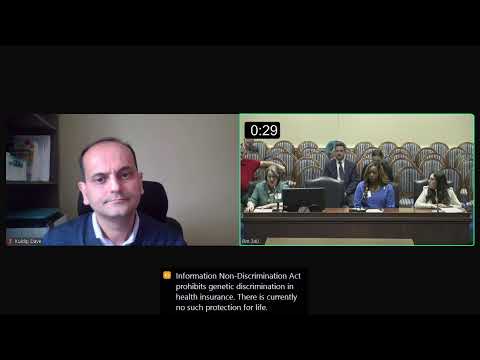
House Bill 1007 — Genetic testing protection act: Delegate Wells’s sponsor team presented a bill that would bar life, long‑term care and disability insurers from taking adverse action solely on the basis of clinical genetic test results. Supporters — who included ALS advocates, cancer patient groups, transplant and kidney advocates, genetic‑testing researchers and affected families — said fear of insurance discrimination deters people from getting clinically indicated tests and prevents access to targeted therapies and preventive care. Industry witnesses (life‑insurance trade groups and company medical directors) opposed the bill, arguing life insurance is a voluntary, long‑duration product whose pricing depends on full, accurate medical information at application; insurers warned that a broad ban could create anti‑selection and long‑term solvency risks. Several members asked for a focused workgroup to study Florida’s 2020 law (the transcript record shows Florida has enacted a related law) and to gather multi‑year claims and market data before advancing Maryland policy. The sponsor agreed to follow up; the committee did not vote at the hearing.
Committee direction and next steps: Committee members repeatedly urged sponsors and opponents to work bilaterally and in small drafting groups on technical fixes — for example, DBM and MSDE clarifications on HB 859, hospice scope language on HB 828, and MDH cost‑report mechanics on HB 933. Multiple items were described as “workable with amendments” and several agencies offered to staff or assist task forces or studies. No final votes were recorded on the bills during the hearing; sponsors and advocates asked the committee to hold the items for subcommittee once the technical language is ready.
Ending: The chair closed the hearing portion after the final panel, thanking advocates, agencies and committee staff and asking parties to coordinate amendments for subcommittee consideration.