Get Full Government Meeting Transcripts, Videos, & Alerts Forever!
Get email alerts on the Land Management Fencing topic
No spam. Unsubscribe anytime.
House passes state lands fencing bill after rejecting appropriation amendment and several notice provisions
Summary
The House approved Senate File 63, which creates a framework for cost-sharing on boundary fences adjacent to private landowners, after rejecting an amendment that would have appropriated $1 million to the Office of State Lands and Investments and turning down other proposed notice and cost-cap changes.
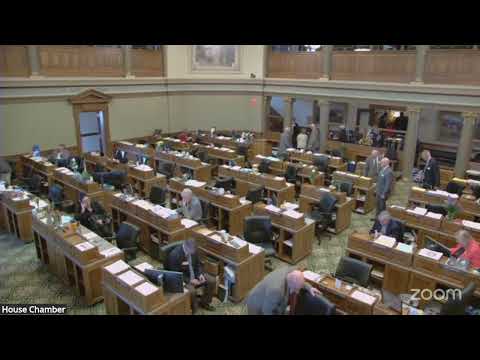
The Wyoming House on Feb. 20 passed Senate File 63, a bill addressing responsibility and cost-sharing for boundary fences on state lands, after extensive floor debate and five proposed amendments.
Representative Nicholas led the floor discussion and offered multiple amendments to narrow or clarify who may obtain state support for boundary fencing and under what conditions. The central policy question was whether the state should pay part of fences built by adjacent private landowners and, if so, how much and under what review and notice processes.
Nicholas described the state'''s situation: roughly 3,400,000 acres of leasable state ground, of which about 98% is leased for grazing, and some parcels lack existing fencing. He warned the existing bill language could saddle lessees with unanticipated costs and said the proposed measures would provide parameters and an initial appropriation to help address costs without unduly burdening leaseholders.
Members debated whether the Office of State Lands and Investments (OSLI) needed an appropriation to cover potential fence-cost obligations and whether private landowners could leverage state support to build new fences. Representative Banks said the office had not requested an appropriation in committee and urged defeating Nicholas'''s funding amendment, saying most affected lands already have fencing or are not subject to large new costs.
The House rejected third-reading amendment 1 (a general appropriation of $1 million to OSLI intended to seed a cost-sharing fund) in a roll-call vote that resulted in 8 ayes, 51 noes and 3 excused. The body then adopted amendment 2, which added the word "private" to clarify that cost-sharing applies when an adjacent private landowner constructs a partition fence. Amendment 3 was withdrawn by the sponsor. Amendment 4, which would have required notice and an estimate for fences costing more than $3 per foot, failed on voice vote. Amendment 5, a requirement that private landowners give notice of proposed fence construction to OSLI, likewise failed to be adopted.
On final passage, the House approved Senate File 63. The roll-call recorded 50 ayes, 8 noes and 4 excused, and the clerk announced that Senate File 63 has passed the House.
Floor debate focused on the potential fiscal exposure to the state and to lessees, the geographic and topographic variation in fence costs, and the need for clearer administrative rules. Representative Nicholas said the intent was to be a "good neighbor," while opponents urged caution and said the office could address many operational questions through its existing rulemaking authority.
The bill will proceed for further steps in the legislative process after House passage.