Get Full Government Meeting Transcripts, Videos, & Alerts Forever!
Get email alerts on the Taxation Personal Property topic
No spam. Unsubscribe anytime.
House adopts higher personal-property exemption for businesses after debate, ballot 56–4
Summary
After debate and three amendment attempts, the Wyoming House approved Senate File 48 to raise the state'''s personal-property exemption for businesses; an amendment to set the exemption at $75,000 prevailed after votes defeated smaller-scale and anti-abuse proposals.
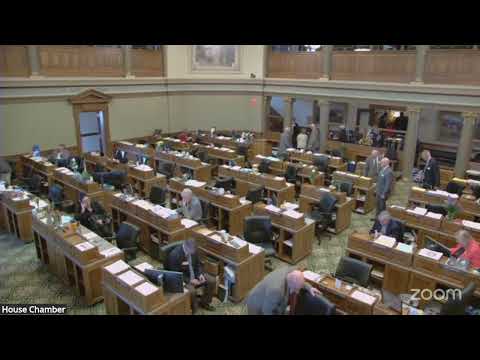
The Wyoming House of Representatives on Feb. 20 adopted Senate File 48, a tax measure that increases the de minimis personal-property exemption for businesses, after rejecting two amendments and approving a third that raised the exemption to $75,000.
The bill, which would raise the current $2,400 exemption, drew extended floor debate about whether the change would benefit small "mom-and-pop" businesses or give an undue windfall to larger firms and whether the text left a loophole permitting multiple claims. Representative Sherwood, who offered the first two amendments, said the first aimed to close a perceived loophole that would let one owner split property across entities to claim multiple exemptions: "A property owner shall only claim 1 exemption for all business property consolidated under an EIN or Social Security number," Sherwood said on the House floor.
Supporters of a larger increase argued the present exemption was out of date and that higher exemptions would help small businesses buy equipment without a significant new tax burden. Representative Feiler and others described modern equipment costs -- "a new skid today... anywhere from 90 to a hundred and 5,000 depending on your options" -- as justification for a larger exemption. Opponents warned that changes could shrink revenue for counties and school districts and urged a broader review of personal property taxation.
On the amendment votes, the House rejected Sherwood'''s amendment to limit claims by employer identification number or Social Security number (amendment 1). A subsequent Sherwood amendment to lower the proposed exemption to $25,000 (amendment 2) also failed. Representative Feiler'''s third amendment raising the exemption to $75,000 (amendment 3) was adopted.
After adoption of amendment 3, the House voted to pass Senate File 48 on third reading. The chief clerk called the roll for final passage; the clerk later announced the result as 56 ayes and 4 noes with the excused count reported in the roll call record. The bill was declared passed by the House.
The floor debate included repeated appeals to small-business economics and to county fiscal impacts. Representative Sherwood noted the bill'''s fiscal note estimating a multi-year impact: "for a 2 year period, it has a 8,200,000.0 impact to our schools and a $5,000,000 impact to local services." Other members urged interim study of the structure of the exemption and the audit/enforcement tools available to county assessors.
The House record shows the bill moved through committee and onto third reading with multiple contested amendments; the House passed the final, amended measure. The bill will proceed to the Senate for its action consistent with legislative procedures.
The debate and votes occurred during the House session Feb. 20; remarks on the floor were recorded in the official transcript.