Get Full Government Meeting Transcripts, Videos, & Alerts Forever!
Get email alerts on the Land Use Development topic
No spam. Unsubscribe anytime.
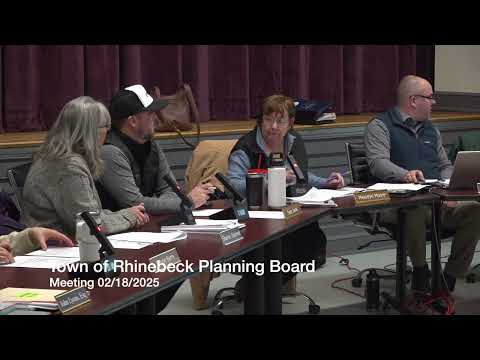
Rhinebeck planning board adopts SEQRA negative declaration for Rockledge condominium project
Summary
On Feb. 18, 2025, the Town of Rhinebeck Planning Board adopted a SEQRA negative declaration for the proposed Rockledge condominium project, concluding the Part 3 FEAF and clearing the way for subsequent subdivision, site plan and special-use reviews, subject to conditions and additional local approvals.
The Town of Rhinebeck Planning Board on Feb. 18 adopted a State Environmental Quality Review Act (SEQRA) negative declaration for the Rockledge condominium proposal, finding that the project, as conditioned, would not result in significant adverse environmental impacts.
The board adopted Part 3 of the Full Environmental Assessment Form (FEAF) and a determination of non‑significance after reviewing Part 1–3 of the FEAF, public comments and consultant analyses. The resolution authorizes Planning Board Chair Melanie Moore to sign FEAF Part 3 on the board’s behalf and directs planning consultant James Levy, AICP, to publish notice and the board clerk to distribute the FEAF and negative declaration to involved agencies including the Dutchess County Department of Planning and Development, the New York State Department of Environmental Conservation and the New York State Historic Preservation Office.
Why it matters: adopting a SEQRA negative declaration means the environmental review phase is complete; the project will next return to the Planning Board for local review of subdivision, site plan and special-use permit criteria and to the Zoning Board of Appeals for area-variance issues identified in the application. Public commenters and several board members emphasized that SEQRA is a statewide, one‑size‑fits‑all process and that local zoning and site criteria will remain central in later stages.
Applicant representative Sean Kemp thanked the board for the effort put into the FEAF, saying, "I'd like to thank the board for all the work that has done on this project." Planning staff and the board repeatedly noted that the SEQRA action does not relieve the applicant of local requirements and that further review of the subdivision, site plan and special-use criteria will follow.
Public commenters raised a range of local concerns during the hearing. Wayne Thompson questioned whether conditions for a special-use permit were met for undeveloped acreage and urged a closer review of density and justification for bonus units. Edna Washington, who identified herself as recused from board action, argued in favor of multifamily housing and said, "Multifamily housing is not alien to Rhinebeck," noting that multifamily units can conserve land compared with scattered single‑family development. Other neighbors raised visual‑impact and infrastructure questions, including the siting of a wastewater treatment outfall and potential groundwater/well‑water issues.
Board members and staff reiterated procedural next steps: with the FEAF Part 3 and negative declaration adopted, the board will consider subdivision, site plan and special‑use permit applications on their local merits; separate reviews by the Zoning Board of Appeals will proceed where area variances are required. One board member, Edna Washington, had earlier declared a recusal and did not participate in the board’s final action to adopt the negative declaration.
The resolution and FEAF Part 3 were incorporated into the meeting record; the board instructed staff to circulate the final documents to involved and interested agencies and to post the determination as required by SEQRA.