Get Full Government Meeting Transcripts, Videos, & Alerts Forever!
Get email alerts on the Local Government Finance topic
No spam. Unsubscribe anytime.
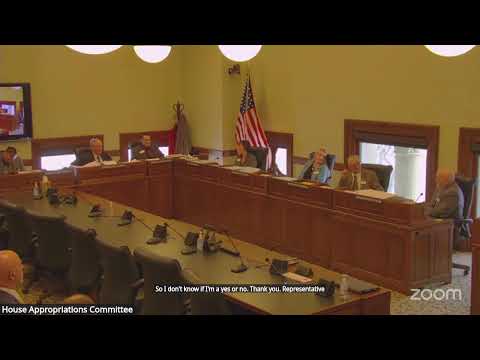
House Appropriations committee backs bill allowing local governments to invest in equities
Summary
The Wyoming House Appropriations Committee voted to advance Senate File 145, which would allow local governments to invest certain public reserves in equities under conditions set by the State Loan and Investment Board. Supporters said the change would help counties and cities hedge revenue volatility; some lawmakers urged limits and oversight.
The Wyoming House Approations Committee voted to advance Senate File 145 on a 7-0 roll call Thursday, adopting an amendment that changes an advisory committee requirement from "may" to "shall" and sending the bill to the floor with amendments.
Proponents told the committee the measure would let counties, cities and certain local districts invest some reserve funds in equities under parameters set by the State Loan and Investment Board (SLIB) and managed by professionals. "The governor does support the ability of local governments to invest in equities," Betsy Anderson, deputy chief of staff and general counsel for Governor Gordon, told the committee, adding that SLIB already sets conditions for state funds and uses an investment consultant.
Supporters said local governments need tools to protect reserves from inflation and to smooth volatile revenues tied to mineral production. "We think that this is a great way for us to utilize revenues that we may be in possession of currently," Converse County Commissioner Robert Short said, describing how mineral producers' prepayments created long-term obligations the county treats like a 13-year revenue stream. Campbell County Commissioner Jim Ford said local governments face sharp year‑to‑year swings in assessed valuation tied to minerals and need options to "attenuate that volatility" so services and employees remain stable.
Why it matters: The bill would change what local governments are allowed to do with some reserve funds, potentially affecting how counties and municipalities manage capital projects, maintenance and tax-rate decisions. Supporters argued investments administered with safeguards and professional advisers could grow corpus used for future infrastructure costs, lowering pressure on current taxpayers. Opponents on the committee voiced caution about removing taxpayer control or enabling excessive accumulation without clear limits.
Key details and discussion points - Current legal safeguards: Testimony cited existing state statute language requiring every political subdivision to have "on file a statement of investment policy" and to "exercise the judgment and care of prudent investors"; panelists read those provisions while urging clear local policies and fiduciary requirements. Jeremiah Grama, speaking for the Wyoming County Commissioners Association, emphasized statutory safeguards and annual audits. "Every political subdivision shall have on file a statement of investment policy," he said while walking committee members through statutory provisions. - SLIB and rulemaking: Witnesses, including Anderson for the governor's office, recommended that SLIB and the state's chief investment staff set parameters and sideboards that local governments then refine. Ms. Anderson said the SLIB uses a long‑time investment consultant "who has consulted for the state's treasurer's office … for over 25 years." - Local practices and oversight: Cities and counties described investment-advisory committees and professional portfolio managers already in use. A City of Casper representative (Ms. Johnson) said Casper's committee is a policy group that does not select specific investments; a professional portfolio manager handles selections under city policy constraints. - Uses of invested funds: Commissioners and the mayor said such returns could be used to smooth budget volatility, pay for capital projects (roads, water, landfill, senior facilities) and reduce pressure on future mill levies. Jim Ford noted multiple reserve accounts and relationships with private advisers and the treasurer's office; Ford said his county uses a mix of advisers (naming PFM and another firm) and has 11 separate reserve accounts. - Concerns and limits: Several lawmakers asked how much invested revenue would be "enough" and whether rising reserves should translate into mill-levy reductions. Panelists avoided a single statewide percentage but suggested aspirational targets (one commissioner mentioned 30–40% as a personal view). Committee members signaled they expect monitoring, sideboards and local accountability so investments do not insulate governments from voter oversight.
Votes at a glance - Amendment (Representative Pendergraft): change language from "may" to "shall" for forming investment advisory committees — adopted by voice vote. - Committee final action: Senate File 145—do pass with amendments. Roll call: Aleman Aye; Angelos Aye; Perrielson Aye; Pendergraft Aye; Sherwood Aye; Smith Aye; Chair Bair Aye. Outcome: passed by committee, advanced to the House floor.
Numbers and examples cited in testimony - Natrona County sale: testimony referenced a roughly $100,000,000 gain from a hospital sale that county officials said they want to invest rather than spend immediately. - Reserve accounts and projects: Campbell County described 11 reserve accounts and multi-year projects such as paving 23 miles of road over four years. - Revenue volatility: Commissioners said assessed valuations in mineral-producing counties can swing 20–35% year to year. - Mill levies: Testimony noted 21 of 23 counties assess the full 12 mills; Campbell County assesses just under 11 mills and Teton County about 6.879 mills. - Local results: The City of Cheyenne reported moving funds between state investment pools yielded $670,000 more in one year on projects where that additional return helped cover cost increases.
Discussion vs. decision - Discussion: Committee heard extensive policy discussion about appropriate sideboards, fiduciary duties, how local advisory committees should function, and whether investment returns should trigger mill-levy reductions. - Direction: The committee adopted an amendment requiring investment advisory committees (changed "may" to "shall") and instructed staff to "work the bill" for floor consideration. - Formal action: Committee voted 7-0 to advance Senate File 145 with amendments.
Ending note: Committee members who supported the bill emphasized it should come with rigorous oversight and local refinement; several said they view it as a tool to help local governments prepare for high‑cost capital needs and to protect reserves from erosion by inflation rather than as a way to expand government spending.