Get Full Government Meeting Transcripts, Videos, & Alerts Forever!
Get email alerts on the Education Budget topic
No spam. Unsubscribe anytime.
Board hears debate over restoring summer programs vs. expanding virtual high school in FY26 budget
Summary
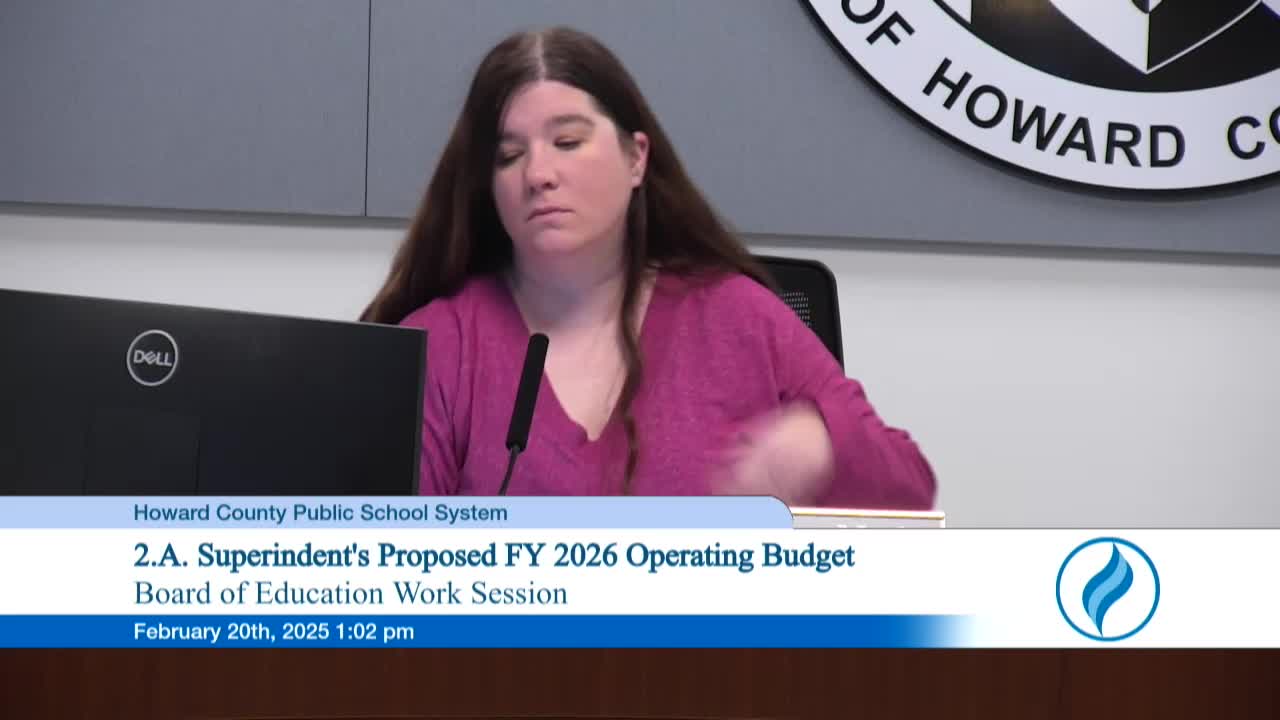
The Howard County Board of Education on Feb. 20 considered competing priorities in the superintendent’s proposed FY26 operating budget for the Equity and Innovation division, including a $3.7 million restoration for summer academic programming and a possible expansion of the district’s virtual high school that staff estimate would cost about $1.1 million to scale to ninth through 12th grades.
The Howard County Board of Education on Feb. 20 considered competing priorities in the superintendent’s proposed FY26 operating budget for the Equity and Innovation division, including a $3.7 million restoration for summer academic programming and a possible expansion of the district’s virtual high school that staff estimate would cost about $1.1 million to scale to ninth through 12th grades.
Caroline Walker, Chief Equity and Innovation Officer for Howard County Public Schools, told the board the division’s FY26 request includes restorations of programs reduced in prior years and shifts to account for a new division structure. “The funding requests in this year's budget around equity and innovation are either restorations to prior programs…or things that are transitioning from grants,” Walker said. She identified the academic intervention program and summer programming among the largest restorations, and listed virtual high school programming, transportation for after-school programs, and expanded professional learning as unfunded priorities.
Board members asked how staff decided to prioritize the summer restorations over expansion of the virtual high school. Board member Miss Watts asked, “I'm curious why the push to restore things, as opposed to expand the virtual high school option…?” Walker said the district has repeatedly placed the virtual program on and off in prior years, and she voiced concern about funding longevity: “I do have concerns about the longevity of funding for the virtual program…we have tried to put it in place in a number of different ways in the district, and it has consistently not been funded.”
Budget staff and Walker told the board that it would cost roughly $1,100,000 to scale a virtual high school to grades 9–12 for next year. Walker said the administration will provide a prior memo with detailed scale-up costs and per-pupil estimates. She estimated a potential enrollment of about 200 students if the program were consistently available and said that revenue and enrollment assumptions affect short-term return-on-investment calculations.
Walker said the $3.7 million labeled a “restoration” largely reflects programs that were historically funded in the operating budget but were cut or temporarily paid from ESSER grant funds during recent budget cycles. “The academic intervention program…was paid for in ESSER funds,” Walker said, adding that the intervention has been in the district “at least 20 years” and that cutting it would reduce services now in place.
Board members pressed for more detail on particular line items. Walker said Mesa, the district’s extracurricular enrichment program, has historically been funded by a mix of operating funds, small grants and donations; she told the board donations for Mesa total “less than $30,000.” Walker said increases in workshop wages for some summer and evening programs account for a requested $84,000 increase in that budget area. She noted that the negotiated workshop wage for teachers is about $46.01 per hour this year (base plus COLA) and that different workshop rates apply for different duties.
Members also asked about transportation lines for summer and post-secondary access. Walker said some transportation costs were charged to ESSER funds in prior years, so the operating budget lines show low or no expenditures even though the services were provided. She said ordinary student transportation remains managed by the Transportation Office; the budget includes some transfers to reflect that management change.
On staffing and roles, Walker said the division’s restoration requests include facilitator and technical-assistant positions tied to running summer programs and after-school work. She characterized MESA primarily as an extracurricular program that historically has sat in multiple divisions because of its academic- enrichment and partnership connections.
The board approved the meeting agenda at the start of the session; a motion to approve carried 7–0.
Why it matters: The board’s choices between restoring long-standing in-person summer and intervention programs versus investing in a sustained virtual high school will shape which options are reliably available to families next year. Several board members asked for cost-per-pupil detail and multiyear projections to judge sustainability before committing recurring operating dollars.
What’s next: Walker said staff will resend a memo with detailed cost estimates for scaling the virtual program and follow up with per-pupil estimates and proposed options for reallocating the summer restoration if the board prefers other priorities.