Get Full Government Meeting Transcripts, Videos, & Alerts Forever!
Get email alerts on the Rent Stabilization topic
No spam. Unsubscribe anytime.
PHED Committee holds bill to widen rent stabilization to all age‑restricted senior rentals
Summary
The Planning, Housing and Economic Development (PHED) Committee heard Council Bill 6‑2025, which would apply rent stabilization to all age‑restricted senior rental units, but voted to hold the bill while staff and committee members seek more data on how many units would be affected and an appropriate cutoff date for exemptions.
The Planning, Housing and Economic Development Committee of the Prince George's County Council on Feb. 20 heard testimony on Council Bill (CB) 6‑2025, which would extend rent stabilization protections to all age‑restricted senior rental units. After legal and fiscal briefings and public testimony, the committee approved a motion to hold the bill pending additional information.
The committee heard from Office of Law counsel that the bill was “in proper legislative form” and identified no legal impediment. Committee staff noted the county executive’s letter in the meeting packet appeared to refer to a different senior policy (a senior tax credit), creating uncertainty about the executive’s current position on CB 6‑2025.
Committee members pressed for data on how many age‑restricted units the bill would affect. The department that compiles building-unit counts had not responded to staff inquiries by the hearing, so the committee could not quantify the impacted housing stock. Committee vice chair Harrison said, “I think it’s really important to know how many units we have that will be impacted by these provisions.”
Hugo Cantu, testifying for the Apartments and Office Building Association, urged an unfavorable report. “We are urging an unfavorable report on the bill,” Cantu said, arguing the measure could disincentivize future age‑restricted development and make financing low‑income housing tax credit deals harder.
Councilmember Riata, a cosponsor who spoke in support of the bill, said she introduced the change after seniors living in post‑2000 age‑restricted buildings told her they were not covered by the earlier version of the policy. “I was surprised when I started getting calls from seniors who were living in age‑restricted buildings built in, I don’t know, 2015. They were not being helped by it, and it was not my intention in the original bill,” Riata said. She asked the committee to identify a date cutoff that would protect existing residents without discouraging future development.
Staff who prepared the fiscal and policy note warned of mixed indirect impacts: the analysis said the bill could reduce displacement among seniors but also could reduce the incentive to build age‑restricted housing after the effective date, potentially lowering future property tax revenue. Staff noted they had reached out to the Department of Permitting, Inspections and Enforcement (DPIE) for counts of units but had not received a response.
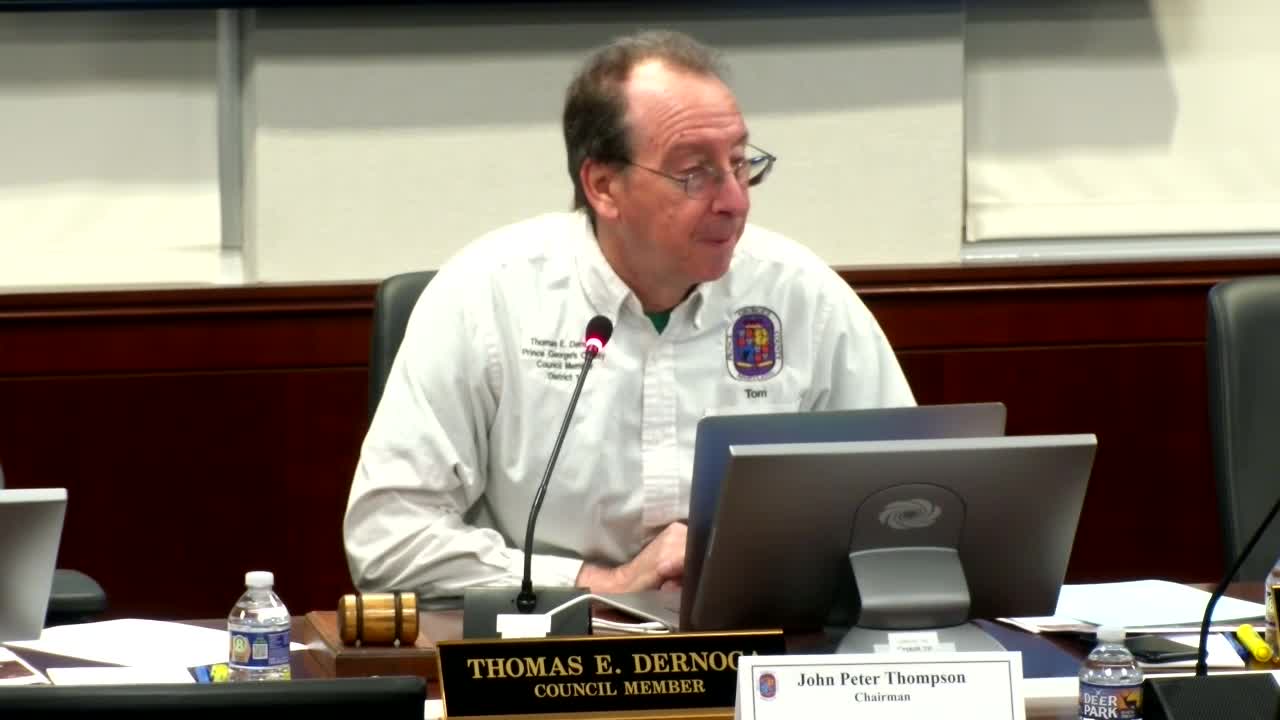
After discussion, the committee approved a motion to hold CB 6‑2025 for roughly two weeks to allow staff to gather the requested information, including the number of affected units and options for an effective cutoff date. The clerk called the roll and the hold passed 3‑0 (Chair Tom Dernoga: aye; Councilmember Harrison: aye; Vice chair Ivy: aye).
The committee did not set a final date for resuming the bill hearing; members said they expect to reconvene once staff has provided the requested unit counts and additional fiscal detail.